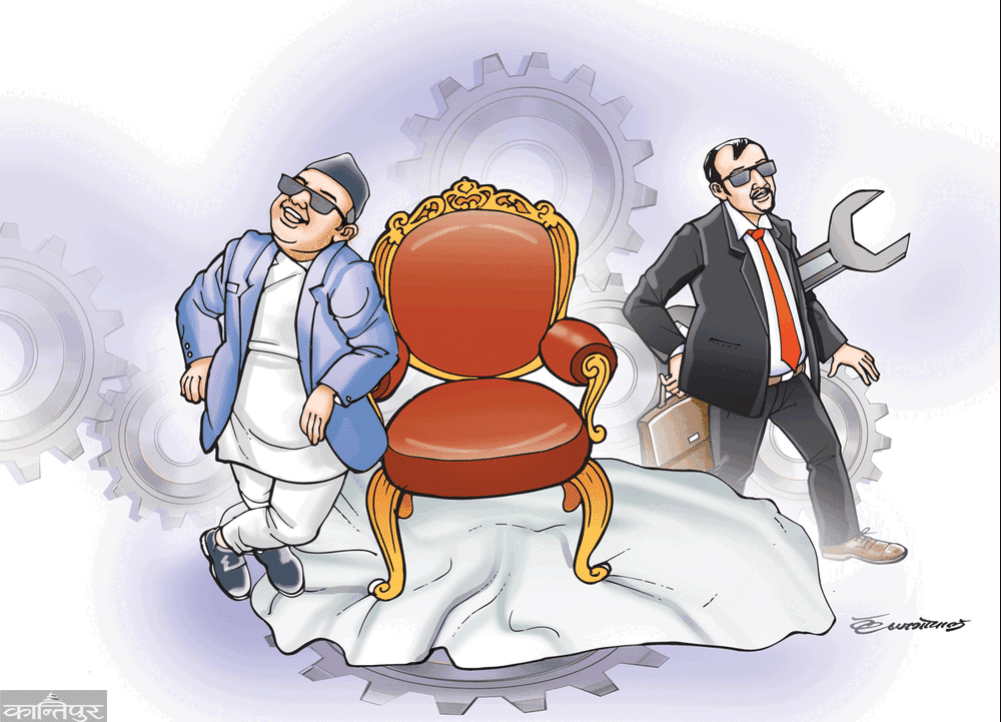
Nine years after the promulgation of the Constitution of Nepal, the standard of living of Nepalis does not seem to have improved significantly. What is the meaning of the cold letters of the constitution when the people do not get the benefits of political change? Now the politics of Nepal is falling under the control of businessmen and middlemen.
We use Google Cloud Translation Services. Google requires we provide the following disclaimer relating to use of this service:
This service may contain translations powered by Google. Google disclaims all warranties related to the translations, expressed or implied, including any warranties of accuracy, reliability, and any implied warranties of merchantability, fitness for a particular purpose, and noninfringement.
Nowadays, 'good governance' has become a lollipop that suits everyone's opinion. Why is this happening, if the governance is not justified, neither the justification of the state nor the legitimacy of the government is proven. That's why many forms of dictators also spread the illusion that they have given Ram Rajya.
Now the slogan of good governance is given more by those who have only given 'misgovernance'. If there is 'good governance', there is no need to worry about it day by day. The Chinese philosopher Lao Tzu said - "A swan does not need to bathe daily to be white, and a crow is black even if it is not painted black." North Korea, which has a dictatorial regime, writes the name of its country as 'Democratic People's Republic of Korea' and South Korea says 'Republic of Korea'.
Good governance should be evaluated on people's perception rather than facts. Therefore, it is practical to explain it in terms of its basic foundations, dimensions and the various elements it covers. Its four pillars are transparency and accountability, people's ownership, equity and predictability. Further it can be understood simply in three main aspects.
First the adopted process (process) is not transparent, second the content of the service provided guarantees justice and equality or not, third the delivered service (deliverable) helps to make the life of the poor and backward dignified or not. If these three aspects are positive, it can be said that there is good governance.
The World Bank has developed six indicators to assess the governance of any country – people's voice and accountability, political stability, government effectiveness, regulatory quality, rule of law and corruption control. Every year the governance status of different countries is shown based on these indicators. Apart from this, Transparency International's corruption status, World Justice Project's rule of law status, Public Integrity Organization's transparency and accountability status, and World Bank's 'World Happiness Index' measure happiness.
Recent reports have shown that the state of governance in Nepal is disappointing. In the 2025 report of Transparency International, Nepal is ranked 107th among corrupt countries. Similarly, in the year 2024, it has been shown that it ranks 68th in hunger, 69th in rule of law, 93rd in happiness, 146th in HDI, 110th in prosperity and 92nd in overall governance. The score on the corruption-related CPI of Transparency has also decreased by one point compared to last year, raising concerns.
Nepal is seen as more corrupt than India, Bhutan, Sri Lanka and Maldives in SAARC. Nepal's score was 35 last year and 34 this year. Unless you score more than 50 points, you will be included in the list of corrupt countries. In the 'World Happiness Index' related to the rule of law and happiness, Nepal looks good among the SAARC countries. In the World Bank's 'World Governance Index', Nepal is ranked 78th in the 'Governance Efficiency Ranking'. Although Nepal is ahead of India, Pakistan, Bangladesh, and Sri Lanka in SAARC, it is behind Bhutan and Maldives.
It is a matter of concern that Nepal's score is negative in all the indices of the 'World Governance Indicator' of the Bank's report. Overall, the situation of good governance in Nepal is critical. Which is a serious issue for Nepali people. Even in practice, various surveys have shown anomalies such as bribery for normal government work, service delivery being fair, and people suffering due to slowness and rude behavior.
Medicines that are supposed to be distributed free of charge are not being received in hospitals in the valley, health institutions in rural areas are running on office assistants, Citamol is not even available in those institutions, textbooks are not available until the time of exams, there are no students in some schools and some farms are being run by teachers, on the one hand, farmers do not get fertilizer and on the other hand, they have to throw their produce on the streets because they do not get a fair price. Big corruption scandals are becoming public. From this, it appears that the government and the entire public sector have failed to provide good governance in Nepal.
The state of good governance is what the conscious and semi-conscious mind of the people creates a picture of 'governance'. If the people start to feel bad governance, the legitimacy of the actors including the government will start to be questioned. The main actors of good governance are the state components, political parties, private sector and civil society. Moreover, kitchen cabinets, consultants, organized crime groups, even big business houses can have positive or negative effects on governance.
The most responsible for this is the political party and the government. Political parties organize themselves for the welfare of the society as a whole by implementing certain principles and policies. It is the government that prepares the playing field for other actors by producing policies and operates its mechanisms to maintain order in the society through strict or soft regulation.
Therefore, in the role of the main character, the main accountability for governance lies with the government. Unfortunately for Nepal, the political sector is falling into the quagmire of corruption and irregularities. What can be expected from other characters if the source of good governance is dirty? The Chinese philosopher Confucius named this condition as 'Sickness'. He said that in such a state, there will be a threat to the sovereignty, there will be a decline in morals in the society and people will not be loyal to the government.
leadership works wonders. That is why Gandhi, Mandela, Kennedy, Lincoln are still remembered because of their different abilities. Machiavelli wrote in his book 'The Prince' - 'Ability without an opportunity is wasted, an opportunity without an opportunity is wasted.' For this they prefer to work differently and original from others. Abraham Lincoln said in a speech - "Great leaders do not walk the path others have trodden." Lee Kuan Yew of Singapore is another successful leader who in two decades managed to raise Singapore from a landlocked underdeveloped island to a modern and developed country. What is even more surprising is that the per capita income of Singapore born in 1965 was higher than that of the UK in 1995.
Such a miracle was made possible by the long-term thinking of Lee Kuan Yew, who is considered a 'liberal dictator'. Singapore ranked first in the Government Effectiveness of Governance Index from 1996 to 2016 with a score of 100. In Transparency International's 2024 report, Singapore was ranked as the third least corrupt country in the world and first in Asia. This is a good example of the miracle of politicians.
The ruler of Dubai, Sheikh Mohammed bin Rashid Al Mokhtam, is another leader who has worked wonders in governance. He has succeeded in making government services effective by using innovative measures like 'Happiness Meter', 'Happy School', 'Service Factory Initiative', and 'Customer Journey Mapping' to measure people's satisfaction. Considering that all classes of people are not given the same services, they have distributed different packages of services to those who have more children (Full Nestor) and those who do not have children (Imty Nestor) in Dubai.
MacLehose, the then governor of Hong Kong, achieved great success in making Hong Kong free of corruption. Skilled leaders like Malaysia's Mahathir Mohamad, Botswana's Seretse Khama, Serbia's Anna Barnabic have contributed greatly to good governance and development in the country. Although there was no political freedom in China, Deng Xiaopeng was able to make significant progress in the economic field.
India's Manmohan Singh is also credited with improving the economy. Therefore, if the leaders are good, they can gain public trust by giving good governance to the country, but if the leaders are corrupt and inefficient, they will lead the country to the blight of 'misgovernance'. Robert Mugawe of Zimbabwe, Marcos of the Philippines, General Suharto of Indonesia, Franco of Spain, Pinochet of Chile, Ceausescu of Romania etc. are some of the rulers in the list of such corrupt people.
In the history of Nepal, there have been many 'critical junctures', when radical changes were possible. The year 2007, 2017, 2047 and 2063 were critical times created by the history of Nepal. If there were leaders with thinking and courage at that time, they could have made a turbulent change that would change the face of Nepal. But unfortunately due to political instability, politics of jealousy between parties, ambition of kings etc., this opportunity was wasted.
In the general election that was held eight years after the 2007 change, the winning government with a majority of two-thirds tried to lay the foundation for some seemingly progressive works. People were allowed to enter the Singha Darbar after 3.30 pm, the admission of Dalits in all schools was exempted and free lunch was provided to them, and the abolition of state rajuta was seen as a radical change in the society. But after this government was also criticized for being arbitrary in the administrative reorganization, an agreement was reached between the Prime Minister and the Chairman of the Public Service Commission, and the Public Service Commission was sent for the competency test.
2017 The change after the political 'ku' was another 'critical juncture'. Mahendra had an open field to implement his policies in a non-party autocratic system where the parties themselves were active because of the corruption. However, Mahendra's reign came to an end when he used all his energy to preserve the system, "infiltrate" his people in the administration in the name of political appointment, and suppressed the opponents of the system. He did some progressive work like civil law, land reform.
Although he was accused of the secret pact of 1965, if we let it go, some significant nationalist work was done at that time. In the subsequent Panchayat period, although there were some good works like the concept of development sector, establishment of service centers, public dissatisfaction increased due to highly directed politics and the student movement of 2036 took place. And King Birendra was forced to announce a plebiscite. During the reign of Birendra, the palace became powerful and the Singha palace became weak.
The Jan Andolan of 2046 ended the autocratic Panchayat system and with the establishment of a multi-party system, the Raja was limited to a constitutional role. Even though it was an autocracy, the working environment was comfortable in the period after 2017. However, it seems that both the kings failed to raise the standard of living of the people by giving good governance even under their direct rule.
After 2046, the subsequent governments could not fulfill the hopes and dreams of the Nepali people who were involved in the people's movement. Corruption is rampant, dictatorship of parties is increasing, the influence of middlemen and businessmen is increasing (plutocracy) in the government, and politics is being run not by ideals but by selfishness, so the silent revolution of frustration among the people was burning like a fire. Moreover, after the destruction of King Virendra's dynasty, Gyanendra, who became the king, became king due to the ambitions and autocratic actions of the public, and the storm of the second mass movement took an explosive form and ended the monarchy forever.
The second mass movement was for New Nepal. A Nepal where there is social justice, inclusive democracy, diversity as the basis of unity, and a prosperous society based on equality. The Constitution of Nepal has indeed given the foundations of an ideal system that includes these features. Benjamin Franklin, one of the makers of the American Constitution, said - 'The American Constitution does not guarantee happiness, it only seeks it, you must be able to catch it yourself.' Nine years after the promulgation of the Constitution of Nepal, the standard of living of Nepalis does not seem to have improved significantly. What is the meaning of the cold letters of the constitution when the people do not get the benefits of political change? Now the politics of Nepal is falling under the control of businessmen and middlemen. Corruption is happening openly. It seems that the constitutional organs and bodies formed to check and balance the government are becoming ineffective due to open politicization. Bureaucracy is losing public trust due to open politicization.
If the people don't get the comforts and they get extremely disappointed, they can throw not only the government but also the political system. Education is taken from world history. The reign of terror of the Jacobin leaders after the French Revolution eventually led to their assassination one by one. Change in African countries Nigeria, Sudan in the eighties
was reversed. It has been resended to growing people in countries like Spain, Portugal, Argugra, Argucle, Brazul, Peru, Turkey. In large abandoned leaders for the change, the power of people's movement was given radical change. After the change, a bold leaders could not have the courage to protest in the way to the government. Now the iron is found. The history 'de narrator' is wasted.
a few years ago, a high-official official was brought into a dispute when he said, "There is no rule of Nepal. In fact, it is not necessary to 'rule the government' capacity (governorline) '. As not implemented implemented, the government's order is not the case with its mechanizes international. The lack of political centers in the Darls Rubertlo and James Rubertson, the lack of political centers, including Afghanistan, Haitan and Nepal, has not been implemented without implementation of law and order. That's what it takes to look at the situation of Nepal.
Good Government Act, 2064 and the provisions of the Right of Information Act, 2064 Act, 2064 provisions can be promoted to promote goodness. Ironically, the public hearing, mobile hearing of Good governance Act, seems to have stop proving in all the conference, such as guisuous, so now. The
political leadership will strictly apply constitution and the concept of open government, and to strengthen internal and external institutions to ensure public accounts and its internal institutions. Having good governance can be established in 'Hello Government Enforce Center' to learn from 'Global Platform' and reluctance. If the country does not enforce it and learn from others, it is certain that it is certain. Small country in
Eastern Europe has performed miracles in the 'Digitivity'. There are 95 percent public service be given by online. Beds can be taken by learning from such practices and fall into good governance. The political leadership should be committed to this. If this happens, the employment and other characters will be mobilized automatically.
political leadership is the sponsor of the change and the employees are the agent of change (CHENGE CHANGES). It does not take time to kill all the good governments from sponsor. If that does not, the people's movement can take the form of growing revolution of the people's movement.