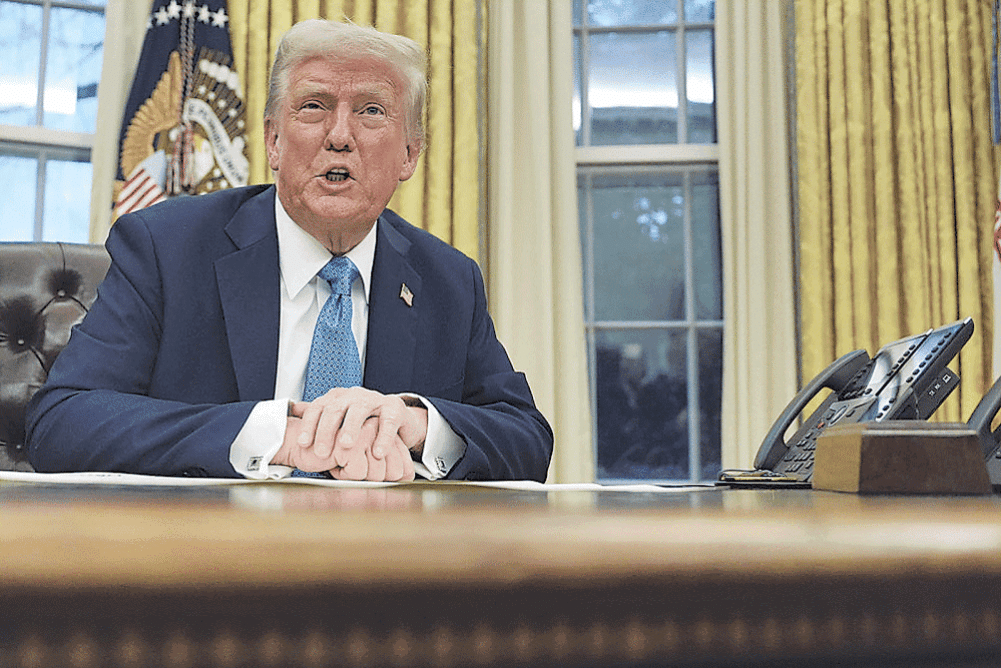
Trump himself has opened the door to a multipolar world, now America's role in world politics will shrink further and because of Trump, the single superpower nation is officially dying.
We use Google Cloud Translation Services. Google requires we provide the following disclaimer relating to use of this service:
This service may contain translations powered by Google. Google disclaims all warranties related to the translations, expressed or implied, including any warranties of accuracy, reliability, and any implied warranties of merchantability, fitness for a particular purpose, and noninfringement.
A powerful diplomatic wave has been created worldwide after the high-profile and tense meeting between US President Donald Trump and Ukrainian President Volodymyr Zelensky at the White House. With the swearing in of Trump's second term, the unexpected change in the US foreign policy has shown a premonition that geopolitical relations and strategic balance will be disturbed.
The conflicting policies and undiplomatic expressions that Trump has announced so far are likely to lead to a new geopolitical and strategic polarization. A diplomatic war of words has started between Europe and America after Trump followed a pro-Russian policy without even informing the permanent strategic partners after the Second World War, such as Britain, Europe, Japan, and Australia. This policy of Trump has created a serious crisis for Ukraine and a geopolitical and strategic disaster for Europe.
America's democratic and diplomatic credibility is falling due to the closeness and possible cooperation between the US and Russia, which led the two poles during the Cold War. The western media has concluded that America itself will pay the price for such short-sighted, contradictory and inconsistent policy of Trump. Joseph S. Ney,
Political scientists such as Darren Acemoglu, Danny Rodrik, expressing the opinion that the existing liberal democratic world system is on the verge of collapse due to Trump, have predicted that a new world order system will develop. It is seen that Nepal will also have a multi-faceted impact due to the changed geopolitical scenario and the new policies adopted by the powerful nations. Whether the government of Nepal and the policy makers, especially the Ministry of Foreign Affairs, Defense and Home Affairs, have studied and analyzed this? If not, it needs to be done immediately.
Trump's 'Coercive Diplomacy'
In the 20th century, which is considered the American century, after the Second World War, the US has been adopting a liberal internationalist (liberal internationalism) foreign policy. Freedom, democracy, rule of law, human rights, liberalism, open economy, trade and transportation are considered its basic principles. After 1990, the US has prioritized "soft power" (soft power) and "smart power" (intelligent power) over "hard power" (military power) to achieve its goals.
Due to the anti-communist and pro-democracy policies of America and Europe, the collapse of the Berlin Wall led to the unification of East and West Germany and democracy was established in a unified Germany. In 1991, not only did the Soviet Union disintegrate and the Communist regime fell, democracy was also established in Russia. Presidents like John F. Kennedy, Ronald Reagan, Jimmy Carter, Bill Clinton, Barack Obama have left their original legacy in foreign policy. With the exception of
, the US has been warning against communists, dictators and totalitarianism, guarding freedom and democracy, and partnering in economic development. The military alliance established against the former Soviet Union has been playing a leading role in the North Atlantic Treaty Organization (NATO) and the alliance of democratic and advanced countries including Europe, Australia, Japan, and Canada. Therefore, America's international image is positive.
But Trump has no commitment to America's legacy and fundamental principles. For Trump, policies, principles, values, and beliefs are secondary. Trump seems to want to adopt 'coercive diplomacy' based on hard power. For billionaire businessman Trump, strategic, economic, trade and transit relations seem to be a major priority.
It seems that he has given special priority to 'transactional diplomacy' i.e. economic transactions and profit-loss. Unsolicited diplomatic pressure for a mineral deal with Ukraine is a dirty version of the same transactional diplomacy. "America's enemies and friends are not permanent, only national interests are permanent," now Trump has reconfirmed the much-discussed doctrine of former US Secretary of State and geopolitical affairs scholar Henry Kissinger, who won the Nobel Prize. What could be a greater misfortune for freedom, democracy and the rule of law?
Trump has already decided to withdraw from the Paris Climate Agreement and the World Health Organization and close the International Development Agency (USAID). Project 2025, a well-known Republican think-tank Heritage Foundation, has suggested withdrawing from the World Bank and the IMF in the roadmap prepared for Trump.
If Trump follows through on that suggestion, it will create an imaginary crisis in the world economy, which will cost the US itself dearly. British Prime Minister Keir Starmer has also announced a cut in foreign aid and an increase in the defense budget. Probably, now the European countries including Germany, France will also follow the footsteps of Britain. In such a scenario, now foreign aid and subsidies will be significantly reduced and it will have a direct impact on Nepal. Therefore, it is necessary for Nepal to formulate policies and plans without delay to develop a self-sufficient economy by mobilizing national resources and capital.
The emergence of a new geopolitical landscape
With the dissolution of the Soviet Union, a unipolar world system developed, while America was established as a superpower. But with the beginning of the 21st century, the unipolar world system was weakening and the multipolar system was gradually developing.
With Trump entering the White House for a second term, a dramatically new geopolitical landscape appears to be emerging. A new diplomatic dispute and geopolitical tension has been created between the US and Europe after the US-led alliance of western democracies became unnaturally and unexpectedly close to Russia, the former enemy.
Analyzing that Trump's policy of getting closer to Russia by ignoring Ukraine and America's prior commitment has caused a serious geopolitical shock to Europe, an unprecedented unity has been seen between European countries. Therefore, less than 48 hours after the failure of the Trump-Zelensky talks, the emergency meeting of the European Union held in London has announced military assistance, expressing unwavering commitment to the sovereignty and geographical integrity of Ukraine.
Contrary to America's expectations, NATO Secretary General Mark Rutte also participated in the meeting and gave a meaningful diplomatic message to America. Perhaps Trump did not expect strong diplomatic resistance from the UK, EU and NATO secretaries. For the first time since the Second World War, this level of diplomatic accusations and counter-accusations and geopolitical competition has been seen between America and Europe.
In the United Nations resolution on the Russia-Ukraine war, America and Russia are on one side and Europe on the other, while India and China are neutral. Because of Trump, the geopolitical and diplomatic influence of China, India, South Africa, Japan, Australia, Brazil and other emerging powers is now seen to expand further.
It seems that Russia, which was disintegrated because of America, is now moving towards the direction of becoming a player in world politics by regaining power under the guise of America. In fact, Trump himself has opened the door to a multipolar world. Now America's role in world politics will shrink further and because of Trump, the single superpower nation is officially dying.
In the 1970s, the 'Madman Theory' was popular. Richard Nixon was president. American diplomats pursued a strategy of achieving favorable results by portraying Nixon as a 'madman' with foreigners. Such a madman theory was used by US diplomats that 'Nixon may even use nuclear weapons' to end the counter-productive and humiliating Vietnam War from 1955 to 1975, especially for the US. Is this Trump's policy or strategy? It will become clear in the near future. If it is a policy, it is sure to be suicidal for America itself.
The cursed fate of Nepal and Ukraine
Ukraine, which is considered to be very important from a strategic point of view for Russia and Europe, has been experiencing the cursed fate of independence and subjugation many times during the period of history due to the geopolitical interests of the powers. In 1991, Ukraine gained independence from the shackles of the Soviet Empire. But in 2014, less than 24 years after independence, Ukraine's next tragic chapter began when the Crimean peninsula was declared rejoined by Russia in a highly controversial referendum. Since the new countries established after the dissolution of the Soviet Union are strategically important, the US and Europe have been giving high priority to expanding their influence.
The West, which dominates the Mediterranean through NATO member Turkey, is as bright as the sun with NATO's expansion as a strategic priority for a stronger military presence in the Black Sea, another strategically important region. Estonia, Latvia and Lithuania became members of the European Union and NATO in 2004, among the new countries formed from the former Soviet Union.
Ukraine applied for NATO in 2008, but so far it has been undecided. While Belarus, Armenia, Kazakhstan, Kyrgyzstan have Russian-backed governments, other countries' governments are considered Western-backed. The geopolitical rivalry between the West and Russia in Ukraine was there yesterday, it is there today and it will continue tomorrow. Therefore, for a long time now, Ukraine has become the battlefield of "proxy war" between Russia and the West.
Ukraine and Nepal are not geographically close. Although diplomatic relations were established in 1993, they are limited in formality. But the geopolitical and strategic environment of Nepal and Ukraine is similar. Geographically, Nepal is a relatively small and underdeveloped country located between India and China, which are big and emerging powers. Like Ukraine, it is a geopolitically and strategically sensitive country.
Nepal, which is going through a cycle of political instability even after a decade-long armed war, a decade-long transition period and the constitution, has deep geopolitical and strategic interests of the powerful nations like Ukraine. But from the point of view of geography, every country is equal from the point of view of sovereignty, whether it is big or small. It is called the 'Principle of Sovereign Equality', which is an integral part of the United Nations Charter.
Although there has been strong global condemnation of the military offensive by war-mongering Russia, the role of neighboring China and India seems ironic. Perhaps because of the Tibet and Sikkim affair, China has given meaningful tacit support to Russia's aggressive and expansionist moves, while India has done nothing but issue diplomatically equivocal statements for formality. Such mysterious and silent trend of neighboring India and China has become a matter of serious concern for landlocked Nepal.
Powers decide policies and strategies towards any country according to their interests. If war serves their interests, they fight. If they benefit from peace, they establish peace. However unpleasant and bitter the reality is, this is the basic principle of the realist policy of the powers. Ukraine has taught how to disintegrate not only the battlefield, but the country as a result of foreign intervention due to the failure to maintain the interests and geopolitical balance of the powerful nations.
Triangular geopolitical competition in Nepal
The rise of the Asian century, the economic and strategic ambitions of India and China, and the uncertain scenario created by America's Asia-focused strategy, Kissinger has projected a complex geopolitical picture in the book 'About China'. Nepal has been maintaining geopolitical balance and he suggested to continue the balancing policy in the future as well.
Similarly, in a world-famous book like 'The Revenge of Geography', Robert Kaplan has predicted significant changes in the strategic and commercial dimensions of Asia, the Indian Ocean, the Himalayan range from Karakoram to Myanmar and the South China Sea in the 21st century due to the triangular geopolitical conflict and strategic interests of America, China and India. Kissinger and Kaplan's findings indicate meaningful.
As predicted by Kissinger and Kaplan, there is a triangular geopolitical conflict and strategic interests of India, China and America in Nepal. Their geopolitical conflicts, strategic interests and diplomatic competition are constantly increasing. Therefore, the geopolitical, strategic and diplomatic importance of Nepal is not only increasing, it is also becoming sensitive and challenging. An objective analysis of India, China and America's foreign policy, security policy and policy focused on Asia and Nepal shows the possibility that such conflict, interest and competition will become more complicated and complicated in the future.
Although America, China, and India give high priority according to their respective interests, all three countries have an undeclared but common objective - to expand their geopolitical, diplomatic and strategic influence in Nepal and control or minimize the influence of competing countries. According to their deep interest, they want to establish close diplomatic and strategic relations with Nepal. Therefore, the impact of such unwanted diplomatic competition and unnatural strategic conflict seems to be more challenging and risky than the Nepali government and policy makers have estimated. Especially in Trump's tenure, who gives top priority to geopolitics, national interests and strategic relations, it is not only risky, it can be even more deadly. Nepal's geopolitical perimeter, volume and density will be determined based on what kind of policy and strategy Trump adopts towards China and India.
Education to be learned from Switzerland
The reference to Switzerland is very relevant in terms of non-alignment and neutrality. Like Nepal, Switzerland is also a landlocked country located between France, Germany and Italy. It has been playing an exemplary role by following the policy of permanent non-alignment and neutrality for about 200 years. Even during the darkest periods of human history like the First and Second World Wars, Switzerland adopted a policy of neutrality and non-alignment.
did not directly or indirectly participate in any war and did not support any country or alliance. Despite being a northern neighbor, Germany did not attack Switzerland during World War II. Switzerland became a member of the United Nations only in 2002 and is still not a member of the European Union. Therefore, taking education from Switzerland will be preferable from the point of view of Nepal's national interest.
Conflict management, peace diplomacy (peace diplomacy) and peacekeeping have become an integral part of Switzerland's foreign policy. This is not only Switzerland's policy, but it has succeeded in developing it into a powerful 'soft power'. During the decade-long armed conflict in Nepal, it has been playing an indirect or direct role by following the 'Track to Diplomacy' (a process of informal communication with all parties, both state and non-state) with the aim of managing the conflict and establishing peace.
'Track to Diplomacy' played a positive role in solving the problem through dialogue with the state and the then rebel side. Like Switzerland, Nepal can also develop it as a 'soft power' by following non-alignment, neutrality and peace diplomacy and play a positive role in establishing peace by managing conflicts in South Asia.
conclusion
Analyzing the above geopolitical and strategic scenario, neutrality, non-alignment and neutrality are suitable policies for Nepal. Even in the very complicated and sensitive period when the Indo-China war and the Cold War reached its climax, Nepal maintained a geopolitical, strategic and diplomatic balance by following the policy of non-alignment, non-alignment and neutrality. This is the main mantra of Nepal's foreign policy. The mantra of
is more relevant now than ever. Because the Ukraine case has reaffirmed the reality that the definition of independence, sovereignty and geographical integrity depends on the interests and power balance of the powerful nations. A visionary policy, long-term strategy and skillful diplomacy, giving top priority to the national interest, is the need of the day. If such basic mantra is deviated from, then like Ukraine, Nepal can become a geopolitical battlefield of powerful nations. The government and the parties became aware.