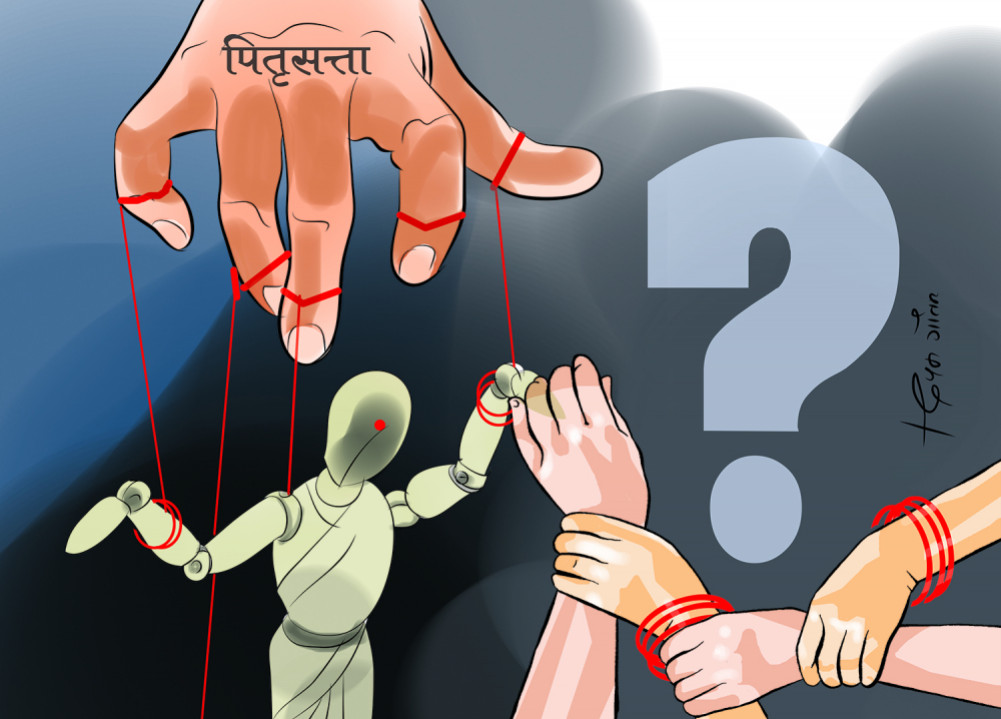
Nepal should also accelerate its pace to remove the systemic obstacles and prejudices faced by women in personal and professional spheres. For the empowerment of women, only policy reform is not enough, a change in behavior must also be ensured.
We use Google Cloud Translation Services. Google requires we provide the following disclaimer relating to use of this service:
This service may contain translations powered by Google. Google disclaims all warranties related to the translations, expressed or implied, including any warranties of accuracy, reliability, and any implied warranties of merchantability, fitness for a particular purpose, and noninfringement.
The society has been shaken by the death of two Nepali women since last one month. The first incident is the death of Rinkukumari Sada of Siraha on 30th of January. The second is the death of Prakriti Lamsal of Adhyarat Butwal at the Kalinga Institute of Industrial Technology (KIIT) in Bhubaneswar, the capital of Odisha, India.
Rinku Sada was gang-raped by three men while going to defecate on the evening of January 27. Three days later, she was found dead in her home. Indian student Adhik Srivastava repeatedly abused Lamsal. Lamsal decided to commit suicide after complaining repeatedly to the university administration that she had been mistreated.
These incidents of death, one in Nepal and the other in India, show a picture of the violence and excesses Nepali women have to endure even now. In the case of Lamsal, there was a situation where we had to protest against the college administration even in Nepal and India for justice. However, all the culprits of the Rinku Sada incident have not yet been arrested.
On the other hand, instead of handing over the culprits to the court and the administration, the society began to settle the matter by sitting in the Panchayat. It has exposed the level of consciousness of the Nepali society, it has also been seen how much price women still have to pay to live as human beings. Also, there has been significant progress in the field of women's empowerment in Nepal. But while the ancient thinking, customs and differences remain, the events created by it are overshadowing the progress made in the field of empowerment.
Women's political representation has increased significantly since the 2062/063 mass protests. From the local level to the federal parliament, there is a legal system to ensure the participation of women. The constitution ensures at least 40 percent female representation at the local level, opening the door for women to assume leadership roles. A mandatory quota of 50 percent has been set aside for women within the 45 percent reservation in the competition held at every level of the state.
According to the results of the local level elections of 2079, 14 thousand 466 women won in various positions in the election held for 35 thousand 221 posts. In 25 out of 753 local levels, women won the position of head/president while 568 people won the position of deputy head/vice president. 69 women won as ward president, while 442 women won as other members.
6,742 women members and 6,620 Dalit women members won. 33 percent of women are present in the House of Representatives and the State Assembly. The political representation at this level, which is considered to be the lowest level of the government structure, and even in the upper association, has definitely opened the door for women to move forward.
Women reaching the main positions like President, Speaker, Chief Justice, Chief Secretary, Secretary can be considered as the highest level of women's empowerment in political terms. Women's access to education has also increased. Various scholarship programs, free textbooks and school enrollment campaigns have played an effective role in promoting girl child education.
According to the 2078 census, 76.2 percent of the total population is literate. Among them, the female literacy rate is 69.4 percent. According to the 2068 census, the female literacy rate was 57.4 percent. The significant increase in female literacy rate in the last decade is a positive sign. Some of the steps taken for economic empowerment have also played a role in providing self-reliance and financial independence to women.
But the overall condition of women does not change if the political representation, educational and economic situation improves. Empowerment of limited women does not represent women as a whole. Still, the challenges women face are many. Orthodox thinking and culture have not completely changed. Women still have a limited role due to patriarchal thinking. Tendencies such as placing the responsibility of the housekeeper on women and giving priority to daughters over sons have not gone away from the society.
Domestic violence, workplace violence and dowry are examples of the suffering women have to endure. Although there are legal provisions against violence against women, some women victims are afraid to seek legal remedies because the society still tends to blame the victim. It is enough to see how intense and painful the fight for justice is for women who have been victims of violence and murder.
According to the official website of International Women's Day, citing data from the World Economic Forum, it will take until 2158 to achieve full gender equality worldwide at the current rate of progress. Therefore, as the slogan of the International Women's Day, which is going to be celebrated worldwide on Saturday, March 8, 'Let's speed up for gender equality', it is necessary to join hands on the issue of gender equality from all sectors.
Achievements in the field of women empowerment in Nepal are remarkable. But there is still a long way to go to address the remaining challenges. Therefore, Nepal should also speed up its pace to remove the systemic barriers and prejudices faced by women in the personal and professional spheres. For the empowerment of women, only policy reform is not enough, a change in behavior should also be ensured.