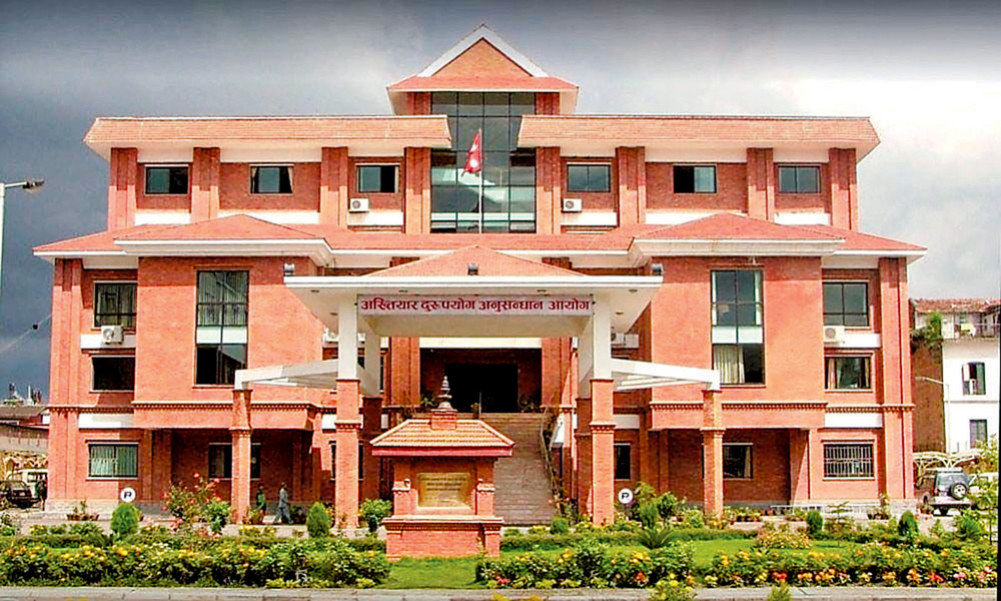
The government and political party leaders, who are the epicenter of corruption, are the ones who investigate and investigate corruption and appoint officials of constitutional bodies who file cases in court.
We use Google Cloud Translation Services. Google requires we provide the following disclaimer relating to use of this service:
This service may contain translations powered by Google. Google disclaims all warranties related to the translations, expressed or implied, including any warranties of accuracy, reliability, and any implied warranties of merchantability, fitness for a particular purpose, and noninfringement.
Kantipur Dainik published an article titled 'Government should not seek immunity from corruption' by former Supreme Court judge Balram KC on January 6. KC has said, 'Government is the epicenter of corruption, so it is afraid to appoint a person who is honest in the authority and who understands the investigation.' Looking at the past experience, as KC said, the head of the government and leaders of other political parties in the constitutional council that recommends officials of the authority have appointed some weak and controversial characters as commissioners.
Article 238 of the Constitution of Nepal provides that there shall be one chief commissioner and four commissioners in the Authority. But if we look at the experience from a long period of history, as said by former judge KC, the government and political party leaders are afraid or do not want to make someone who is honest and understands research as a commissioner. Instead, they are determined to continuously weaken the authority and fulfill their own interests.
In very few countries in the world, the constitution has given the authority of 'Ombudsman, Investigator and Prosecutor' to the body that controls corruption. Authority is one of them. From the point of view of law and rights, the Authority is also the only constitutional commission in South Asia to have all three powers. However, when partisanship prevails in the appointment process, it is difficult to work even when good people reach the authority. In spite of having a strong authority from the point of view of law and rights, Nepal has fallen into the vicious cycle of corruption. If history is studied properly, this fact is made clear by the events themselves.
Suryanath Upadhyay, who was appointed as the Chief Commissioner of Authority on 18th November 2057, retired on 17th November 2063. During Upadhyay's tenure, the Abuse of Authority Investigation Commission Act and Prevention of Corruption Act 2059 were promulgated. After this, during his tenure, investigations and lawsuits were filed against some big politicians and high-ranking employees on charges of extreme wealth. After Upadhyaya's retirement, Lalit Bahadur Limbu and Commissioner Ved Prasad Sivakoti, who were permanent chief commissioners, gave written instructions to the land office to register the government land under the name of the UN Park in Kathmandu in the name of an individual by merging the authority's jurisdiction. A case was filed in the Supreme Court regarding the incident. In connection with the said case, on 17th Chait 2067, the Supreme Court ruled that both Limbu and Sivakoti were involved in corruption and ordered action.
Lokmansingh Karki was appointed as the chief commissioner of the Authority on 25th Baisakh 25, 2070. Karki, who was found guilty by the judicial commission formed to investigate those responsible for suppressing the public movement under the leadership of former judge Krishnajung Rayamazhi, and who earned financial infamy in his working life, was appointed as the chief commissioner with the consent of all parties. After Karki made one controversial decision as the Chief Commissioner of Authority, on October 3, 2073, he was impeached in Parliament. On December 24, 2073, the Supreme Court annulled the process of his appointment, oath, etc. Along with Karki, both Deep Basnyat and Rajnarayan Pathak, who were appointed commissioners on the same day, are controversial characters. Before the commissioner of the authority was appointed, the complaint that Basnyat had earned a lot of wealth was lodged in the authority. The parties appointed Basnet as a commissioner ignoring the past image and the investigations being carried out in the commission. Later, he was involved in the embezzlement of Lalita Niwas government land in Baluwatar and the authority filed a case against him in a special court.
The special court on February 3, 2080 gave a verdict in the case and sentenced Basnet to 2 years imprisonment and a fine of 8 million 48 thousand. The audio and video of Rajnarayan Pathak, who was appointed as the Commissioner of Authority along with him, accepted a bribe of Rs 78 lakh from Nepal Engineering Campus in Bhaktapur. Authority filed a case against the same reader in special court on Chait 12, 2075.
These are some public examples of what characters were appointed as officials in the past. Appointing a person who has been sued by the authority, under investigation or who has gained financial infamy throughout his working life, on the one hand weakened the work of controlling corruption and on the other hand also tarnished the public image of the authority. No one questions the personal image, honesty and integrity of the current Chief Commissioner but there are various comments about the appointment.
Article 284 of the Constitution of Nepal has provisions for the Constitutional Council to recommend the appointment of officials of all the Constitutional Commissions including the Authority. In the council, the Prime Minister and the Chief Justice, the Speaker of the House of Representatives, the Speaker of the National Assembly, the Leader of the Opposition in the House of Representatives and the Deputy Speaker of the House of Representatives will be members. All the members of the said council, except the Chief Justice, are leaders of political parties. The Prime Minister is its chairman. Although they appear to be neutral in terms of positions, the Speaker, Speaker of the National Assembly, Leader of the main opposition party and Deputy Speaker are also leaders of political parties. Thus, it seems that there is a 'conflict of interest' in the process of appointing authority officials by the Constitutional Council, which includes 5 out of 6 heads of government and leaders of political parties.
In some countries, there is a system to be appointed by a single agency, while in some countries, there is a system to be appointed in partnership with various agencies. Likewise, some countries seem to require coordination and consultation with other agencies or opposition parties, while others have a mixed system. It seems that the arrangement regarding the appointment of such bodies is determined based on the social, economic, cultural and administrative conditions of the respective country, political system, etc.
Nepal's epicenter of corruption is basically shown by the fact that there are two entities. First government and second political party. This is also proved by two statistics. First, the Global Corruption Barometer published by Transparency International in 2013 states that political parties, leaders and activists account for 70 percent of corruption in Nepal. Secondly, the study on corruption and good governance in Nepal conducted by the Abuse of Authority Investigation Commission in 2075 has also presented the conclusion that political parties and their leaders-activists have the most role in the increase of corruption in Nepal.
Therefore, the government and political party leaders who are the epicenter of corruption are the ones who investigate and investigate corruption and appoint officials of constitutional bodies who file cases in court. Which is against the provisions in section 18 of the Good Governance Act 2064 that no decision should be made if there is a conflict of interest. This method of appointment seems to cause practical difficulties in conducting an impartial investigation of high-level officials and leaders and officials of political parties, even when honest, virtuous people with a clean image are appointed.
Therefore, it is not the final truth that the appointment of authority officials should be done only by the Constitutional Council. Nor does it mean that only leaders of political parties should remain in the Constitutional Council. There are different methods of appointing such bodies around the world, Nepal can learn from them.
There is a need to improve the appointment process of the authority by learning lessons from our own past experience and practice elsewhere. First, the system of keeping the roster of people appointed to the authority should be organized and effective. Second, it is appropriate to separate heads of government and political party leaders from the bodies and processes that appoint authorities. Thirdly, it is better to develop a system of hearing the proposed officers of the authority (the current parliamentary hearing) to be more transparent, responsive, accountable and with direct involvement of citizens. It will increase the confidence of the public if the system of not having the leaders of the political parties in the hearing committee can be implemented. Fourth, a permanent and effective system of public scrutiny (scrutiny) of persons proposed to the commission should be implemented. These are only some of the proposals, it is appropriate to reach a conclusion after a wide, intense public debate and discussion regarding the appointment of officials of the authority during the much-discussed constitutional amendment.