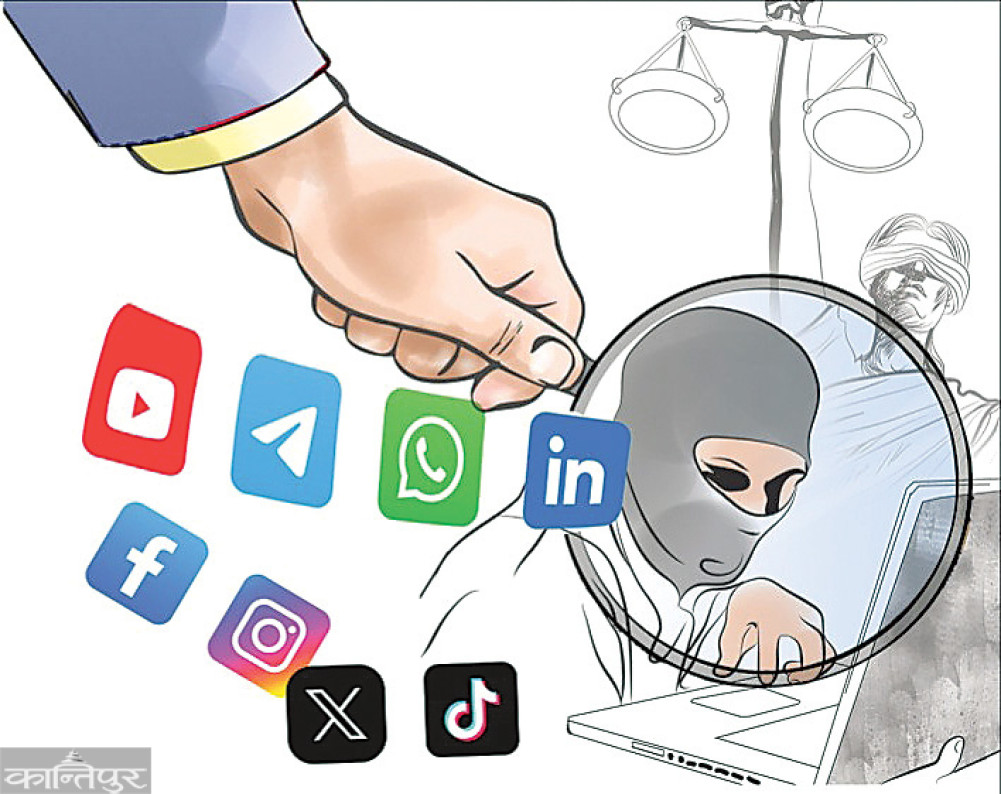
Defamation or character assassination of citizens and repressive or despotic efforts by governments are both abuses of democracy
We use Google Cloud Translation Services. Google requires we provide the following disclaimer relating to use of this service:
This service may contain translations powered by Google. Google disclaims all warranties related to the translations, expressed or implied, including any warranties of accuracy, reliability, and any implied warranties of merchantability, fitness for a particular purpose, and noninfringement.
Along with the rapid professional development of information technology in Nepal, the use of social networks and digital platforms has taken an unprecedented prevalence as a sense of democracy.
The movement that overthrew the government of Prime Minister Sheikh Hasina Wazed in Bangladesh a few months ago (2024), Hong Kong's democracy movement (2019), the Arab Awakening in Egypt, Tunisia and Libya (2010-11) are examples of the power of social media and digital platforms.
On the other hand, this is a double-edged sword. Since there is a danger of 'predator being prey' due to its abuse, it is also important for every user to be responsible for not abusing it. If one letter is wrong in public speech or writing, the meaning will be ruined, the development will be destroyed.
The use of social media and digital platforms is justified to look at someone who spreads awareness, not excitement and passion. In this way, the disease, deformity and anomaly of abuse is increasing alarmingly in Nepal. The number of complaints of fraud, dishonesty, defamation, character assassination, family discord and discord and defamation are increasing day by day in Cyber Crime Bureau. Impunity is getting away with spreading chaos, confusion and exaggeration anonymously or pseudonymously.
Stealing use of the internet (cyber bullying), cyber abuse of others (cyber stalking), criminal abuse of sexual material (sextortion), extortion, criminal abuse of obscene images, audio or visuals, character assassination of a person using artificial intelligence, provocative delusions, defamation, hate speech, 'deep fake', etc. Criminal activity seems to encourage the network to glorify crime by damaging the just social system, the moral life of citizens, and human dignity.
is democracy, unfettered civil liberties but not chauvinism or anarchism. To say that every person has the freedom to wave and walk down the street means to the extent that they are not allowed to punch another person in the nose. There is a need for a just solution to the fact that the credibility, reliability and public trust of social networks are seriously eroded due to misuse.
It is necessary to regulate. However, it cannot be to the extent of stifling or discouraging the constitutional right to expression. If the government tries to control the fundamental rights of citizens under the pretext of social media regulation, it will be an unconstitutional audacity that will only cause harm.
It is the government's duty to make social networks and digital platforms a more responsible, accountable, fair and honest system for citizens' freedom of speech and expression. A certain code of conduct, professional ethics and human responsibility are aspects that the media should always have. However, under the pretext of this, the government should not formulate laws that adopt an autocratic and repressive path.
The revolutionary change, unprecedented development and freedom in the communication world after the people's movement of 2046 is the gift of democracy. The audacity to control it from the state or anywhere else would be anathema. The style of modern democratic governance is not primarily to impose decisions on the people, but to persuade the people. In this, the role of moral and ideological campaign is meaningful rather than physical force.
The defamation or character assassination of citizens and the repressive or despotic efforts of the government are both abuses of democracy. Social media and digital platforms act as powerful tools in the hands of activists to challenge power and thwart its unjust efforts.
Its effectiveness is proven by the government's ability to develop a meaningful balance between the boundaries between freedom and control to meet these challenges of the digital age. In a democracy, the media may be highlighting the existence of the opposition. Because democracy carries the belief that the truth is in the minority. It will be absolutely regrettable for those in power to get angry unnecessarily and take an attitude of oppression on citizens.
In this regard, the government has submitted a bill for the operation, use and regulation of social media in the National Assembly. It should have absorbed the directive order issued by the Supreme Court on January 21, 2072 and the judgment and explanation of June 26, 2073 on electronic transaction offences. The
bill contains definitions and provisions that include abuse of social media or criminal prosecution and the government being the plaintiff. There is a provision to form a rapid response team (Rapid Response Team) for the rights, interests, justice and compensation of victims of social media. Provisions like fines ranging from three lakh to one crore and imprisonment from two to five years increase favoritism, vindictiveness, corruption and autocracy. It is mentioned that the person who gets the
license will 'develop the necessary technology on the platform or adopt other necessary measures so that content that is against the current law cannot be posted or shared'. Such decision-making by administrative bodies is not democratic, it should be done by empowered autonomous legal institutions and mechanisms.
Due to the incompleteness of this bill and the ambiguity in some topics or contexts, there is a possibility of misuse of the law by the government in the status quo, misinterpretation of the law and punishment based on people rather than crimes. The ambiguity of the law is the source of the 'nine horns of justice' or the strong possibility that the government becomes oppressive in the administration of justice.
The bill provides for compensation but it should be mandatory, not voluntary or flexible. In democratic countries like India, UK, USA, there is a legal system to pay compensation for digital crime. In the United Kingdom, there is a legal provision for compensation in the case of a personal offense that cannot be proven. It is better to focus on this rather than state control.
There should be a clear arrangement that users of the network should mention their identity in such a way that their real names and surnames are revealed, not pseudonyms. It is important for the government not only to prosecute and punish the guilty, but also to provide incentives and rewards to responsible citizens who earn fame through creative contributions to society by effectively operating social media within the scope of rules or laws. There is no provision in the bill for a mechanism to bear accountability from the government agencies according to the number of participants on issues of national importance or issues that have been prepared by raising the agenda. There are many deficiencies and weaknesses in the bill.
Democratic governance means forming public opinion through public debate and communication. Information technology, digital platforms and mass media are the official conduits to market information and ideas. Media or social networks are not themselves political players, but are the means of creating a creative and favorable political and social environment. It is also accepted by authoritarian regimes. The difference is, the media is not allowed to be free and fair by the authoritarian regime. It should not be misused and make the proverb 'coconut in the hand of a monkey' a metaphor.
21st century generation and society, traditional media as well as YouTube, Facebook, X (Twitter), Instagram, Tik Tok, Messenger, etc. are driven by the ability to broadcast information instantly and create a sensation in society. It has become necessary to make it disciplined, dignified, responsible and codified so that freedom of expression in the society does not take the form of chaos and the government is autocratic and vindictive and civil rights are not distorted and anomalous.
It is meaningful to have social networks, digital platforms and media to raise the cooperative interest of the government and civil society towards the deprived communities of the society, helpless, disabled, elderly, children, patients. Social networks and media must be held responsible for the negative impact on the general public due to illegitimate benefits, sensational, superficial, intrusive, false and provocative elements from news or social media content. The best test of truth is the power of thought readily assimilated in a competitive market. The sensitivity of the opinion is the responsibility of the social network to be followed in every letter.
Organizations representing various press including the Federation of Nepalese Journalists, International Convention on Digital Rights (ICCPR), activists of digital rights have demanded to correct the provision of taking away constitutional rights. Some of the provisions on discrimination are vague, leaving plenty of room for abuse and the proliferation of discrimination rights to stifle freedom of expression. Therefore, it is necessary to correct this bill in many places through a comprehensive discussion involving all stakeholders. The process should proceed only through consensus and modification, not status quo.