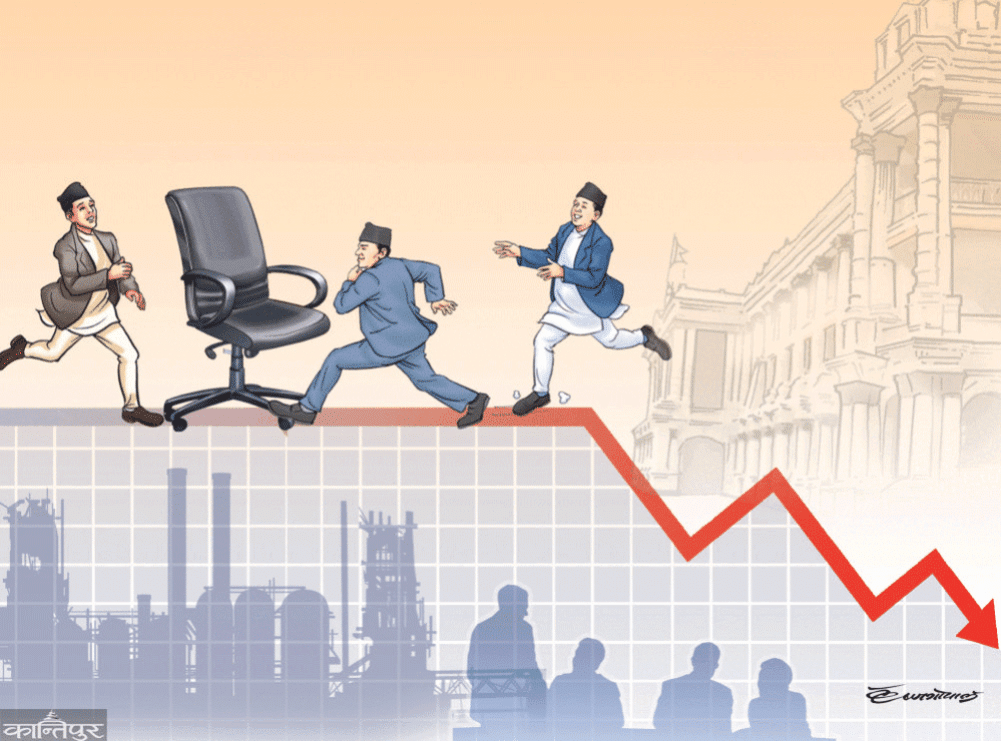
Still, if the political leadership does not take the 'bold' decision to cut large general expenses, it is certain that the next generation will face a big crisis.
We use Google Cloud Translation Services. Google requires we provide the following disclaimer relating to use of this service:
This service may contain translations powered by Google. Google disclaims all warranties related to the translations, expressed or implied, including any warranties of accuracy, reliability, and any implied warranties of merchantability, fitness for a particular purpose, and noninfringement.
Finance Minister Bishnu Paudel informed the parliament on January 24 that the size of the budget for the current fiscal year 2081/82 has been reduced by 1 trillion 67 billion. He reduced the budget of 18 trillion 60 billion to 16 trillion 92 billion. The then Finance Minister Barshman Pun explained the reason for reducing the budget by saying that there were many programs for which there was no guarantee of resources in the budget.
But in the previous fiscal years 2079/80 and 2080/81, both times, the budget (2 trillion 44 billion and 2 trillion 21 billion respectively) was reduced in the middle.
In this way, it has become the practice of every government to make an ambitious budget at the beginning and after seeing that the income-expenditure targets are not achieved, they come to the middle of the financial year and revise the targets by reducing them. What causes this and what should be done to improve it?
Actually this is not a problem of purely economic policy like monetary policy or purely fiscal policy like tax policy or public spending. This is a problem connected with our meaning politics. Therefore, the political leadership should find a solution for this and the meaning should be found through political decisions. For that, vote bank politics, populist, publicity-oriented, decisions that cannot take risks should not be made.
We are very short on resources. Whether it is direct or indirect, all revenue rates have reached saturation, so there is no room to increase the rate. By exaggerating, they will increase prices and inflation. Problems such as tax evasion, leakage, low invoicing, smuggling and corruption will increase. Because of this, instead of increasing tax collection, it may also decrease. There may still be a few places where the range varies, not the tax rate. However, for that, it will take us more time to reach the level of efficiency and records system of revenue administration. Even if the range is greatly increased, only the revenue collection expenses will increase but the net revenue savings may be very low or zero.
Let's talk about domestic debt. Which is a resource to be repaid with interest, not a net receipt like tax. Again, the other bad aspect of the internal debt raised by the government from the market is that it dries up the debt of private sector banks and financial institutions that run economic activities. which hinders economic development. In this way, there is no room to increase both the tax and the debt on the domestic side at today's prices.
On the other hand, it is not in our hands to increase foreign resources. Instead of increasing that resource, the world situation is decreasing. Since a country like China and even its close neighbors have taken a policy of not giving grants and only giving loans under its ambitious project BRI, we do not expect much from bilateral or multilateral grants. Similarly, we have to spend a large part of the current expenditure on the principal and interest payments of external and internal loans. Taking more debt will increase the liability ie ordinary expenses. After the rise of Trump in the US, it can be easily analyzed that those debts are also decreasing. Because, it is Trump's policy to reduce the grant money given by the US to all such international organizations.
In this way, we were and still are almost dependent on foreign sources for development expenses, as the ordinary expenditure from the revenue reaches Zenten and only a little is saved for capital expenditure. We were forced to increase the internal debt, but now the internal debt, which is usually raised in the middle of the financial year, also has to be raised at the beginning of the year due to lack of expenditure. If this situation continues, there is a strong danger that the country will collapse and become a failed state in the next few years.
In the current situation where it is difficult to cover the budget deficit by increasing the income, we have no choice but to reduce the expenditure. Because, those measures are not propaganda in the name of austerity campaign such as reducing the use of masaland, reducing foreign travel, not organizing events in star hotels, but they will not be fully implemented, but only a very small part of the national budget will be saved. "Radical" measures can be taken to reduce the big expenses by reducing the ordinary expenses in bulk and effectively, but not harming the country, the people and the economy. Adopting measures that can be risky for politicians.
There should be no delay in canceling the provinces that were brought to satisfy the caste-regional political activists and to fulfill the agenda of a certain political party rather than on the basis of feasibility and necessity. Now, if only two levels of federalism are made effective, a large general expenditure will also be saved.
Similarly, by reducing the number of troops, general expenditure can be significantly reduced. The army that was added during the King's rule to counter the Maoist armed rebellion is no longer in that position, so there is room to reduce it to keep only what is needed. There cannot be a leader/politician who is afraid to do anything in case the army leadership does not like that proposal. Our country is not Pakistan. The army has a proud and patriotic history here since the time of Prithvi Narayan Shah.
Another area where spending can be cut is the management of social security. As such, since the National Identity Card has been made mandatory, there have not been many cases of double-triple and fake payments. In the case of old-age allowance, with the increase in the average life expectancy, if a reasonable decision is made, such as increasing the age limit to be a beneficiary, it can save a lot of expenses. To do this, political will will be essential to make bold decisions, not by coveting the vote bank or thinking of the nation as an empty treasure.
In the future, police, education, health, infrastructure construction, maintenance and delivery will need many times more budget allocation than now. With the increase in population, increase in the number of crimes, diversity in the types of crimes and increasing challenges in law and order, a large amount of manpower and equipment will have to be added to the police. The need for budget towards health services is unlimited, towards education, a large sum of money will have to be added to make school education completely free up to secondary level and to increase the quality of education.
In this way, if the political leadership does not make a 'bold' decision to reduce the general expenditure, not only today, but for the challenges that will be added tomorrow, it is certain that the coming generation will face a big crisis.