After being a sufferer myself, I now have a deep feeling - we are responsible for ensuring that the helpless, poor, destitute, remote citizens get quality treatment on time and that their lives are saved, now we must fulfill it somehow.
We use Google Cloud Translation Services. Google requires we provide the following disclaimer relating to use of this service:
This service may contain translations powered by Google. Google disclaims all warranties related to the translations, expressed or implied, including any warranties of accuracy, reliability, and any implied warranties of merchantability, fitness for a particular purpose, and noninfringement.
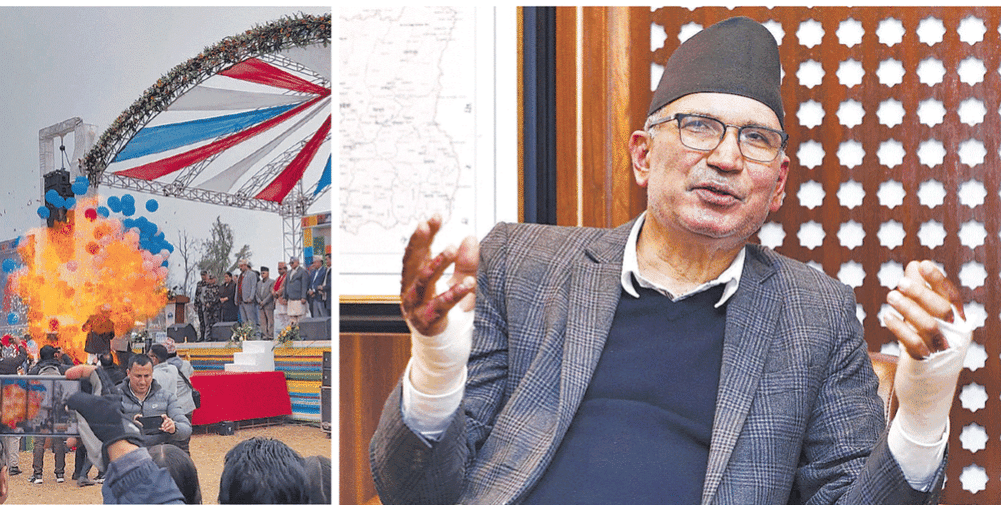
After Pokhara Metropolitan Municipality invited me to the announcement meeting of 'Pokhara Visit Year 2025' on February 3, I reached there at the appointed time. The organizers have arranged to light the lamp in Panas after 'switch on' to inaugurate the program in a new way.
With 'switch on', the lights came on. The 'fire candles' began to emit flickers. And I was returning to the stage as the opening work was over. However, there is also an arrangement to fly one jhuppa balloon by me and another jhuppa by Dhanraj Acharya, the head of the Metropolitan Municipality.
So back down from the platform we grabbed the balloon rope. While trying to fly, it hit a Jhirjira which was 'sparking' near a hut. Together with the two groups of balloons
burst. The loud noise, the smoke and flames coming out of it were nothing short of a bomb going off. Meyersab fell off the stage after being engulfed in flames. I ran towards the platform. My hat, coat, face, scalp were burning. PSO open the cap. Extinguished the fire. Now there was a dilemma whether to go to the hospital or to continue the program. But I felt that I should go to the hospital and my friends took me to Gandaki Medical College.
Doctors gave first aid after receiving information about the incident. My hands are burnt trying to put out the fire. So it was burning gradually. In the case of burns, pain and suffering will gradually increase later than in the beginning. When the doctors examined me, they saw that my nose and the hairs there were burning. They are suspicious - 'Didn't the flame coming out of the hydrogen gas enter through the nose and go to the lungs?'
'If it goes to the lungs, it will be complicated', they suggested to go to Kathmandu immediately. My friends were discussing which hospital to go to in Kathmandu, but I decided to go to 'Burn Hospital' in Kirtipur. Because, I knew that hospital was providing excellent treatment with limited resources.
Coincidentally, a Simric Air helicopter was at Pokhara Airport at that time. By riding the same helicopter, we came to the hospital in Kirtipur, Kathmandu.
Even in Kathmandu, after looking at the doctors, they analyzed whether there is an effect on the lungs. and placed under surveillance for at least 72 hours. Fortunately, there were no side effects, and I was discharged from the hospital. After a few days of rest, I am now back to the daily work of the ministry. But there is still the burning pain. The wounds have not healed. I am following the doctor's supervision and suggestions.
Fortunately, what would have happened if two/three circumstances had not cooperated? Now I'm guessing. Hydrogen is a highly flammable gas. What would have happened if such a gas had fallen like a bomb, and the flame with the gas had entered during inhalation? Within seconds I ran towards the stage, burning my face and hands, luckily sparing a lung.
Second, according to the doctors, if I didn't wear glasses, my eyes could be damaged. Glasses protected my eyes. Thirdly, if I were a hatless person, my head would burn more than my face. Because of these three coincidences, I seem to have escaped the internal effects.
After that incident till today, those who supported me and looked after me according to their respective roles, including President Ramchandra Paudel, Prime Minister KP Sharma Oli and sympathized with me at the hospital, and especially the way the entire team of the hospital, including Dr. Shankar Rai, treated me, I am grateful to them. I got a lot of psychological strength from this support. In the wounds of the burning of the physical body I have received the unfailing salve of sympathy and good wishes.
.....
Actually, I'm realizing now, what are the problems with our security 'protocol'. When going to an event, our curiosity about the security 'protocol' decreases. But security should be taken care of regularly. If someone is doing a new 'innovation', it should also be looked at from the point of view of security. Like, filling balloons with hydrogen gas at public events is very risky. Therefore, the practice of filling hydrogen gas in balloons must be stopped now.
Second, to make the programs attractive, including the opening, it is necessary to find an original method, not an artificial one. It should also be seen in connection with the safety of the citizens attending every program.
After coming to Kirtipur Hospital, I saw two/three things there. Actually this hospital has done a great service. For fire victims, this hospital has provided the highest level of service in the face of limited resources, adverse conditions and difficulties.
We don't even have a 'burn unit' in many hospitals yet. No ICU either. The number of expert doctors who see 'burn cases' is also less. We are going through this kind of problem. Therefore, we need to have at least a 'burn unit' in all provincial hospitals, all medical colleges and major hospitals and a separate ward to treat some burn patients. According to the situation, specialist doctors and medicines should be arranged. There is an urgent need for a well-equipped 'Burn Hospital' in the country with specialist services to maintain good units in provincial hospitals and to divert them elsewhere for additional treatment.
In the meantime, I also had the opportunity to listen to the experiences of many friends about what kind of problems and incidents of irritation occur. Among them, the contribution and campaign of one social activist, Ujjwalvikram Thapa, is not closely understood and remembered. He spent many energetic hours of his life for the treatment of burn victims. His experience and suggestions also motivated me to join this campaign and move forward. I have taken suggestions from him at some stage of meetings, noted the issues to be considered while formulating the policy.
myself, being a victim of an accident, I now feel deeply – the onus is on us to ensure that helpless, poor, disadvantaged, remote citizens get timely quality treatment and that their lives are saved. Now it must be completed somehow.
.....
I was met by flames. His hands and face were burnt. In particular, it was the result of an accident caused by not taking enough precautions. Officially, I am the Deputy Prime Minister and Dhanraj Acharya is the head of the metropolis, but we were injured in the accident. Naturally, the injured person is treated according to the doctor's advice. Efforts are made to deliver as quickly as possible to the best hospital as per requirement and availability. Therefore, after the doctors said that he should be taken to Kathmandu, his friends arranged for a helicopter to deliver him quickly. I didn't say I had to go in a helicopter myself. However, I did not deny the arrangement. Because when injured, bandages are needed first, there is no time to be confused about choosing this or that.
There has been a discussion in the House and on social media about I came in a helicopter. But the way it was discussed and debated is very good. Because, the topic of who will use/not use the helicopter under what conditions has been raised. It is right that all the victims, injured, patients should be able to use such facilities. I have deep respect for everyone who participated in the discussion. In fact, regarding the treatment, it should be determined based on what is the effect of his illness, event, accident and not on the rank and status. The discussion is very good from the point of view of who should be taken to which hospital as soon as possible. I've also come to a point where I've been deeply pondering why we've failed to provide everyone with rapid access to treatment.
.....
Some may have reacted bitterly when they were injured in an accident. Did you find out after falling on your own? You may have said. I have respect for such comments. Because, the personal feeling of falling and falling is different. But I have a history of taking the lead in such events in the past as well.
Some time ago the Honorable Member of the House of Representatives Chandra Bhandari met with a gas explosion accident. He and his mother were initially treated at the Burn Hospital in Kirtipur. Attempts to save the mother were unsuccessful. Chandraji and mother were family members whom I also visited closely. Chandra Bhandariji's health condition was not the least dangerous.
At that time I happened to be in charge of the Ministry of Finance. When I went to see him, I promised that I would do whatever it takes to get him treated, and if it is not possible within the country, he should be taken abroad for immediate treatment, and the state would bear the responsibility for that. He was flown to India by air ambulance. What would have happened if he had not been taken then? Imagination is a matter beyond imagination. Therefore, even though the feeling of seeing and experiencing is not the same, there is close perception.
Not only for myself, but for anyone, improving and strengthening such sensitive treatments are the main agendas today. Now I am the Deputy Prime Minister so I have to show some things not just talk. I believe that after work, I should have done this. So what to do in the treatment of burns will have to be something new in the coming days.
About 65,000 people are exposed to some kind of burn every year. About 15 percent of them have to be treated in a hospital or intensive care unit. So this is a big topic. It's not just a loud voice saying this should be done, it should be done now.
I have intimately realized that not only in building health infrastructure, but also in organizing programs, its patterns should be changed. Clumsy programs on the one hand waste time, on the other hand increase unnecessary wasteful expenses. Not only that, there is also a security threat. In some countries, there is a podium on the stage, the president or the chief guest of the program comes through the door, speaks quickly and leaves.
is not even called by the announcer, there is no formality of taking the guest seat, welcoming and thanking. Where we have a different practice than that. Now, taking into account the time management, should we do the program only in the presence of the necessary and essential people? Will the programs be based on Nepali originality and tradition and will attention be paid to strengthening security arrangements?
is human nature, some things don't open until you fall into them yourself. Being social in nature, a lesson is not learned until others see it. One's own carelessness and overconfidence in others also sometimes lead to accidents. But every incident/accident teaches some lesson. We should learn from those lessons and move towards improvement. That is the way of my coming days.
(Based on the conversation of Durga Khanal of Kantipur with Deputy Prime Minister and Finance Minister Paudel who was injured in the balloon explosion in Pokhara)