We use Google Cloud Translation Services. Google requires we provide the following disclaimer relating to use of this service:
This service may contain translations powered by Google. Google disclaims all warranties related to the translations, expressed or implied, including any warranties of accuracy, reliability, and any implied warranties of merchantability, fitness for a particular purpose, and noninfringement.
Social media platforms have proven to be useful for getting information, generating ideas, engaging in dialogue and collaborating. Social media is also a democratic platform because you can share your experiences, thoughts and reactions freely without being threatened or pre-approved by anyone.
Such an achievement of being able to express one's expression to the world by writing and speaking on the smartphone in hand is a boon for the human race. However, the fact that the society that exercises rights has yet to be accepted is that democracy has given us freedom of speech, not chauvinism. Along with the right to criticize comes social dignity and legal responsibility. However, the tendency to sit in a dark room and attack someone's reputation in a planned or misguided fashion has grown electrifying, making social media debates vile and undernourishing democratic ethos. Therefore, the initiative and lobbying of the conscious community has become mandatory to make social media 'social'.
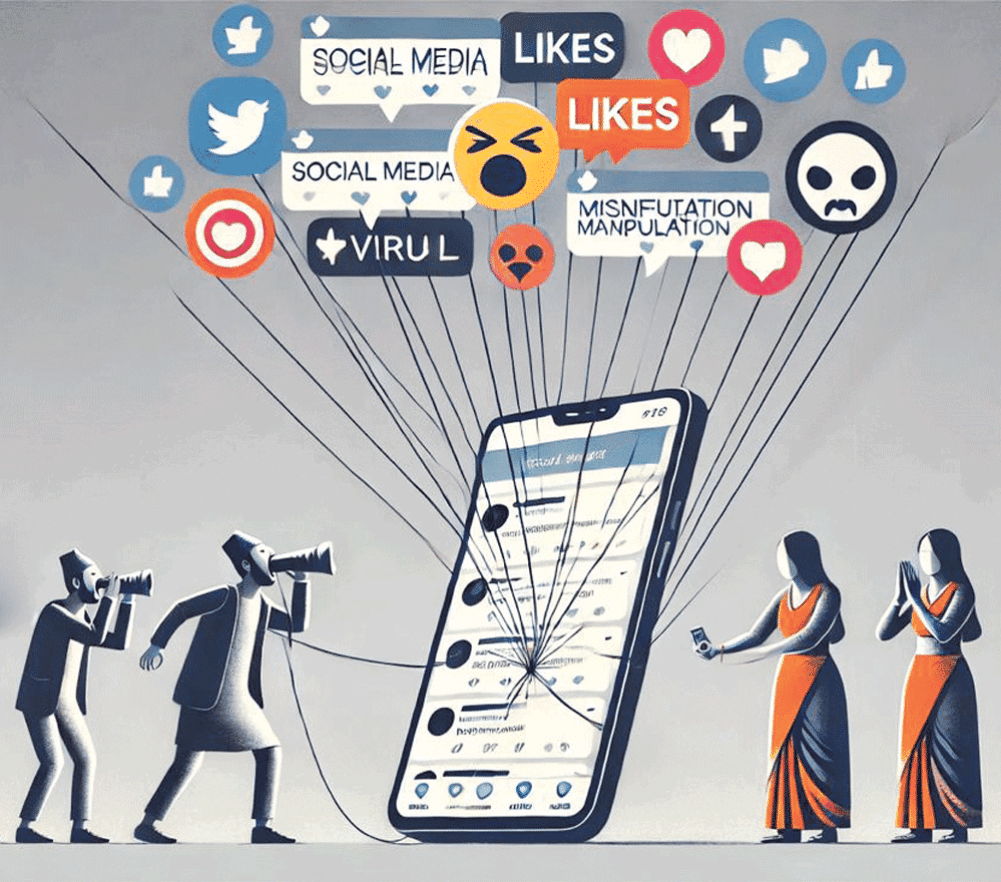
Especially since false information spreads rapidly, individuals and groups who mislead the society are using it forcefully. Some social media users have made disinformation and character assassination a fun lifestyle. They have no interest in the reputation of another person, nor respect for the law and order of the country. There is a tendency to make any kind of accusations to spread hatred towards people or organizations who have different views. There is also the illusion that this trend has sprung up spontaneously, but studies and research have made it clear that organized cyber cells are created by various individuals, groups and political parties to create such 'trolls'. The main mandate of such a team is to spread misinformation about organizations and individuals. When the material created by such groups is disseminated knowingly by others, the planner's objective is fulfilled. The psychology of disbelieving processed information and treating deliberately constructed false information as inscriptions is confusing social debate. As a conspiracy created in a dark room spreads across the world in an instant, interest and concern about it has increased all over the world. While cyber cells naturally carry out organized attacks, civil society seems to have a tendency to remain silent, to wait, to watch, and to fade into conflict. However, silence is the most deadly character in democracy. If a person has not followed the policies and rules of the state at that time, it is justified and expected to raise questions. But if an organized cyber attack occurs, social countermeasures and legal remedies should also be practiced.
The government has introduced a bill in parliament to discourage abuse on social media. Questions have been raised in the society about the proposed bill. In particular, by keeping abstract provisions, the provisions that will be interpreted by government officials tomorrow should be rejected. However, in the name of democracy and freedom of expression, the society cannot turn a blind eye to the legal punishment that should be taken by individuals and groups who create false information, make photos or videos, and assassinate characters. Because the reputation of any person is paramount in a democracy. Collecting the personal details of women and girls and putting them on social media, bargaining and giving them mental control cannot be normalized and should not be done. For this, there should be a debate on whether the existing laws are sufficient, if they are not sufficient, the state and society cannot continue to disagree on adding laws. There is also an argument that to break the story, crimes like blasphemy are dealt with by existing laws. However, compared to yesterday's abuse in the street, the size and impact of social media crime, its style and the mental trauma suffered by the victim is incomparable. In times of changing technology and influence, the old laws may not be enough. If the constitution of the country is dynamic, it cannot be said that the law is stable. The main concern is that laws made in the name of protecting a person's reputation should not be used by the government as a tool to prohibit questions about themselves, for that a comprehensive debate on the existing and proposed laws is necessary. Because the dimension of social media and its misuse is also a new topic for us. It has immense potential for positive and negative uses. There is a need to encourage misuse and discourage misuse.