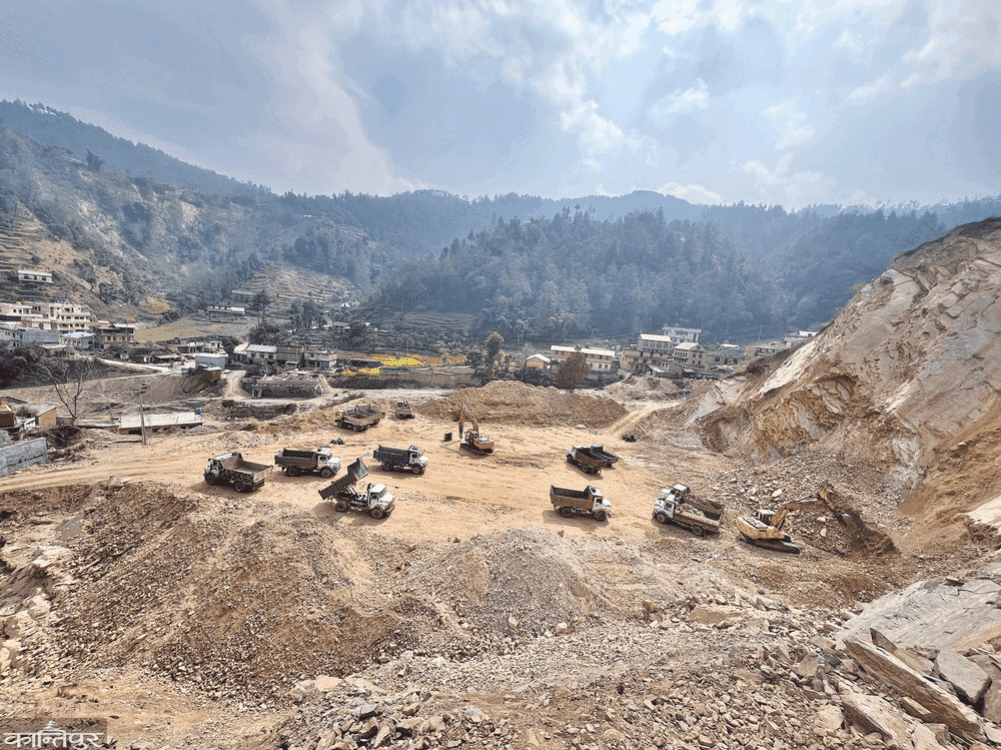
Even if the operator gets direct benefits, the interests of the officials of the permitting and monitoring bodies are also connected. However, ordinary people have to bear the extraordinary damage caused by such industries. There is a delay in studying and implementing how many industries will be allowed to operate in which places.
We use Google Cloud Translation Services. Google requires we provide the following disclaimer relating to use of this service:
This service may contain translations powered by Google. Google disclaims all warranties related to the translations, expressed or implied, including any warranties of accuracy, reliability, and any implied warranties of merchantability, fitness for a particular purpose, and noninfringement.
The floods and landslides of October 11 and 12 are the biggest disasters of this year in which 250 people died, 78 of them in Kavre alone. Many families were displaced as their houses were washed away and destroyed. It is not known how long it will take for people's lives that have been disrupted to return to their old state, but the crusher industry has started exploiting nature.
The conclusion of the study is that Roshi and other areas of Kavre have suffered irreparable damage due to the crusher industry. The district monitoring committee's meeting held on January 9 concluded that the river and mining crusher industry and geographical heterogeneity of Kavre are the main causes of the floods. Allowing mining to take place without ensuring the development and implementation of geological study and excavation standards is to invite another disaster. Therefore, the government cannot be a silent spectator.
Floods in Kavre's Panauti, Bethanchok, Temal, Mandandeupur and other municipalities have caused relatively more damage to human habitations, crops, livestock, and farmlands. At that time, many families who were displaced and forced to live in Tripal have not been able to make new arrangements for safe accommodation. There is no condition to grow crops as the flood sand has covered the fields.
The damage to roads and bridges has not been repaired. As the BP highway could not be repaired, the vehicles had to cross through a temporary road built in the river. Passengers have to suffer due to dust. There is a risk of landslides. After the start of winter season, it is not possible for vehicles to cross through the temporary road. Considering that possibility, it should be repaired now, but the government has not paid attention to it. The justification of these references is clear - there are many issues that should be prioritized by the government and concerned bodies.
There are 11 crusher industries in Panauti Municipality, which suffered the most damage during the disaster. Similarly, three crushers and mining industries are operating in Bethanchok rural municipality, one in Roshi, three in Mandandeupur municipality and 11 in Bhumlu rural municipality. However, most of the industries have not met the standards.
To what extent is the harassment and coercion? As the Chalal Ganesh Sthan Mineral Industry Pvt Ltd is excavating near the Ganesh Basic School located in Bethanchowk-4, the study and teaching in the school is disturbed. Due to the dust flying from the mine, the health of children and locals has also increased negatively.
Mining and crusher industry in Kavre has already been criticized due to exploitation of natural resources, increased insecurity in settlements and damage to human health. However, no level of government has been able to be serious about it. After the floods in October, this issue came up for discussion again. However, within 6 months, this issue has been resolved. The crusher industry should be operated at least 500 meters away from highways, streams, rivers, bridges, Taltalaiya and at least 2 kilometers away from educational institutions, health institutions, settlements, religious, cultural, archeological places and security agencies. However, these and other standards are not observed.
It is mentioned in the report 2079 prepared by the district-level monitoring task force of the river and mining industry that the mining and crusher industry did not follow the standards. Such a trend indicates the possibility of risk and loss in the future. Unfortunately, a limited class benefits from such exploitation.
Even if the operator takes direct benefits, the interests of the officials of the permitting and monitoring bodies are also connected. However, ordinary people have to bear the extraordinary damage caused by such industries. There is a delay in studying and implementing how many industries will be allowed to operate in which places. Therefore, the standards should be strictly enforced. For that, concerned organizations or local residents should raise their voices.