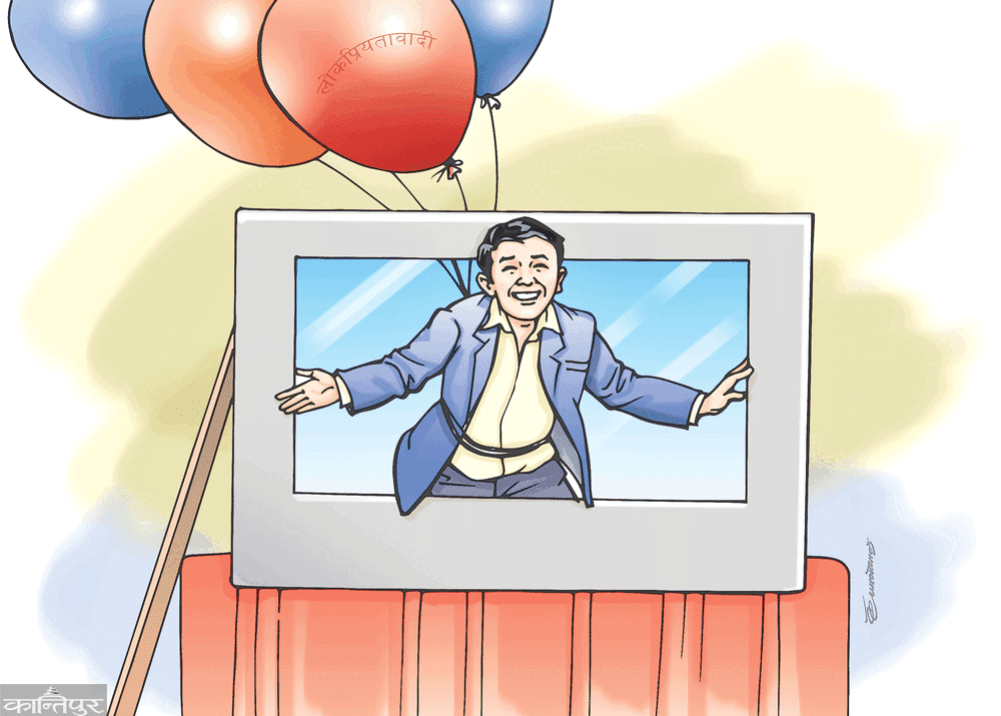
Populist, militant and liberal parties, tendencies and characters are attacking democracy, democratic and constitutional institutions and liberal values.
We use Google Cloud Translation Services. Google requires we provide the following disclaimer relating to use of this service:
This service may contain translations powered by Google. Google disclaims all warranties related to the translations, expressed or implied, including any warranties of accuracy, reliability, and any implied warranties of merchantability, fitness for a particular purpose, and noninfringement.
After the victory of populist, extremist, liberal, and anti-immigration parties in about 50 percent of the 65 countries where elections were held in 2024, a serious debate about the future of liberal democracy has begun. "Make America Great Again" has created a powerful political wave worldwide after Donald Trump was re-elected as the President of the United States.
Not only populist, militant nationalist, liberal, anti-immigration parties have won the election, such comments and waves seem to be spreading like wildfire globally. Therefore, Western media and political scientists like The New York Times, The Economist have made pessimistic predictions about liberal world order, liberal democracy and pluralistic society.
Has a crisis been created on liberal democracy and the mainstream moderate party? Is it the failure of liberal democracy or the success of populists, extremists and liberals? What effect does this have on Nepali politics? Debates and discussions are going on.
The message of the election year
The year 2024 has been termed as the election year because there are elections in countries with about 50 percent of the population, including America, Britain, India, France, Russia, South Africa, Brazil, Indonesia, Mexico, Hungary, and Sri Lanka. According to the election results, the people were against the ruling, mainstream and political elite and in favor of change. People seem to give more importance to nationalism, economy, immigration, strategic relations than democracy, liberalism, pluralism, climate change, international relations. Populist, ultra-nationalist, liberal, anti-immigration parties and leaders succeeded in taking direct and significant political advantage of it. So Trump won in America, Narendra Modi in India, Vladimir Putin in Russia.
From the point of view of liberal democracy, the result of Britain, which is considered the mother of parliamentary democracy, is only positive. Not only did the Labor Party win in Britain, the Conservative and Populist parties weakened. Even in the French parliamentary elections, President Emmanuel Macron's centrist party weakened and Marine Le Pen's far-right and far-left parties were established as decisive forces. After Macron, there are indications that populist, far-right and far-left parties may dominate in France as well. Even in a liberal democratic, multicultural and pluralistic country like Germany, where the elections will be held on February 23, polls have predicted that a populist and anti-immigration party like 'Alternative for Democracy' will achieve significant success.
When analyzing on the basis of such political scenario and election results and projections, it seems that liberal democracy is turning into liberal democracy and liberal democracy into totalitarianism and authoritarianism. Likewise, the liberal, democratic, centrist, pluralistic party is being dominated by extremist, populist, liberal, and anti-immigration leaders, and the party is also being transformed in the same direction. Trump in the US Republican Party and Modi in the Bharatiya Janata Party are representative examples of this trend. Although it is bitter, the reality is that democracy is threatened by those who are now called democrats. What else could be this great irony for democracy?
Why the crisis on liberal democracy?
Not only after the announcement of last year's election results, but the birthplace of democracy, liberalism, pluralism, diversity, rule of law, and human rights, Europe-America is becoming a fertile ground for populism, extremism and liberalism. Freedom House, a Washington-based think-tank that studies democracy, concluded that democracy is becoming unpopular due to the authoritarian tendencies of the elected government, lack of rule of law, corruption and misrule. According to "The Economist's Democracy Index 2023"
Since 2010, democracy has been steadily declining and the democratically elected government has been transformed from liberal democracy and democratic system to authoritarianism or totalitarianism. According to The Economist, liberal democracy is currently a victim of exaggerated propaganda by populists, extremists, and liberals.
The book "How Democracy Die" written by Harvard University professors Stevin Levitsky and Daniel Giblot also mentions that the crisis of liberal democracy is challenging. Livitzky and Ziblot summarize - "Cold War Communism, executions, military rule and one-party dictatorship are not the current challenges, populism, extremist nationalism, liberalism, elected authoritarianism are the main challenges."
Due to the fact that the democratic system could not deliver according to the people's wishes, populists, extremists and extremists seem to be emerging by trading on the dissatisfaction, anger and displeasure created in the people. It seems that they have succeeded in achieving maximum political gains by creating sponsored and toxic commentary on the underlying governmental shortcomings of the democratic system.
The wave of democracy - a series of counter-waves
American political scientist Samuel P. Huntington has expressed the idea that democratic waves and counterwaves are like regular contingencies. After studying and researching the global rise and fall of democracy from 1828 to 1990, he made this conclusion in the book "The Third Wave of Democracy" published in 1991. According to Huntington, there have been three waves and three counterwaves so far.
was the first wave, from 1828 to 1922. Democracy was established in about 33 countries over a period of almost a century. But the 20 years from 1922 to 1942 were the first counter-wave. The backlash began in 1922 when Mussolini overthrew Italy's weak and corrupt government and seized power. In 1933, the counter-wave reached its peak after Hitler seized power in Germany, ending democracy. Countries that established democracies before or after the First World War were victims of such a counter wave.
Second, with the end of World War II, there was a second wave of democracy again from 1943 to 1962. During this period, Rana rule ended and democracy was established for the first time in 1951. During this period, democracy was established in Germany, Italy, Austria, Japan, Korea, Turkey, Greece, Brazil, Costa Rica, Peru, Colombia, Argentina and other countries. Although there were democratic and periodical elections in the constitution and on paper, the unestablished democracy was moving towards authoritarian and totalitarian direction.
In 1962, the second wave of democracy began with the military intervention in Peru. The 12-year period from 1962 to 1974 was a short second counterwave. During this period, democracy ended in Greece, Turkey, Brazil, Bolivia, Argentina, Ecuador, Chile, Uruguay, Pakistan, and South Korea. In 1962, there were 13 countries in the world under military rule, and in 1974, there were 38.
Third, from 1974 to 1990 is considered the third wave of democracy. Huntington has extensively studied, researched and interpreted the Third Wave. At midnight on April 25, 1974, the third wave of riots began when the song "Grandola Vila Morena" was broadcast from the radio station of Lisbon, the capital of Portugal. During this period, democracies were established in about 30 countries.
Former Soviet Union, East Germany, Hungary, Czechoslovakia, Romania, Poland, Bulgaria, Mongolia, Nicaragua and other countries were overthrown and democracy was established. During this period, democracy was also restored in Nepal in 1990. In 1922 only 29 countries had democracies, by 1990 this number had increased to 130. Huntington also projected a third counterwave. But because the research was done until 1990 and the counter wave did not come until that time, they did not mention the third counter wave in the book. short-lived wave of
populism and radical nationalism
As Huntington predicted, a third counterwave began in 2010. But like in the past, communist, military and authoritarian regimes were not established by overthrowing democracy, but the parties, presidents and prime ministers who came to power through elections in the democratic system are weakening democracy itself. Hitler and Mussolini were able to seize power by exploiting the frustration, anger and dissatisfaction created due to the economic crisis that started in America and Europe from 1929.
Western political scientists are of the opinion that the third counter-wave has come since 2010 because of another economic recession that started in 2008. Just as Hitler and Mussolini rose on the basis of extremism, populism and propaganda, so did Trump in America, Modi in India, Victor Orban in Hungary, Javier Millei in Argentina, Recep Tayyip Erdogan in Turkey.
, especially populist, extremist and liberal parties, trends and characters are attacking democracy, democratic and constitutional institutions and liberal values. They have been challenging democracy in the name of democracy by using the democratic system and election process. Trump did the same in his first term and is doing the same now with the swearing in of his second term. In 2023, the extreme right-wing and populist Milley of the Libertarian Party announced that after becoming the president of Argentina, they will not only attack, but also destroy the democratic institutions.
But not only the wave of populism and liberalism, the counter-wave has also started. In last year's Lok Sabha elections, Modi was weaker than before. In the 2022 election, another populist former president of Brazil, Jair Bolsonaro, was defeated. The populist, liberal and extremist 'UK Independent' party, which led the campaign to leave Britain from the European Union, has dissolved and even ceased to exist. So the wave of populism is fleeting, short-lived and reactive. Because populism is the problem, not the solution. Populists have a list of problems but no solutions.
Co-Production of Social Media
Alternative media, digital platforms and social networks like Facebook, X, YouTube, Instagram, Tik Tok have become very popular, useful and influential mediums in terms of quick information, direct dialogue and lively debate. With the development of information technology, digital media and social networks, access to information, knowledge and entertainment has been established even among the common people, and the dimension of public discussion has undergone a fundamental change. From the leaders to the people, from the government to the party, from the policy makers to the intellectual community, everyone's attraction to social media seems to be like 'mass hysteria'.
But in the name of creating an alternative commentary, national and international organizations have concluded that alternative media and social networks have encouraged populism, extremism, liberalism, and extremism. In particular, digital platforms and social networks are popularist, liberal and extremist propaganda machines, and they are tools for spreading 'misinformation', 'disinformation', hatred and intolerance. Principles, ideas, policies are not debated and discussed on the basis of facts and figures, exaggerated and unhealthy accusations are made based on falsehoods. Those who denounced and condemned loudly, it seems that the misleading standard and commentary of revolutionary is being established.
Traders of power and traders of despair are becoming surprisingly dominant in the political speculation market. There is an unfortunate tendency to define and assimilate exaggerated, intolerant and toxic propaganda as popular commentary. It seems that parties, leaders and activists are also becoming social media and digital platform based and focused. New incarnations of Goebbels are emerging every day.
Trump, Modi, Miley, Lee Pen have emerged through social media and alternative media. They have emerged by attacking liberalism, democratic institutions, the establishment, mainstream parties and the media, the intellectual community. Therefore, social media has become a dangerous weapon for populists, liberals and extremists to attack democracy, liberalism and spread hatred and intolerance. Therefore, it has been a vivid state of popular garments created by social networks and the victims of the deadly garments of generics. & Nbsp;
Nepal has a direct or indirect effect of international politics. Guaranteed democrats, such as generous democracy in the world, depressed and popularists, and characters, and characters and characters are enthusiastic. Additional challenges have been created a further challenge to the Congress, UML, the Maoist. Another new popularist, an intrace, and characterists were rising in the foundation of the people in the part of the people.
will be more motivated and aggressive now that such parts of depression and dreams trade will now be more motivated and aggressive. The mainstream liberal, pluralism, mid-path, idea, thought and edge is likely to become more immune. But even no matter how exaggerated and sponsored propopo is against democracy, Nepali people are not in favor of popularism, regression and tyranny. It is as clear as the sun.
is now attacked by the mainstream, mid-valid and generous value and the current popularity trends and stunnist tendencies. Promonjanda of Propaganda Joseph Threars, Propaganda, who says that untimely comes a thousand times, is rising as popularism in Josephism. But such parties, characters, and trends called new and alternate are popularists, an extremist, cynivist. There is no political vision, thought and policy except opposition, outrage and abuse.
is under the poor in a poor country like Nepal, for a non-ground and deprived of popularity politics. In Nepal, it has not only been risons in Nepal, popularists and conservatists have been successful and successful in a short time and started to reach power.
Randhapa, Ravitha Lamichhane and Main Shah in Kathmandu are such a party, trends and characters. They are claiming to proceasend in Goabals style against the moderate and the mainstream party. But when a major election chairman and Randhap of the mainstream party and the leader had repeatedly moved to the government, River and Riverpays have become a scripture. & Nbsp; President, President of Party-BREAK chairman has made a major issue and filed in court for a major issue, the intention of the future of Randhaka has been stood at a serious question. Randhapa has challenged the process of judicial reform to other party leaders of the allegations of corruption. Is this standards of good governance and standard of good governance?
is being dissolved for Baale (especially young generation of working style because of the controversial, the obligatory and opaque working workshops. Residence due to the domestic character and the internal disputes of the party, not just a disinformed name but have not only been a strong question, and nbsp over existing and justification. & Nbsp;
conclusions & nbsp;
Democratic system has not been able to give relatively delivery. This is a bitter truth. This is why there is only some questions not only about the government, party, and leadership, but also over democracy. Nobel Prize winning BhaKil is not the best of the best system of practices. Although successful success in the election is successful in the election, theoretical-ideological grounds of popularity and extremism is weak. As Huntington's conclusion, such as the wave of democracy is. & Nbsp;
& Nbsp; Like 1922 and 1962, there is some extent now. But as in 1828, 1943 and 1990, it is certain that democracy will be reached due to the near future. Because there is no alternative to democracy. The option of democracy is popularism, extremitism, confersiatrist, not yesterday, not today and NBSP;