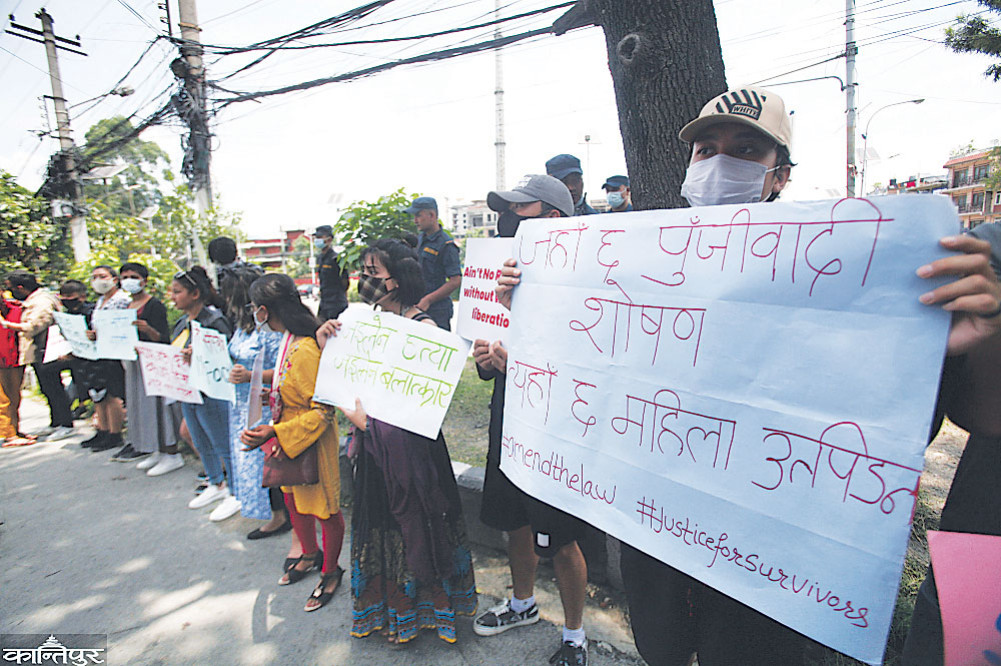
Feminism opposes the objectification of women's bodies by the neoliberal economy and challenges the tendency to portray women as objects of consumption.
We use Google Cloud Translation Services. Google requires we provide the following disclaimer relating to use of this service:
This service may contain translations powered by Google. Google disclaims all warranties related to the translations, expressed or implied, including any warranties of accuracy, reliability, and any implied warranties of merchantability, fitness for a particular purpose, and noninfringement.
Neoliberalism is a political and economic theory. It has been widely discussed and criticized worldwide. Neoliberalism is a theory that prioritizes free markets, privatization, reduced government roles, and open international trade.
This theory has become globally influential since the 1980s, especially as developed countries popularize it. Scholars have different views on
neoliberalism. Some consider it an effective tool for economic development. Some see it as a principle that promotes social inequality and exploitation. American economist Milton Friedman in his book 'Capitalism and Freedom' claims that free market system brings efficiency, innovation and overall prosperity.
British economist and theorist Frederic Hayek, supporting Friedman's ideas in his book 'The Road to Serfdom', emphasized the importance of reducing government interference and prioritizing individual freedom. But critics of neoliberalism claim that it increases inequality, exploitation and social insecurity.
According to British theorist David Harvey, neoliberalism has increased economic inequality by centralizing wealth and power in the wealthy class. Feminist activist Silvia Federici has emphasized that neoliberalism has intensified the exploitation of women's labor, especially care and reproductive work. She emphasized that neoliberal policies have strengthened the patriarchal control over women's bodies and labor, and especially through privatization, the responsibility of caring labor has been transferred mainly to women.
In the last few decades, the influence of neoliberalism on the economic policy of the government of Nepal is evident. The influence of neoliberal principles has brought many changes in Nepal's economic policy making. In Nepal, many public sector industries were privatized after the 1990s due to economic liberalization policies. Like
: Nepal Telecom Company and government owned institutions in agriculture sector were privatized. It is clear how neoliberalism is flourishing in Nepal by limiting the role of the state in areas that are directly related to the quality of life of citizens such as education and health under the market-oriented policy and giving priority to the private sector.
Alternatives to public education have been undermined by the growth of private schools. Access to private hospitals has also increased in the health sector, which has increased class inequality. Due to lack of money, the community is deprived of quality healthcare. Some have died due to lack of treatment. The situation of the Covid epidemic is a vivid example of this.
where people lost their lives due to lack of basic health infrastructure and services. Therefore, this neoliberal system seems to be in conflict with the constitutional system of the country. Where health is provided as a fundamental right. In this system, women have become more and more socially discriminated in terms of class, caste and gender.
In the same way, the export tax has been reduced in the name of encouraging foreign investment from the state level and efforts have been made to connect with the global business network. Nepal joined the World Trade Organization in 2004 with the aim of joining the world market. This is a clear example of neoliberal economic policy adoption. The neoliberal approach has opened Nepal's natural resources to foreign investment.
In the name of development and bringing in foreign investment, without studying the social environment and geographical conditions, hydropower companies, cement factories, highway construction, many tribal tribes had to be displaced from their slums. Such development projects often ignore prevailing land rights, leading to loss of livelihoods for indigenous peoples.
Similarly, colonization by multinational companies in our Raithane agricultural skills, seed production has led to a decline in our traditional seeds and produce. Due to the open market policy, the products produced by the local farmers have not found a market. Our food sovereignty is under attack. What we eat, how we produce it, and the quality of our products and food are determined by the neoliberal economic system.
Labor laws have been reformed to bring flexibility to employment and the labor market. Large companies inside and outside the country have made it easy for workers to work without ensuring a living wage and social security, which has made workers insecure. Due to the profit-oriented economic system, how to keep the wages of the workers low under various pretexts and avoid accountability in case of any accident during the work, the businessmen have a strategy which is supported by the policies and laws of the state.
Women's oppression and rights
Neoliberalism, which emphasizes market-oriented policies, privatization and minimizing the role of the state, has created new challenges for women and women's rights in Nepal. This system is classifying the society through unhealthy competition, creating the notion that 'those who can do it' without a deep analysis of historical differences. Analyzing its impact from a feminist point of view, it was seen that it had a profound impact on women's labor, social structure and efforts for equality.
Economic liberalization following the implementation of neoliberal policies has given women the opportunity to enter the labor market, but they are often confined to low-paid, temporary and insecure jobs. According to the Nepal Labor Force Survey 2017/18, 84.65 percent of total employment is based on informal labor, of which 90 percent are women.
Domestic work and care work are still considered invisible and worthless. Neoliberalism has commercialized such labor, but it seems to have failed to address it fairly. Women are exploited in the dual roles of careless domestic labor and cheap labor outside the home. So this system is based on the politicization of cheap labor.
Neoliberalism frames women's empowerment in terms of personal choice and economic freedom, which may give the impression of empowerment on the surface. However, it ignores the structural barriers women face, such as gender violence, systemic inequality and lack of access to resources. Thus, neoliberal ideology limits women's empowerment to market-based solutions (eg entrepreneurship), but fails to address the root problems of inequality.
The wealth of the world's richest people has grown enormously, while the living standards of the poor have not improved significantly. For example, according to Oxfam's 2021 'Inequality Kills' report, during the Covid-19 pandemic, the wealth of the world's billionaires has increased by trillions of dollars, but the poor have been pushed further into poverty, affecting women the most.
Therefore, it cannot be imagined that women's rights are guaranteed in a neoliberal economy. Feminism opposes the objectification of women's bodies by the neoliberal economy and challenges the tendency to portray women as objects of consumption.
Political activist Angela Davis has criticized neoliberalism for perpetuating economic and racial inequality, which disproportionately affects marginalized women in particular. Neoliberal policies have undermined women's rights to education, health, employment, land and housing while undermining public services and social protection, exacerbating poverty.
Feminist movements have been advocating for the social, economic, and political rights of marginalized communities in the face of these challenges. Like
, there are struggles around the world for access to reproductive health care, ensuring rights to labor, bodies, and identity, and ending racial and class discrimination. However, neoliberalism is trying to weaken the women's movement. Because it prioritizes individual success and competition and ignores collective struggle.
places power in the hands of a limited number of people, is market-centric. Profits are made through cheap labor and other resources, fueling inequality. It also negatively affects less developed countries like Nepal geopolitically.
In this situation, it is necessary to document, analyze and analyze the impact of the neoliberal economy on the marginalized communities from the community level by raising political awareness and build a debate from a feminist perspective in Nepal. Along with this, policy advocacy and movement to end this system by finding an alternative solution is the need of the day.