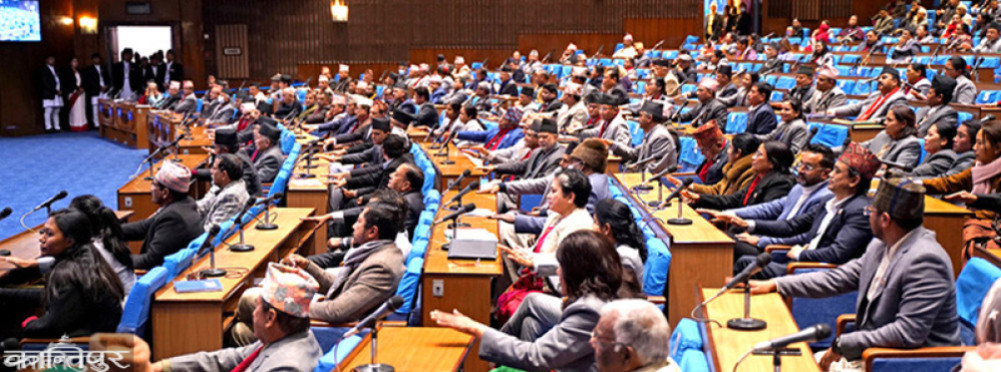
Nepalese people have been fighting for democracy, prosperity and equality for generations. But the deep vicious cycle of changes always failing, people coming back to the streets, changing again and failing again has created despair.
We use Google Cloud Translation Services. Google requires we provide the following disclaimer relating to use of this service:
This service may contain translations powered by Google. Google disclaims all warranties related to the translations, expressed or implied, including any warranties of accuracy, reliability, and any implied warranties of merchantability, fitness for a particular purpose, and noninfringement.
Assessing the results of the recent US elections, 2024 Nobel laureate Daron Ekemeglu has discussed that the Democratic Party suffered a major defeat because it looked only at the interests of a privileged limited elite and neglected the interests of ordinary citizens. According to his analysis, democracy should bring about common prosperity, citizens' voice, expertise-based administration and effective public service, but the past American administration failed in all these standards.
How different is the situation in Nepal?
The results of a citizen survey conducted last November by an organization called Sharecast Initiative Nepal are mixed. Government service delivery has improved in the last five years, but the economic situation has worsened and dissatisfaction with the federal government and political parties has been reported. 68 percent of the participants are of the opinion that the direction of Nepalese politics is wrong, while 42 percent said that the political leadership is weak. 30 percent said they have decreased confidence in the federal government. Let's look at some long-term results. Looking at the 'Worldwide Governance' indices published by the World Bank, compared to 1996, Nepal's achievements in citizen voice and accountability, political stability, government effectiveness, regulatory quality, rule of law and corruption control are the same or have decreased in 2023. In the past 27 years, Nepal's index on government effectiveness has dropped from 30 to 27.
In a country where economic growth is slow, more than a quarter of citizens depend on remittance income from foreign employment, unemployment and poverty are significant, and few people have access to economic opportunities, shared prosperity is only a dream that adds to the despair. Informal organizations at the community level are beset by party politics. The administrative apparatus has become an apparatus that enjoys the proximity of power centers, not a group of experts. Even though the help of IT has brought some relief to the customer, the voiceless, marginalized, marginalized, remote citizens are deprived of getting quick and quality services. This is an overall commentary on existing depression, not unlike Akeglu's analysis of American depression.
' Depstate' role
There is currently a discussion of constitutional amendment. Before entering into its debate, it is also necessary to remember the negative role of the Nepalese 'Deep State' in the implementation of the constitution and the failure of political changes.
The Constitution of Nepal was released on 3rd October 2072. After the Great Earthquake in the year 2072, when there was widespread disillusionment with the then government and political parties, this constitution was issued without consultation and dialogue at the highest political level. To which, especially the Madhesh parties and tribal identity groups protested. This constitution was also called the agreement document of the political powers of the time and was often criticized by all parties. The Maoists voted in favor of documenting their opposition points.
This constitution reinstated the Interim Constitution of Nepal, 2063 which was a more popular constitutional practice among new political forces including Maoist, Madhesh, tribal identity parties. Also, in search of a solution to the 2062/63 people's movement, people's struggle and previous armed conflict, the interim constitution brought republicanism and secularism and made the people sovereign.
The people's movements of the past seven decades, class, regional, ethnic, gender struggle and as a result of the commitment and continuous people's struggle for achieving democracy, the Constitution of Nepal, 2072 was able to be issued through the Constituent Assembly. This constitution proclaimed a secular, federal inclusive republican state. However, some of the basic provisions of this constitution have not yet been implemented and the transition period continues. As per Article 56, special protected areas have not been created. There are many ambiguities in the Schedules of the Constitution which are yet to be clarified. The reports of administrative commissions and high-level committees on state restructuring have not been implemented and are still in the process of improvement.
It cannot be said that political stability has come after the completion of two periodic elections. The pace of change in the federal government explains this, due to which the state governments have also been dissolved and changed. The Federal Civil Service Act, the Federal Police Act and the relevant laws of some important sectors have not been issued yet.
On the other hand, political cultural distortions exist at the federal, state and local levels. Political parties blame each other but are not honest in introspection. Parties do not practice internal democracy, do not accept pluralism. They don't choose party representatives from the people's level (primary elections), but they want to attract the people to them by talking about the amendment of the constitution. On the basis of mutual identity and cooperation and coordination, the federal system of governance could bring rapid economic and social development, common prosperity and ease and effectiveness in public service and expertise could also be developed at the local level. But for the past nine years, after blaming each other, disharmony and running an administration driven by vested interests, and the pessimism of the people deepened, it seems that the political parties are trying to win the hearts of the people by discussing the amendment of the constitution. That is, without taking measures to solve the behavioral (attitudinal) defects of the implementation of the constitution, the amendment of the constitution has tried to give a solution to these problems.
Nepali people have been fighting for democracy, prosperity and equality for generations. People's struggles and agitations have been brought to a conclusion. But the deep vicious cycle of changes always failing, people coming back to the streets, changing again and failing again has created despair. Before amending the constitution, it is necessary to find its cause, it is necessary to find an answer to those selfish tendencies, which have not allowed any change to be successful.
Bureaucracy sometimes called (and proud of) permanent government, business houses, political persons with the mentality of not contesting elections or otherwise defeating the power of the people, civil society working in the 'nexus' of interests, some members of the media and people who want to benefit from sensitive geopolitics can be called unconstitutional selfish 'deepstate'. In 2016, Mike Lofgren called such a self-interested group the "Deepstate" in order to defeat Barack Obama. Trump of the Republican Party in America is like this
He succeeded in becoming a favorite candidate of the common people by opposing the 'Deep State'. The changes in India, Sri Lanka and Bangladesh were also against the grain of the 'deep state', even though the protagonists and anti-heroes were from different backgrounds. Panchayat Prime Minister of Nepal Surya Bahadur Thapa used the term 'underground gang'. After 2063/64, Prime Minister Girija Prasad Koirala often expressed doubts that the 'Grand Design' would not erase the changes. This apprehension is also found in the statements of the existing political leadership.
seems to be a common example, but even after 9 years of the implementation of this constitution, some officials of the provincial government are still in a state of 'wait and see' that federalism is being abolished. He expresses that he has done so with the understanding of an informal order from somewhere above. The main reason for the confusion and confusion regarding the implementation of the constitution is not only the weakness of the political leadership, but also the fear of the erosion of the power of the elite class and the unconstitutional negative activities played by the 'Deep State'.
Discussion of constitutional amendment
One of the main points of the seven-point agreement reached by Nepali Congress and CPN-UML to form a joint government on June 17, 2081 is to amend the constitution for political stability. There has been no concrete progress in this regard in the past 6 months and recently the Prime Minister has stated that the constitution will be amended after the next general election after the majority in the National Assembly. Although it is seen that their preparations and understanding are different within the two ruling major parties, there are also opinions that do not differ on the surface.
There is also talk that a working group of constitutional experts should be formed to review and take suggestions. The discussion of political stability in the circles of the ruling parties basically points to the need to increase the limit of the 'threshold' used for the proportional election system and to improve the federal republic form of the state and make it less burdensome. Sometimes there is a discussion that secularism and republic should be reviewed. Reforming the electoral system from fully proportional to full 'first come first served' system and change of mixed percentage and transparency of election expenses are also under discussion.
When discussing the context of the constitutional amendment debate, two opposing demands should also be kept in mind. Various monarchist and Hindu parties including the RPP want to return the constitutional monarchy and Hindu Rajya and want to abolish federalism. Madhesh parties and identitarian forces are angry with the existing limited use of federalism and want the use of joint government in the Union and full autonomy in the provinces and want to change the delimitation and nomination of the provinces. Dalits and women's rights activists have their own demands.
CPN-Maoist Center, the main partner of the 2062/63 mass struggle and mass movement, had a different opinion when the 2072 constitution was promulgated. The Maoist executive wants to amend the constitution according to its own fundamental ideas about the use of presidential system, fully proportional electoral system, federalism and socialism. The National Independent Party has a distinctly critical view of this constitution. Needless to say, some leftists and other political forces have their own demands that have not yet been included in this constitution. It is easy to remember that Nepal, which has a sensitive geopolitics, had to bear external interest during some important internal changes.
In the above perspective, the proposals to amend the constitution should be seen in the light of the current situation of the implementation of the constitution. A group of independent experts and civil society facilitators can review various aspects of the implementation of the constitution and create a 'status assessment paper' and bring it to the public debate. Also, they can identify the negative characters and tendencies of the 'Deep State' and protect them from their influence and give suggestions for the implementation of the Constitution according to the spirit and letter. Expanding the scope and responsibilities of different levels of governments is not difficult to complete quickly, the will of the political leadership is enough. The political leadership can easily pass the main laws (including the Federal Civil Service Act) regarding federalism and the implementation of the constitution under consideration in the federal parliament.
If the implementation of the constitution can be speeded up, the awareness of the need for amendment will also become stronger. But for that, it will be easier to write a draft of the amendment if it is possible to identify the concrete nature of the proposed amendments through dialogue, broad consensus building. If a debate can be held on the necessity of implementing and amending the constitution by starting a broad dialogue at the people's level, the morale of the 'Deep State' or unconstitutional and undemocratic forces will also weaken.
According to the rule of law, a fair and independent judiciary, emphasis on transparency and accountability of public institutions, and inclusive character of institutions can be built, and external interventions will naturally be abolished. The implementation of the constitution should not wait for the amendment, it needs to be realized. By sitting together with the leaders of all political parties and various aspects of the society with mutual trust in a transparent manner and discussing the agenda of the constitutional debate, the mutual doubts and conflicts lurking under the carpet will be resolved through peaceful dialogue. Such a dialogue will facilitate the rest of the work of transitional justice as well as find solutions to the challenges faced at the political/administrative level of the implementation of the constitution and will also assist in the work of amending the constitution by setting the agenda.
But if it is discussed only at the political leadership level, if the basic demands of the people are not addressed and if the amendment process is started in haste, it will be difficult to amend the constitution. It cannot be implemented again. In serious debates such as the issue of constitutional amendment, it will be easier if the political leadership takes the role of a facilitator and listens to the main issues of the conflict.