The authority has the constitutional responsibility to investigate and treat corruption-related activities, i.e. to file a case.
We use Google Cloud Translation Services. Google requires we provide the following disclaimer relating to use of this service:
This service may contain translations powered by Google. Google disclaims all warranties related to the translations, expressed or implied, including any warranties of accuracy, reliability, and any implied warranties of merchantability, fitness for a particular purpose, and noninfringement.
On October 12, 2081, a discussion was going on regarding the amendment of the Abuse of Authority Investigation Commission Act in the meeting of the State System and Good Governance Committee of the House of Representatives. At that time, some MPs of the committee questioned Prem Kumar Rai, Chief Commissioner of Authority, whether the donation of land by businessman Meen Bahadur Gurung to the Prime Minister's party is corruption or not.
Looking at the questions asked by the parliamentarians in the said meeting, it seemed that the parliamentarians who can call the prime minister to the parliament and question them either do not know about their role or rights or are unable to do so. The parliamentarian who is in charge of making or amending laws and saying 'this is corruption' and 'this is not corruption' was seen to be unaware of his own power.
When the situation of the policy maker became like this, its effect also affected the common people. Which some statistics show. In the financial year 2080/81, 26 thousand 918 new complaints were filed with the Authority. On the other hand, only 11,476 complaints were registered in the National Vigilance Center headed by the Prime Minister from the financial year 2059/60 to the financial year 2077/78. Details for subsequent years are not available on the Centre's website. According to unofficial information, there are currently about a thousand more complaints in the center.
Authority in the form of Constitutional Commission and National Vigilance Center under the direct supervision of the Prime Minister are active in controlling corruption related activities. The Prevention of Corruption Act 2059 empowers both bodies to receive complaints about corruption in public bodies. But the majority of citizens also have the understanding that the authority is only responsible for controlling corruption and complain about it. They either don't know or don't believe that the Prime Minister has the prime responsibility for corruption control.
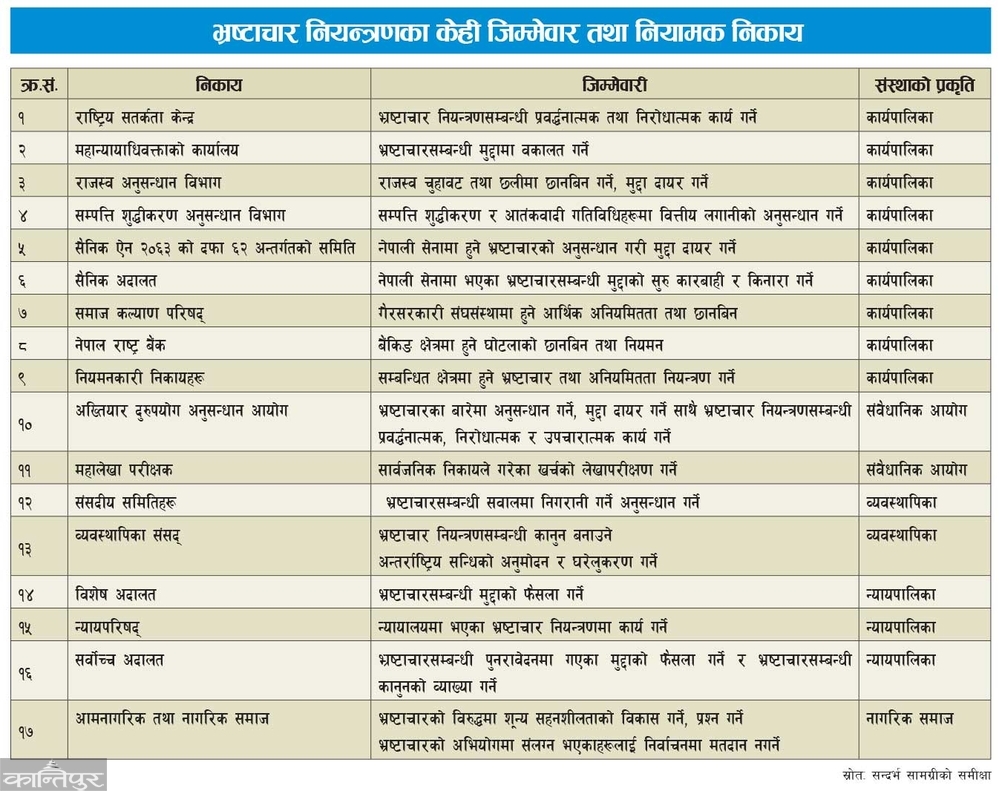
According to the understanding of the policy makers, the available data and the general trend, the understanding that the authority is responsible for corruption control has become common. But is corruption control the only responsibility of the authority?
'Empowerment' of corruption control
There is a widespread perception that corruption control is the responsibility of the authorities in Nepal. This has overshadowed the role of the real responsible bodies and leadership for corruption control. It is intended to make the authority a 'comprehensive' institution, which takes the view that if the authority investigates and files a case, it is corruption, if it does not find it, then it is not corruption.
This approach has neglected the responsibilities and duties of the Prime Minister and the National Vigilance Center, Asset Laundering Department, Revenue Investigation Department, Taluk Ministries and other regulatory agencies and offices under him. It has ignored the role of Parliament, Courts and Civil Society.
This has had some serious impact on corruption control. First, everyone is forgetting the reality that the primary responsibility for controlling corruption lies with the head of the relevant office or agency. Secondly, the prime minister, ministers and other responsible officials have stopped paying attention to the general fact that corruption control is within their responsibilities and obligations. They seem to be unaware that the rise of corruption is their 'incompetence'. Thirdly, the role of civil society and mass media in working against corruption has also been reduced.
As a result, no matter how much financial misappropriation and corruption they have committed, a comment has been made that a person who can avoid the investigation and prosecution of the authorities is a 'virtuous' person. An understanding has developed that it does not matter if one's colleagues, family, society, neighbors, the head of one's office or anyone else knows about corruption, one can avoid the authorities. "Decentralization" of corruption control is fatal in terms of overall corruption control. It has developed corruption from an 'incident' to a 'culture'.
In fact, the authority is not and cannot be the only body fully responsible for corruption control. The authority's resources, human resources, institutional capacity, and scope of legal rights are limited. Compared to the authority, the capacity and responsibility of the executive, judiciary, legislature and civil society is immeasurable.
When these parts of the state 'swang' as if they don't know their capabilities, a constitutional commission has to take a beating. As a result, the Government of Nepal, Prime Minister, Ministers, Secretaries, Heads of Departments or Heads of other agencies, Legislature Parliament, Parliamentary Committees, MPs etc. are forgetting their responsibilities and responsibilities. Such agencies are indulging in the authorization of corruption control. The country is falling into the quagmire of corruption.
shared and collective responsibility
Currently, discussions are going on in the legislative parliament about the amendment of the Prevention of Corruption Act and the Commission for Investigation of Abuse of Authority Act. There can be no disagreement that the authority should be strengthened through the amendment of these laws to control corruption. Legal strengthening of authority is an essential prerequisite for corruption control. However, this is not all. Authorizing corruption control cannot control corruption in the country. For this, other bodies should also play an effective role.
The countries that are considered good from the point of view of corruption control do not depend on one institution to achieve success in corruption control, but the combined efforts of all. Although the role of the Corrupt Practices Investigation Bureau in Singapore's corruption control is important, it is not the result of the Bureau's singular activism.
Singapore's political will, strong justice system, civil society and mass media have made corruption control possible. Similarly, in Denmark and Finland, which are known as the countries with the least corruption in the world, the role of civil society and media is important along with other government bodies in addition to the Corruption Control Commission. Also in India, the Central Vigilance Commission established in 1964 is a government agency under the executive.
Looking at the international experience, it seems that the three aspects of corruption control, promotional, preventive and remedial methods should be given equal importance. However, the authority has three types of constitutional responsibility for corruption control. However, the prime responsibility of the National Vigilance Center under the Prime Minister is in promotional work. It is the responsibility of the Legislature, Parliament, Parliamentary Committees, and the Ministry of Law and Justice to create strong laws to create an environment where corruption does not occur as part of preventive actions.
The government of Nepal should build an institutional, political and systemic system that does not allow corruption. But this did not happen. For example, the constitution promulgated in 1972 removed the responsibility for improper actions from the authority's jurisdiction. But even till 2081, no law has been made about who is responsible for investigating and recommending action regarding unfair actions.
How many unfair actions have happened for almost a decade? Those who commit such improper acts are unimpeachably outside the ambit of action. It is the responsibility of the Executive and the Legislative Parliament to enact laws on this matter immediately and enhance good governance. But when both the bodies fail in their responsibilities, unfair actions are increasing. Despite being widely discussed, the law regarding 'conflict of interest' has not been enacted.
In order to promote morality in the country, the Office of the Prime Minister and the Council of Ministers had prepared a draft of the National Moral Policy in 2074. But so far the policy has not been passed and implemented. The annual report of the Authority, the Auditor General reaches the Parliament through the President. But there is no discussion in the parliament. None of the Prime Ministers seem to have any interest in enhancing the effectiveness of the Asset Laundering Department, Revenue Investigation Department and other regulatory bodies. If it is found that the executive head is not paying attention to such actions, the parliament is not able to fulfill its role by calling the parliament and demanding its accountability.
Similarly, the court also has an important role to make the work of corruption control effective. If we look at the trends of the courts in the past, it seems that corruption cases are less in the priority of the courts. The common people are also voting and electing people who are said to be involved in corrupt activities. These and such facts are the result of the collective weakness of not only the authority but also the executive but also the legislature, the judiciary and the citizens.
In the end, even though there is a discussion from the point of view that corruption has increased due to the weakening of authority in Nepal, the fact that the authority is not the body with the overall responsibility of corruption control has not been noticed in such debates. The authority has the constitutional responsibility to investigate and treat corruption-related activities, i.e. to file a case.
It is not possible to control corruption with only such actions. In other words, just as no person can be healthy just by building a quality and well-equipped hospital, for this, a person's own health-enhancing diet is necessary. In the same way, corruption control is not only by increasing the quality of official 'hospitals', individual governments and related agencies that need quality health must develop strong mechanisms and commitment to prevent corruption.
It is not only the responsibility of the authority to adopt methods and procedures to prevent corruption, but it is the responsibility of the executive, judiciary, legislature and civil society. The task of corruption control can be completed only through the joint and collective efforts of all such agencies.

