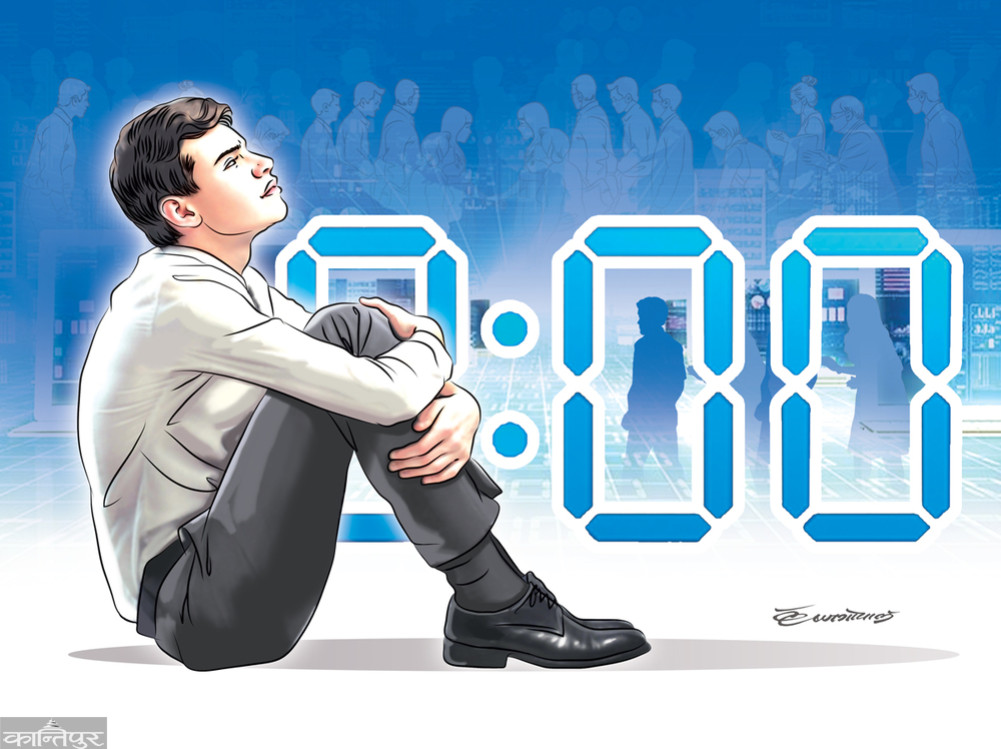
Even in a society that is considered developed, democratic and capable of delivery, technology and networks on people's patienceThere has been an uproar, the whole society is becoming intolerant, angry and disappointed
We use Google Cloud Translation Services. Google requires we provide the following disclaimer relating to use of this service:
This service may contain translations powered by Google. Google disclaims all warranties related to the translations, expressed or implied, including any warranties of accuracy, reliability, and any implied warranties of merchantability, fitness for a particular purpose, and noninfringement.
What we want, when we want it, if it is not available at that time, our blood boils. While patience is a virtue, why is impatience increasing in people?
In a survey of 2,000 adults in the UK and Ireland, three-quarters found that social media and 'home delivery' have increased their intolerance of general hassles and inconveniences. Many reported being irritated by having to stop at a traffic light for more than 25 seconds. Despite growing impatience, 95 percent said being patient was good for them. However, some people have stopped even considering patience as a virtue.
Patience is also a characteristic and psychological trait. However, technology has increased the belief that people can get everything they want instantly when they provide instant communication, entertainment and all the necessities of daily life. And, even though it is a little late, Kanparo has been making heaters. Technology has also taken away attention. Let's not fix our eyes on any material or object for too long. Before, how long did you wait to watch news, serials or movies on television? Advertisements were also viewed in their entirety. Now the stories of the social media are the same. The video has not been posted - it's too late to see how many likes and comments it has received. In a 2015 study by Microsoft, it was found that the average human attention span is broken in 8 seconds.
Earlier, Gorkhapatra was reached after several days in the village. Then the SLC result can be viewed. Today, almost all of us are readers of headlines. A genre has been born in journalism, 'glance journalism'. One look, done! Assessing the growing impatience of people, technology companies have created fast service applications such as Twitter and Tik Tok that can hold limited characters and audio visuals. Doing so would have a double benefit. One, the audience would watch more of the content, meaning the views would increase. Second, the entire content is viewable. The effect of this on journalism is that the trend of not reading and watching the latest has increased. A 1,000, 2,000-word article or a half-hour investigative report will not get an audience compared to the amount of resources and effort that goes into it. Instead, a 30-word tweet became more likely to engage.
The digital information economy is exceptionally 'click-based', i.e. based on audience-engagement. Hence, the focus of the technology company is to attract as many audiences as possible. If the digital information economy were subscription-based, both the present and the future of compelling articles and investigative news could flourish. Due to technology, there seems to be a change in the understanding of time or generations. Generally, a generation means about 20 years or the time that one person can give birth to another person. Now every new generation seems to change. I was chatting with my niece 'Jen-ji' who recently completed class 12. She said to her sister who studied in the class before her, "what to do with old people"!
According to a study published in Harvard University's Science in the News in 2018, the 'notifications' we receive on social networks satisfy our immediate gratification (instant gratification) desire. In the said article, the scholars have concluded - 'Social networks provide us with unlimited virtual social stimuli. And, from that, the chemical (dopamine) that is produced in our brain when we eat sweet food, when we have sex, it flows in excess. It has an effect on the work, etc. An imbalance of dopamine leads to mental and physical problems such as depression, Parkinson's disease and drug addiction.
Pakistan's renowned physician Sahajad Wasim writes about social media and impatience—'Those who use social media a lot, (especially teenagers), are likely to show symptoms of extreme impatience. According to the latest statistics, people aged 16 to 64 years worldwide spend an average of 6 hours and 40 minutes on a digital screen every day. The 'Gen-G' generation and the youth of developing countries are further ahead in this. American youth spend 7 hours 4 minutes a day on digital screens, while South African youth spend 9 hours 24 minutes. Such period of 'Gen-G' youth is nine hours on average. Some people are addicted to mobile phones, which can be considered as 'digital addicts'.
Official data on this is not available in Nepal. What can be estimated is that our situation may be similar to that of developing countries as a whole. I asked journalism students some time ago, most of them said they spend 8 to 10 hours on mobile. Some told that such time reaches up to 12/14 hours.
According to Wasim, regardless of age, the excessive and continuous consumption of the network develops in the user a mindset that everything is under the control of his finger tips. From the virtual world, his brain learns that everything is under control and that it is normal. Social media is not the only responsible behind the development of such mental thinking. Faster computers, mobile phones, other smart devices, prompt home delivery services as well as artificial intelligence (AI) that operate on prompts are also to blame. Such gadgets, apps and platforms have established the mental understanding that everything is under the control of the individual as the 'New Normal'.
Ramesh Sitharaman, professor of computer science at the University of Massachusetts in Amherst, says - 'Because modern technology depends on people's immediate gratification, it has taught us to expect things quickly.'When he analyzed the habits of 6.7 million Internet users, he only waited 2 seconds for the content to load on the webpage Look ready. After waiting 5 seconds, 25 percent and after 10 seconds half of the participants disappeared. He concludes that advances in technology affect our patience and impair our ability to control impatience and tolerate delayed gratification. The
technology has made the common people so impatient, while those involved in politics have been filled with 'hoothooti' that perform miracles every day, but the reality is not under their control. His impatience to remain relevant in the public space has so gripped him, that he has to play a strange and unseasonal instrument at times. That is why even the so-called good leaders have gradually transformed into scumbags and populists. The populists are baking the bread of politics in the same technology-infused impatience and despair. Hence, populism and right-wing hegemony are not only prevalent in underdeveloped, pseudo-democratic and under-delivered countries. Even in countries that are called advanced, democratic and capable of delivery, it is becoming increasingly popular. That is, technology and basically social media are in the driving seat of globalizing populism and right-wing wave.
Even in societies that are considered developed, democratic and capable of delivery, technology and networks have attacked people's patience. The whole society is becoming intolerant, angry and hopeless. In the case of Nepal, there is no room to escape by giving the blame to technology. The delivery of the state is slow. Public trust in institutions has been eroded by partisanisation. Unemployment is high. Moreover, technology has added fuel to the fire. Even with three/four degrees in the hands of the youth, the type of job is not the same. They often consume social media heavily and make it their primary source of information. In the virtual world he seems to have everything under his control, but the real world is quite the opposite. This has increased their collective impatience. In such a situation, it is natural that public opinion is attracted and agitated towards populist and inflammatory expressions.
It is true that modern technology and convenience have assaulted our patience, which is constantly influencing our character, behavior, economic and political decisions and worldview. Its mitigation journey can be long and patient. On the one hand, the state should be able to instill confidence in delivery, job creation and institutions. On the other hand, judicious use of technology and basically social media should be increased. State control and regulation of technology and networks can be counterproductive. Instead, it is effective to develop self-regulation and self-control in its consumption.
For this, first of all, it is necessary to understand that over-dependence and extreme consumption of technology is a problem in itself. Second, families, especially children, can be taught other things than to expose them to technology from an early age, so that they do not become 'digital addicts' in the future. A third solution could be to systematically reduce internet and technology consumption. This can range from slowing down the internet to target groups, times or making apps only run for certain periods of the day. However, in a democratic and capitalist society, such work will not be easy and without criticism. Because the tech giants who have made the instant gratification of people the mantra of their business do not allow this, nor do we who are accustomed to modern fast technology have the patience to run slow internet or apps again. That is, we are trapped in a vicious cycle of technology, from which there are only difficult options to escape.
– Associate Professor of Journalism at Tribhuvan University, Pandey is a researcher on journalism, technology and communication.