Which image of development can be pointed out as an example of a real change in the social and economic life of Nepalese?
We use Google Cloud Translation Services. Google requires we provide the following disclaimer relating to use of this service:
This service may contain translations powered by Google. Google disclaims all warranties related to the translations, expressed or implied, including any warranties of accuracy, reliability, and any implied warranties of merchantability, fitness for a particular purpose, and noninfringement.
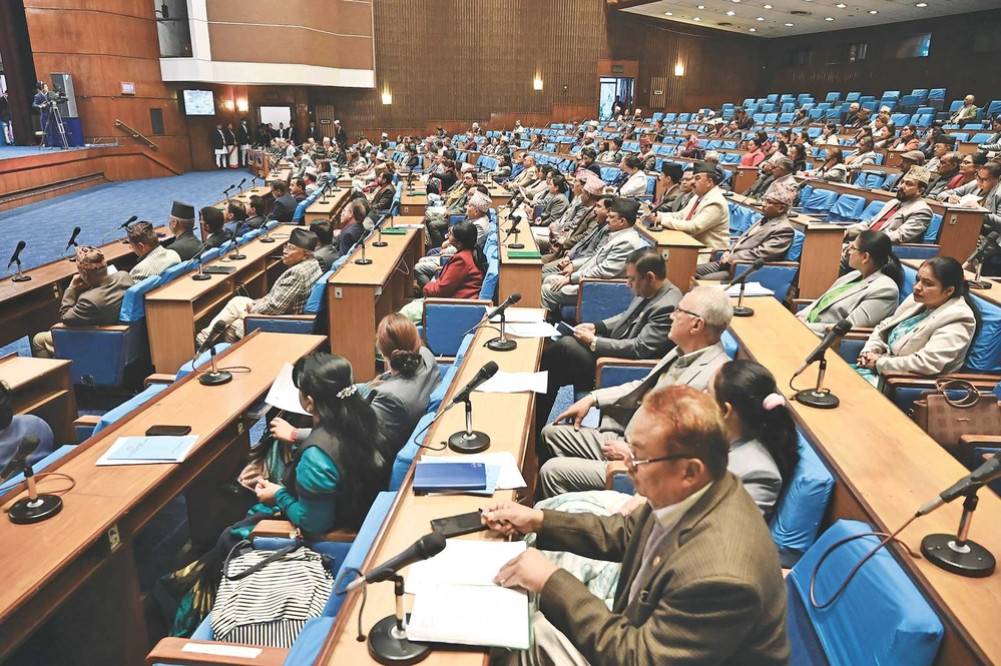
With the beginning of the parliament session, will the leaders in the parliament do something in the minds of the people this time? The hope is awakened. All the leaders of all the parties have joined hands in the political development of the country according to their respective groups. The Nepali people are clear about this. People understand that Nepal's situation is complicated. In such a situation, it is not easy to run the government. Although the country is small, the size and scope of the government is many times bigger than the country.
It starts with Prachanda. The personality of Prachanda, the chairman of the Maoist Center of the Communist Party of Nepal, who remained as the supreme commander of the people's war fought for a decade, is unfathomable. After the dissolution of the people's war, with the intensity with which his personality has become dynamic in the power politics of Nepal, it should be seen in a positive way. Baburam Bhattarai, his stalwart ally, was sharp in scholarship but could not get involved in politics.
Mohan Vaidya, who is considered to be the top personality of Maoist ideology and politics, who behaves like a guru himself, is lonely in his old age. There are many other such examples. However, Prachanda's dynamic personality is constantly in flux. What kind of political moves does he make? No one can say. However, everyone who knows him is convinced that he is no longer willing to go against the current political system.
The dissolution of the decades-long armed movement with the slogan of economic, social and political transformation of Nepal took place after a mutual agreement between Nepali Congress Chairman Girija Prasad Koirala and Maoist Chairman Prachanda. By the time of the comprehensive peace agreement, the mutual and political relationship between Congress President Koirala and President Prachanda was intense.
Their mutually agreed comprehensive peace agreement had the support of all the important political forces of Nepal. Through the mutual cooperation and understanding between the political parties, the hope of faster development of the country was raised among the people.
Prachanda, who has had the good fortune to be the executive head of the nation three times, is not in a position to stand without the heat of power. His mind, which had started to waver since the first election for the Constituent Assembly, did not stop wavering even after the creation of the constitution and two elections.
A decade has passed since the promulgation of the Federal Republic Constitution. Sher Bahadur Deuba, Pushpa Kamal Dahal Prachanda and KP Sharma Oli are still moving in and out of power while overshadowing the new generation. However, they have not yet done anything for which they should be remembered.
After the country entered the federal republic, the heat of the people's war led the party led by Prachanda to form a government on its own. However, in recent times, it has not been able to stand on its own. Although the rebellion was successful, some of the rebels who were deprived of the achievement they sought and chose went abroad and some went on the path of idolatry. Even though by quarreling with the supreme leadership, Dr. Only Baburam Bhattarai managed to become the Prime Minister of the country once.
There is no doubt about it – Prachanda has been trying to balance Nepal's politics from time to time. During the People's War, Maoist rebels bombed the vehicle of Sher Bahadur Deuba, the current chairman of the Nepali Congress, in the Far West. Nevertheless, Prachanda's 'chemistry' with Deuba has not deteriorated even now. Prachanda's relationship with the then General Secretary of UML, Madhav Kumar Nepal, has always been intimate, whether he was in power or not. However, when hearing the word "republic", it seems that both "physics" and "chemistry" do not match between UML President and Prime Minister Khadga Prasad Sharma Oli, who says that "one cannot reach America by riding a bullock cart". Both the leaders have the same lust for power and the strong desire for heat is evident. However, it does not mean that the two leaders will not be in a position of negotiation to arrange the handover of power.
Prachanda is now associated with the movement of various named parties. He also stands up to the leaders who have the title of 'cooperative thugs' and also stands in support of the movement of the victimized people who have been cheated by the cooperative thugs. He wants to strengthen his grip on politics by digging holes in the Nepali Congress, the oldest party in the country, and the Communist Party, UML, which he considers to be the strongest. Congress always wanted to be established as the promoter of comprehensive peace agreement, UML adopted the 'gaon fark' formula of panchayat-style development and built view towers in villages. If not, amazing Kashmir, amazing Nepal.
After the first election of the Constituent Assembly, there is no change in this scenario. It was natural for Prachanda to become the elected Prime Minister as the chairman of the party that got the most votes. In the politics that followed, a cloud of mistrust emerged over the 'close' relationship between Chairman Koirala and Prime Minister and Maoist Chairman Prachanda. Prachanda, who was very excited and happy with the overwhelming number of votes his party got in the Constituent Assembly elected for the first time in Nepal, started to distance himself from Koirala. He could not keep his promise of making Girija Prasad Koirala the President.
He nominated Ram Raja Prasad Singh, who raised the slogan of republic for the first time in Nepal, as the presidential candidate. It was natural for Koirala to be hurt by this, even though it was not obvious. Then, Congress against Dr. Ramraja Prasad Singh. Gave Ramvaran Yadav's candidature. Yadav won.
Singh's defeat was not only the first political setback for Prachanda, but also a lesson. After that, he could not stay in power even for nine months. When an attempt was made to remove the general who was about to retire after the expiry of his term, he himself had to step down from the post of Prime Minister. However, one of his qualities must be recognized: Prachanda did not behave reactively like the revolutionary leaders of other countries. He kept his commitment to peace.
After these events, Prachanda started to complain and enjoy multi-party politics more and more. He tried to create a storm of agitation against the then government. In order to attract the people towards the movement, he also made the country's well-known film-artist Rekha Thapa walk on the streets in favor of the movement.
The first Constituent Assembly collapsed just like that. Even when the political inclination of the people was clearly in favor of the federal republic, the inability to formulate a constitution was a kind of bad omen for the political parties. In the second edition of the Constituent Assembly elections, the Maoists did not reach the majority. However, President Prachanda remained active in the creation of the current constitution. The Constituent Assembly drafted a single constitution. The stability of the change in the country's politics was assured.
At present, Prachanda's 'command' of the 'supreme leadership' in the Maoist party seems to have been lost in the parliamentary geography, and the Maoist is very active in power-centered politics. After the establishment of the Federal Republic of Nepal, the Maoist President Prachanda has succeeded in keeping the Congress and the Maoists at bay. Prachanda, who has been the prime minister several times with the help of the Nepali Congress and the Nepal Communist Party (UML), has remained in power continuously after the dissolution of the People's War. This is his beauty.
After Nepali Congress Chairman Sher Bahadur Deuba and Nepal Communist Party UML Chairman KP Sharma Oli decided to remove Prime Minister Prachanda, it appears that Prachanda's coin will no longer be used in Nepal's changing political horizon. His own party seems to be getting lost in the thick and mysterious fog of Nepali politics. After being out of power, his voices against the new regime have become unwelcome. "What did he do?" said a politician, "In terms of achievements, not only him, but no prime minister of the federal republic has been able to bring good numbers."
A decade has passed since the federal republican constitution was issued. Sher Bahadur Deuba, Pushpa Kamal Dahal Prachanda and KP Sharma Oli are still moving in and out of power while overshadowing the new generation. However, they have not yet done anything for which they should be remembered. In other words, after the death of Girija Prasad Koirala, the era of miraculous, courageous and mighty leaders has come to an end in Nepal.
If you look at it in a subtle way, there is a lack of 'vision' in the recent leaders of Nepal. It is a different matter if it is called a 'New Nepal' vision by including the small achievements since the Rana period. If not, which image of development can be pointed out as an example of a real change in the social and economic life of Nepalese?