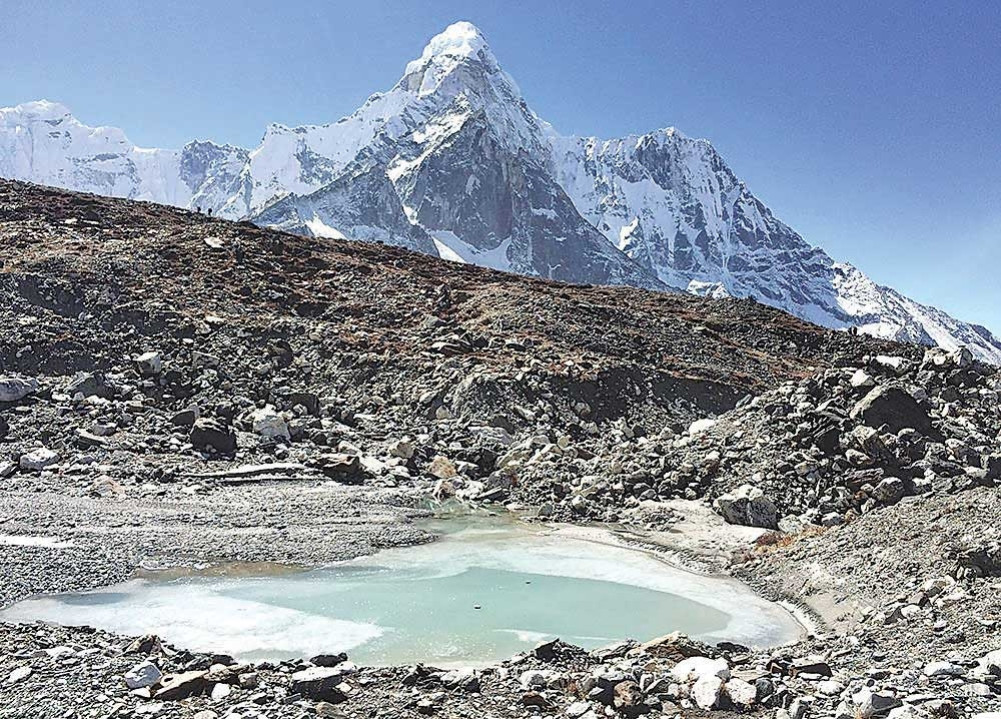
Of the 47 potentially dangerous glaciers identified, 42 are in the Koshi basin. The number and area of glaciers and the risk of breaking up have increased every year. Even unlisted glaciers can be dangerous. So it is clear that the risk due to avalanches is much higher than we estimate.
We use Google Cloud Translation Services. Google requires we provide the following disclaimer relating to use of this service:
This service may contain translations powered by Google. Google disclaims all warranties related to the translations, expressed or implied, including any warranties of accuracy, reliability, and any implied warranties of merchantability, fitness for a particular purpose, and noninfringement.
The Himalayas are one of the most dangerous regions in the world due to climate change and seismic risk. The main threats facing the region include glacial eruptions and the resulting floods, glaciation, permanently frozen soil (permafrost), melting rock ice and other climate-induced disasters.
Between 1999 and 2018, the number and intensity of large landslides in the Himalayas has increased with the melting of glaciers and permafrost. Glaciers that are larger than 0.02 km2 have received attention in their mapping and monitoring of some vulnerable glaciers, but less attention has been paid to the problem of melting permafrost and mapping and risk assessment of smaller glaciers. In addition, measures to reduce vulnerability and vulnerability, which are important for risk reduction, have not received sufficient attention.
The risk of glacier break
In the Himalayan region there is a risk of glacier breakup due to temperature rise and other reasons. Severe natural disasters occur when glaciers and ice caps melt, earthquakes, heavy rains or landslides cause dams to collapse. When the water level of the Himalayan lake rises or the ice melts inside the 'moraine' dam, the dam is weakened. A moraine is a pile of soil, sand, boulders, and rocks brought down by glaciers, which freeze and accumulate when glaciers melt or stop. When the land around the lake collapses or when an iceberg falls into the water or another glacier spills, the water pressure suddenly increases. This pressure can cause the dam to burst.
This is the reason for the recent floods in Gorkha by Birendra Himtal. Floods caused by the bursting of glaciers are called 'glacier lake outburst floods'. When the dam bursts, a large amount of water flows into the lake at once, causing a series of disasters such as floods, landslides, mudslides. It causes great damage to humanitarian and coastal structures, agriculture, bridges, roads and hydropower projects.
2024 On August 16, 2024, floods in Thame village of Khumbu region caused extensive damage to residential houses and hotels, schools and hydropower projects. Thame is also a famous tourist area within Everest National Park. The 900 kilowatt hydropower project that was damaged here has been supplying electricity to a large area including Namche Bazar.
In 1985, the Khumbu region was also seriously affected by the floods caused by the bursting of the Dig-Cho glacier. These floods destroyed hydropower projects, bridges and houses, causing huge economic and environmental damage. A devastating flood in Melamchi in 2021 destroyed the dam and other structures of the Melamchi water supply project. In 2012, a flash flood in the Seti River also caused huge damage.
These events are linked to climate change. However, the lack of necessary research and data makes it difficult to distinguish which disasters are caused by climate change. In Uttarakhand in 2021 and in Sikkim in 2023, Himtal floods killed hundreds of people and destroyed hydropower projects. These incidents have highlighted the frequent avalanches in the Himalayan region and the huge calamity it causes.
A large amount of water flowing suddenly from a glacial break in the Himalayas can trigger landslides in low-lying areas, which can cause large landslides on the right-left side of the river. A river flowing through a narrow and steep terrain like ours can be blocked by large landslides. An example of a landslide dam is the Jure landslide. In 2014, the Jure Landslide created a large lake in the Sunkoshi River, creating a panic situation in the low-lying coastal areas.
However, the lake did not explode as the water slowly drained away. Floods caused by the bursting of dams and lakes created by landslides are called 'landslide dam outburst floods'. Flash floods, debris flows and landslides can form temporary dams. This rupture process can cause huge human, physical and economic losses. Due to our topographical and geological conditions, the floods caused by the bursting of glaciers can cause multiple catastrophic disasters.
In Nepal we are talking about many reservoir power projects. Some reservoir-based power projects are entering the construction phase. If we do not take into account the impact of such avalanches during the design and construction of the project, it can lead to a bigger disaster.
The Thame (Thanbo) glacier that erupted in the Khumbu region last August was not included in the list of glaciers in the Himalayas. This lake was not included in the listing due to its small size and less than the minimum area to be classified as a glacial lake. This suggests that the inventory of glaciers should be constantly updated and that smaller glaciers may be equally vulnerable and monitored. Even small, neglected avalanches can pose serious risks. There are thousands of such lakes scattered across the Himalayas, from which there can be an equal risk.
According to a recent study, there are more than 3,500 glaciers in Nepal alone. Some of the glaciers in Tibet fall within the river catchment area of Nepal, they are equally vulnerable. With all this, about 47 glaciers have been declared as potentially dangerous. Out of the 47 potentially dangerous glaciers identified, 42 are in the Koshi basin, 3 in the Gandaki basin and 2 in the Karnali basin. The number and area of glaciers and their risk of breaking seem to increase every year, and even unlisted glaciers can be dangerous. Therefore, it is clear that the risk of avalanches is greater than our assessment.
It is necessary to reduce the human, physical and economic damage that can be caused by the multiple disasters caused by the Himalayan breakup. For this, it is necessary to adopt a multi-problem early warning system, scientific methods of risk and sensitivity reduction and the design of structures that can withstand such disasters.
Thawing Permafrost
Permafrost is a layer of soil, rock, or compacted ground that remains frozen for two consecutive years. It is mostly found in polar regions and high mountain regions. The permafrost that stabilizes soil and rock in the highlands is now melting rapidly due to rising temperatures.
This melting process weakens moraine dams and increases the risk of catastrophic glacial outbursts. Lake Thorthormi in Bhutan is classified as a high-risk lake due to permafrost degradation. Various studies have shown that areas covered by snow or ground freezing (permafrost) gradually move up, and large landslides occur in places that are frozen first.
Permafrost thawing can cause serious disasters and risks in the Himalayan region. Permafrost is permanently frozen ground or rock, which provides vertical ridges and stability to terrain. When the permafrost thaws, the rock and soil become unstable, greatly increasing the risk of landslides and landslides. The permafrost binds and strengthens the rock and soil, but when it thaws, large boulders can fall from the embankment, causing significant damage to settlements and structures below.
Also, glaciers made of frozen water are weakened, increasing the risk of glacier breakup and flooding. It also affects water flow, which further increases the risk of soil wetting, landslides and mudslides. The geographical structure of the Himalayas and the safety of local settlements can be threatened.
In the Ladakh region of India, frequent landslides and flash floods caused by the depletion of permafrost have had a serious impact on local communities and infrastructure. Permafrost thaw increases the amount of sediment in rivers. E.g. High Gegran seen in the Indus River Basin of Pakistan. High tides greatly affect the built structures in river basins. It disrupts the flow of rivers, reduces the efficiency of hydroelectric projects and endangers the safety of bridges.
Although the permafrost problem is serious, very few studies and researches have been done in Nepal. There has been little public discussion. Its condition and effects have not been assessed. Scientific studies, early warning systems and the development of effective policies for permafrost continuous monitoring and management are essential to minimize the multiple disasters that may occur due to permafrost degradation and its impact on the livelihoods of local residents.
Mitigation measures
Climate change and temperature increase will melt glaciers, ice caps, ice rocks and permafrost, the rate of melting of snow is higher than the rate of snowfall. The risk of multiple calamities is increasing in the Himalayan region and the lower regions when there is abnormal rain in the high areas where it did not rain before. A few years of events and statistics make this clear. Melting of glaciers and degradation of permafrost as temperatures rise are global problems, and halting or reversing these processes is beyond the scope of local or national efforts.
Despite global commitment and immediate action to mitigate the causes of climate change, reducing the effects of warming or climate change is a long-term challenge. To reduce the risk of glacier break-up, reducing the water level of the glaciers as done in Chho Rolpa and Imja lakes is possible in some glaciers and places, but it is not a long-term solution.
Rapidly melting glaciers have already created thousands of lakes. Hundreds of new lakes are being formed every year. Even small glaciers like Thanbo have proven to be dangerous. There are also no short-term measures to prevent permafrost thaw. Keeping these limitations in mind, policy, construction, structural sensitivity and risk management should be focused. This requires innovative risk assessments, building resilient infrastructure and community participation.
Risk is the interaction of hazard, vulnerability, and exposure. Risk reduction requires mitigation of more than one of the following: disaster, vulnerability, or vulnerability, depending on the location and situation. However, in Nepal, in the case of disasters such as landslides, flash floods, and avalanches, attention is often paid only to disaster reduction, but sensitivity and
Disaster situations are ignored. This can be a huge waste of time and resources and many of our attempts have failed. Therefore, it is equally important to focus on vulnerability reduction and disaster mitigation. They must be constantly monitored to counter glacier breakup, melting permafrost and other glacier-related threats.
Policy should be formulated to analyze changes in detail, design climate change-resistant infrastructure and prioritize disaster resilience of communities. Critical infrastructure such as hydropower projects, bridges, roads and settlements must be designed to withstand high flows and flash floods. Infrastructure planning should incorporate risk mapping and multi-disaster early warning systems to protect high-risk areas and minimize risk and damage. Combining developments in
ing technology with local knowledge can enable timely rescue and risk mitigation, which minimizes human and economic losses. Community-based disaster risk reduction is also essential. In addition, inclusion of insurance and reinsurance systems adapted to Himalayan risks can further reduce economic losses and encourage investment in resilient infrastructure. Investing in
research and innovation is equally important. Remote sensing and machine learning techniques can improve risk monitoring and probability forecasting, providing new information on glacier movement and new insights into risk patterns. Incorporating future climate scenarios into risk assessments can help policymakers and communities prepare for the uncertainties of a warming world.
The multi-disaster caused by climate change in the Himalayan region is not only a problem of one country, because if the Tibetan glacier melts or the ice lake breaks, it can affect Nepal and India as well. There is a need for agreement between the countries of the Hind Kush region to inform about the findings of research conducted in the Himalayan region, to provide related data and to exchange successful practices in disaster risk reduction.
All countries should cooperate in this area and share information on glaciers crossing borders. Such collaboration will enable comprehensive monitoring of the threat posed by climate change in the Himalayan region and effective preparation for potential disasters.
By learning lessons from past disasters, developing and using modern technologies and appropriate policies, and encouraging regional cooperation, we can pave the way for sustainable development in the Hind Kush Himalayas. It is a universal requirement not only national and regional priorities to reduce the conservation of this risky area and reduce plural changes.
- Sharma, a co-controlled engineering, are working on the movement of gender change from climate change in Nepal and Bhutan.