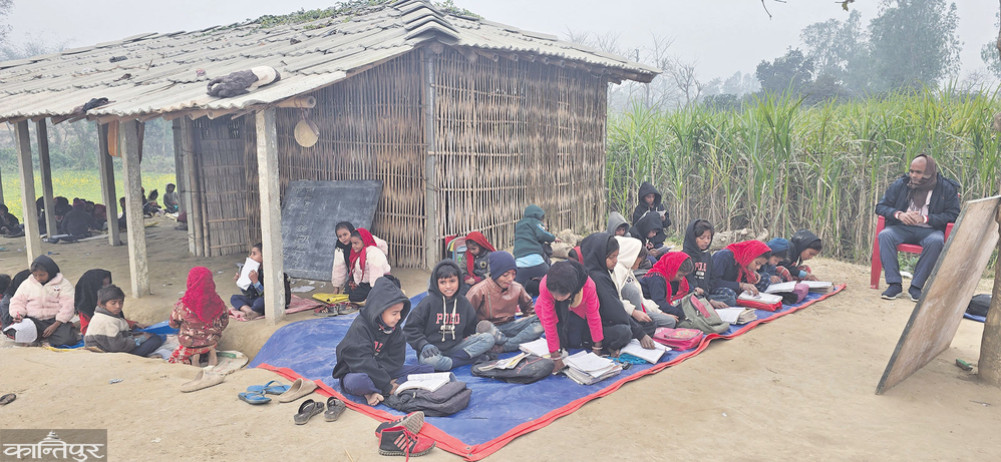
Rautahat's Dalit primary school, which has the lowest literacy rate, is just a reference. The overall educational environment of public schools where 70 percent of students study is poor.
We use Google Cloud Translation Services. Google requires we provide the following disclaimer relating to use of this service:
This service may contain translations powered by Google. Google disclaims all warranties related to the translations, expressed or implied, including any warranties of accuracy, reliability, and any implied warranties of merchantability, fitness for a particular purpose, and noninfringement.
At the moment, a cold wave is going on in the districts of Madhya-Madhesh. Life has been affected. No one wants to stay outside or go out unless forced. However, Dalit primary school children in Rautahat's Fatuwa Vijayapur municipality are forced to study on the cold floor outside the hut without a fence.
In the heat that starts in a few weeks and lasts for months, those children will be forced to study under the scorching sun or hot cement tiles. This is not a fateful situation created for a few months or years.
is a 17-year-old compulsion. Overall, the poor educational infrastructure that still exists in rural Nepal and the poor learning achievement that can be measured through it is a stark picture. In such a situation, the entire state structure, all three levels of government, people's representatives and stakeholders should try to bring positive change.
The fundamental right of Nepal's constitution states that every citizen will have the right to access to basic education. At the same time, every citizen will have the right to get compulsory and free education from the state up to the basic level and free education up to the secondary level. Terminology such as compulsory and free as mentioned in the constitution expects a quality educational environment and learning methodology.
It is the right of children to progress in a positive environment with adequate educational materials, from competent teachers, and to achieve class-specific learning outcomes. Students should bring sacks and tents from home, otherwise they have to stay in the cold, not only against the spirit of the constitution, but also against human rights. However, most of the children studying in public schools in Nepal have not been able to get a proper educational environment. Rautahat's Dalit primary school is also a marginal form of deprivation.
The overall foundation of any country is strengthened when investment in the education sector is a top priority. It is not seen that the short-term thinking political leadership or the state apparatus does not give priority to the education sector as it does not give results tomorrow and cannot be presented as concrete achievements to be shown immediately. The budget allocated by the Nepalese state for the education sector every year shows such thinking.
If we look at the education budget in the budget presented for the last decade, it is around 10 or 11 percent. For the financial year 2081/82, the government has allocated a budget of 2 trillion 3.66 billion to the Ministry of Education, Science and Technology. Which is only 10.09 percent of the total budget. Most of this budget is spent on administrative work. As a result, the budget is insufficient to implement the fundamental rights associated with education and to improve the educational environment. On the other hand, it is the election manifesto of the main parties, public speeches of several leaders and 20 percent of the total budget expressed in the education sector.
is also the opposite of commitment. Therefore, the priority of the state should be to increase the budget in the education sector and create a situation where schools like Rautahat's Dalit Primary School will benefit from it. After federalism, basic and secondary education is under the authority of the local government, so it should also realize its responsibility.
The Dalit primary school in Rautahat, which has the lowest literacy rate, is just a reference at the moment. The overall educational environment of public schools where 70 percent of students study is poor. Community schools have not become strong in the basic aspects of keeping students in schools, ensuring teacher positions, preparing suitable school buildings, collecting educational materials, sports materials, libraries, etc.
Incentive programs to strengthen the weak educational environment are very few. Due to this, students with poor academic achievement are reaching the upper level. On the other hand, the dropout rate is also high. Many schools are facing the problem of low student numbers. If
is not the main priority of the state, public schools will become weaker and weaker. On the one hand, more than two-thirds of the students study, and on the other hand, learning in a poor educational environment, it can be concluded that our school education is moving towards a dangerous situation. Concerned agencies from the state should become sensitive to this in time.
A competent and competitive citizen cannot be prepared if students of any level cannot achieve the level of learning achievement in a complete educational environment. From this, only the student can be disadvantaged. But if such a number becomes a common trend for the entire school, local level, province or the country, then society and the country will lose. Because, the person himself is deprived of getting educational nourishment from the family, the society and the country.
The same trend is gradually reflected in policy making to political decisions. There is another side to this. In many cities of the country, there are also students who participate in the learning process using all the innovations developed in the world, in a quality educational environment.
Such a situation is sure to produce two types of manpower and create inequality in every sector. which is the seed of social idolatry or collective expression of discontent. Therefore, the state needs to take the Dalit primary school of Rautahat as a reference and decide its educational policy and program.