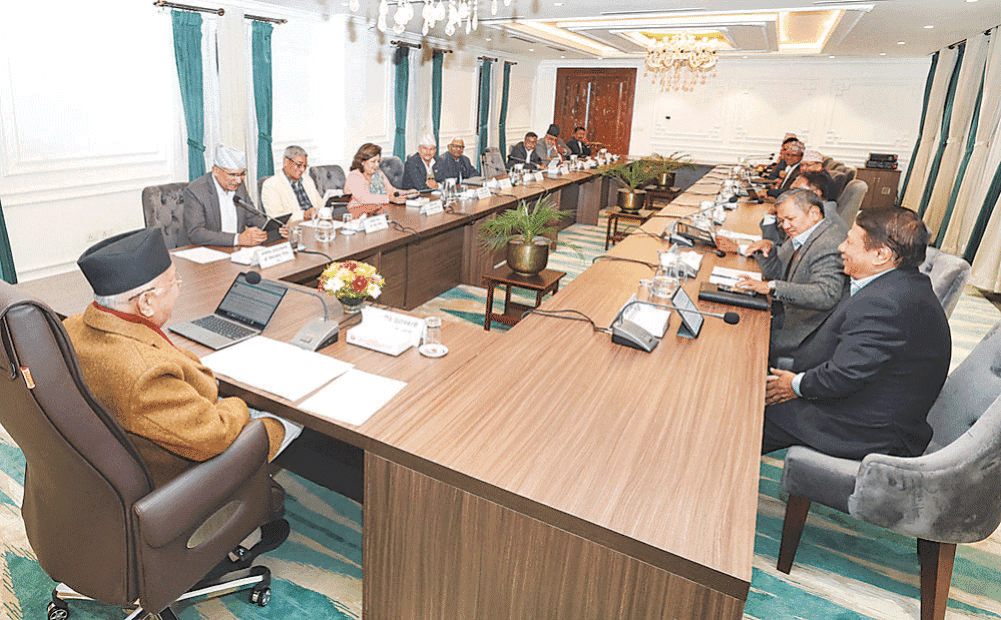
Will the committee of the sovereign parliament become a prisoner of the will of the two top leaders or will it move forward on the basis of collective conscience? Abandoning the collective conscience by going after the top would be disrespectful to the sovereign people who gave birth to representative institutions.
We use Google Cloud Translation Services. Google requires we provide the following disclaimer relating to use of this service:
This service may contain translations powered by Google. Google disclaims all warranties related to the translations, expressed or implied, including any warranties of accuracy, reliability, and any implied warranties of merchantability, fitness for a particular purpose, and noninfringement.
In the name of public interest, the system has been changed many times. The common people's aspirations for prosperity are there. There is no end to the mismanagement that causes frostbite. Instead, it is spreading and spreading everywhere. The stain of the corrupt country is not going to be erased, it is getting darker.
One of the reasons for this is the protection of corruption from the highest political levels. Limiting the slogan of zero tolerance to corruption and increasing the state's tolerance towards corruption. Ending misrule, which has become a mountain of challenges in the path of social justice and equitable prosperity, is a national aspiration. However, there is still a lack of strong political will for this.
If that was not the case, the flawed system (Section 4(b) of the Commission Act, 2048) which is being misused to give immunity to those who abuse authority by covering up policy decisions would not have been in practice. It is currently under consideration in the State Administration Committee. The use of the said bill is to correct Section 4(b) which is being misused to give immunity from the investigation of abuse of authority by raising questions on the collective policy decisions of the Federal Council of Ministers and its committees. It should have been done. On the contrary, there is a proposal in the bill to extend the immunity that is limited to the level of the federal cabinet. The demand to include the decision of the federal cabinet within the scope of the investigation has been raised, which is justified at this time The fact that KP Sharma Oli and Congress President Sher Bahadur Deuba are in disagreement has come out It has been said that the committee was caught, but this news has not been refuted by anyone. This reinforces the argument that the main beneficiaries of Section 4(b)'s legal immunity are the top leaders and they want to preserve the flawed arrangements in order to benefit from it in the future. This is absolutely serious.
Will the committee of the sovereign parliament become a prisoner of the will of the two top leaders or will it move forward based on collective conscience? Now is the time of examination. It would be natural for the top leader to put his opinion on the content of the bill before the committee. However, that alone does not justify 'dictating' the committee or accepting their position as a veto by the committee. Abandoning the collective conscience by following the top is disrespectful to the sovereign people who gave birth to representative institutions.
Remember, the committee is guided by the spirit and spirit of the constitution. It is from the obligation under the convention against corruption ratified by Nepal. It is from the legitimate aspirations of the common Nepali people for good governance.
Now we are not governed under the Constitution of Nepal Dominion 2047. At this time, we are going through post-conflict democratization. The government, parliament and parties are under the principles of constitutionalism established by the popularly elected Constituent Assembly. He should play a role for sustainable peace and prosperity by properly addressing the problems including corruption and misrule which are the underlying causes of past armed conflicts and many political and social movements.
Compared to previous constitutions, the principles of good governance adopted by the current constitution seem to be advanced. Safeguards against corruption and maladministration are strong. Meanwhile, since December 9, 2068, we have been a party to the Convention against Corruption. Therefore, the commitments under the Constitution and the Convention against Corruption cannot be on the one hand and the laws made by the Parliament on the other. Parliament has no choice but to take a decision in the light of the Constitution and Convention.
Parliament has no right to create an exception to the provisions made in the Constitution to ensure accountability against corruption and misrule. The immunity granted to the Executive under Section 4(b) is unconstitutional. Based on the study of the overall arrangement of the constitution, it can be understood that the justification of such immunity cannot be confirmed anywhere.
In the preamble of the constitution itself, the fact that 'the current constitution was issued by the Constituent Assembly to fulfill the aspirations of sustainable peace, good governance, development and prosperity' is announced. Sustainable peace, good governance and prosperity are complementary to each other. Good governance is the foundation of lasting peace and prosperity. After good governance is replaced by bad governance, the goal of lasting peace, social justice, socialism and equitable prosperity will become the fruit of the sky. Similarly, fundamental rights suffer the final blow of political corruption. Political corruption does not create a reasonable environment for the enjoyment of fundamental rights.
Corrupt policies and decisions lead to misuse of budget and revenue and exploitation of government and public assets. It has a negative impact on the implementation of economic and social rights in particular. Citizens in need of state protection are vulnerable to malnutrition and food insecurity, are deprived of basic education, health services and social protection, and end up dying of extreme poverty. Conflict and instability arise in the society. Corruption indirectly victimizes a large population. Accounting for the multifaceted consequences of political corruption seems necessary.
Article 49 establishes the guiding principles, policies and responsibilities of the state as stated in Part Four of the Constitution as guidelines for the operation of the state. Therefore, it is important to examine the positive or negative impact on the guiding principle, policy and responsibility of the state when making a law that directs a sensitive issue like political corruption. Because these arrangements are not of the nature of either accepting or rejecting. Due to their complementarity with fundamental rights, their observance is indispensable. The Supreme Court has been reminding about this for a long time through various orders and judgments (such as: Surya Dhungel, Yogi Narharinath case).
Political corruption hinders the achievement of the political, social and economic objectives of the state as set out in Article 50. Article 51(b) below (4) specifies the policy of guaranteeing good governance by making the public administration clean, competent, fair, transparent, corruption-free, accountable and participatory by ensuring equal and easy access of the people to the services provided by the state. Similarly, sub-section (3) of Article 51(k) is also particularly important.
It has a policy arrangement to adopt effective measures to control corruption and irregularity in all sectors including political, administrative, judicial, social. The aforementioned constitutional guidelines are sufficient to show the country's zero tolerance towards any form of corruption.
Article 52 specifies the obligation to make the country prosperous and advanced through the gradual implementation of the directive principles and policies of the state. A Joint Parliamentary Committee exists under Article 54 to monitor and evaluate the progressive implementation of the State's directive principles, policies and obligations. If the process of amending the law goes ahead in a way that is contrary to the directive principle, this committee is also responsible for warning about it. Inter-committees should play a role of checks and balances. The role of this committee, whose mandate is set by the constitution itself, remains important. This is understandable.
Similarly, Article 56(6) subordinates the Union, State and local levels to the rule of law and the principle of separation of powers including checks and balances. The provision of setting up an independent constitutional body for the purpose of investigating corruption serves the same principle. Immunity from investigation means loss of control over the executive and creation of a situation of imbalance contrary to the stated arrangement.
Under Article 75, the executive powers are subordinated to federal laws that are consistent with the Constitution. Making a law contrary to the constitution and putting the high executive officers of the union and state level under the jurisdiction of the authority leads to the violation of the constitution. In Article 239(1) of the Constitution, there is a provision that "the Abuse of Authority Investigation Commission may investigate or conduct an investigation in accordance with the law in relation to abuse of authority by a person holding a public office".
In the restrictive phrase of the same, it is said that "but this clause shall not be applicable to officials who have a separate provision in this constitution and officials who have special provisions under other laws". In sub-section (2) there is a provision that "in the case of a person who is relieved of office after the impeachment motion is passed in accordance with Article 101, a judge who is relieved of office by the Judicial Council and a person who is prosecuted according to the Military Act, an investigation may be conducted or carried out in accordance with federal law after being relieved of office."
It is clear from the study of these arrangements that even in the case of 'officials with separate provisions in the constitution and officials with separate special provisions in other laws' who fall within the scope of immunity mentioned in the restrictive phrase, such immunity applies only while in office and then they have to face investigation. The intention of the constitution to make any official unaccountable is not confirmed anywhere.
Not only the constitution, Nepal also needs to take care of international commitments regarding the establishment of good governance. The obligation to observe and implement the International Convention against Corruption to which Nepal is a party is specified in Article 51(b) of the Constitution. In addition, Article 9 of the Nepal Treaty Act, 2047 not only considers the provisions of the approved treaty as laws made by the Parliament, but also provides that if the provisions of the Parliament-made law conflict with the provisions of the approved treaty, the provisions of the treaty will be effective. On this basis, no amendment should be made to the detriment of the Convention. Otherwise, the amended provision may become subject to judicial review.
Article 30 of the Convention against Corruption emphasizes a balance between facilitating the performance of the executive and investigating, prosecuting and adjudicating corruption-related offences. Immunity from investigation appears to be acceptable only to the extent that it is necessary for a democratic society. But, it should be understood that giving immunity to the decision-makers of the Council of Ministers as a whole is not compatible with the spirit of the Convention and the Constitution.
In other countries, there are also examples of cases of special nature of the executive being kept out of the scope of investigation based on justification. For example, Section 14 of India's Lokpal and Lokayukta Act 2013 empowers the Lokpal to investigate corruption complaints of any nature against the Prime Minister, Ministers, MPs and employees. However, there is also a special exception regarding the Prime Minister.
If the corruption complaint against the prime minister is related to international relations, external or internal security, public order, nuclear energy or space, the Lokpal cannot investigate. This exception appears to recognize executive prerogatives in sensitive national security matters. However, the law does not allow the Prime Minister to receive absolute and blanket immunity on the basis of a policy decision or any other pretext.
It doesn't seem like there is any new or old party in our country that doesn't talk about establishing good governance. It occupies a good position in the official documents of each state, election manifesto, etc. In practice, the political cultivation of misrule has flourished. Check and balance has been replaced by 'participation and balance in appointment'. Leadership and courage in cutting the roots and branches of misrule is not seen at the political level.
Which leader actually stands against corruption and who has directly or indirectly supported corruption should be held accountable from the citizen level. Based on that, the people should decide who will be punished in the upcoming elections. Unless serious issues of common concern are linked with electoral democracy, parties and leaders will not have the will to reform themselves.
Let's hope, the difficulty at the top won't last long. The collective conscience of the Honorable MPs will not be a prisoner of their will. The aspirations of the common people for good governance reflected in the constitution will become decisive. In the amended Act, there will be no excuse for seeking blanket immunity in the name of policy decisions.