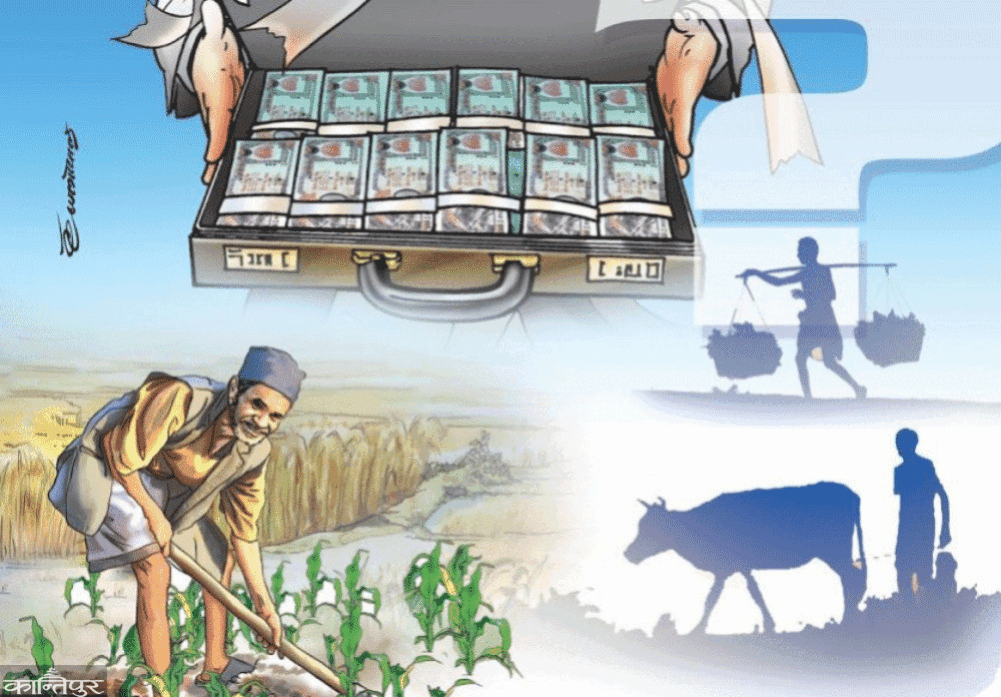
Many reforms can be done from developing a system where only real farmers can get subsidies by establishing coordination between the three levels of government and ending the existing duplication. But the main task at the moment is to make public the list of those who misused the funds.
We use Google Cloud Translation Services. Google requires we provide the following disclaimer relating to use of this service:
This service may contain translations powered by Google. Google disclaims all warranties related to the translations, expressed or implied, including any warranties of accuracy, reliability, and any implied warranties of merchantability, fitness for a particular purpose, and noninfringement.
With the Ministry of Agriculture and Livestock Development publishing the list of recipients of agricultural subsidies, a curtain has been opened on this much-discussed topic. A five-member committee formed by the Ministry under the coordination of Joint Secretary Hari Bahadur KC on November 2 to find a list of grants has prepared a report that 1 trillion 7 billion 66 billion 27 lakh 89 thousand grants have been distributed in the last five years.
From the financial year 2076/77 to 2080/81, the direct flow from the ministry was 20 billion 33 million rupees and 87 billion 35 million 97 million rupees indirectly (subsidized chemical fertilizers). The details released by the ministry are important, this matter will not be complete until the list of grant takers is published. Now, the details of those who misused the subsidy should be made public and the process of investigation and action should be taken forward. For this, the activation of Agriculture Minister Ramnath Adhikari and his leadership structure is indispensable.
Subsidies are being flowed under many headings such as chemical fertilizers, crop and livestock insurance, incentives for sugarcane production, small irrigation, market infrastructure, agricultural implements, seed production, promotion of agriculture and livestock sector to increase production and productivity. For that, various programs/projects are being run by the federal to local governments for the development of the agricultural sector.
has been receiving grants from several programs/projects with different target geographies and work areas for different times. According to public information, an amount of Rs. 6.61 billion 95 lakh 31 thousand rupees has been released from the Prime Minister's Agriculture Modernization Project. 1 lakh 41 thousand 670 agricultural cooperatives, agricultural groups and agricultural firms have taken the amount. Rani Jamra Gulria Irrigation Project Agriculture Program Implementation Unit has received 1848 million 61 thousand rupees, which amount has been taken by 21 thousand 450.
800 million 19 million 61 million rupees have been taken from the agricultural sector development program by 27 thousand 650 people. 1 billion 92 crore 75 lakh 13 thousand 11 thousand 150 rupees have been taken from Nepal Livestock Innovation Project. 1.5 billion 37 lakh 79 thousand rupees 46 thousand 226 have been taken from the food and nutrition security improvement project. Similarly, 4 billion 72 million 24 lakh 20 thousand rupees have been flowed through sugarcane farmers incentive subsidy.
500 million 48 lakh 82 thousand rupees have been transferred towards premium subsidy of agricultural insurance and 5 billion 13 crore 80 lakh 66 thousand rupees towards premium subsidy of livestock and fish insurance. 2 billion 100 million 26 million rupees has been distributed through Pact Project through 1223 agricultural cooperatives, agricultural groups and agricultural firms.
Agricultural subsidies flow not only from programs/projects under the federal government, but also from state and local governments. So it has a duality. Therefore, if we integrate the amount of subsidies from any level of government, the amount will be even higher than what is currently disclosed by the Ministry of Agriculture. Therefore, coordination between all three levels of government is necessary to prevent duplication of grants.
There are already complaints about misuse of grant funds. There is a situation where real farmers cannot claim subsidy due to procedural problems. On the other hand, people with political or administrative access have taken subsidies even though they are not involved in agricultural work. They are only paper farmers. Some people take subsidy by exploiting the confusion or ignorance of the real farmers. Cunning people who have no knowledge of agriculture are profiting by sneaking through loopholes where subsidies can be easily obtained.
It seems that the government is spending a large amount of money for the development of the agricultural sector, but in reality, such amount does not reach the farmers or the agricultural sector. As a result, the subsidy amount continues to increase, but the agricultural production is relatively unable to increase. Even more profoundly, a situation is being created where the new generation cannot connect to agriculture, which is becoming a forced profession. If the
subsidy would only reach the target farmers, today it would have become a strong sector from capital formation to job creation. But that didn't happen. As a result, today the agricultural sector itself is becoming stagnant due to subsidies.
Now we are left with the only option of improvement. Where there are weaknesses, they will be improved. Many reforms can be done from developing a system where only real farmers can get subsidies by establishing coordination between the three levels of government and ending the existing duplication. But the main task at the moment is to make public the list of those who misused the funds.
Those who misappropriate public funds must be held legally accountable. The agriculture minister officer who has repeatedly committed to taking subsidies and publishing the list of abusers should keep his commitment and responsibility as a priority.