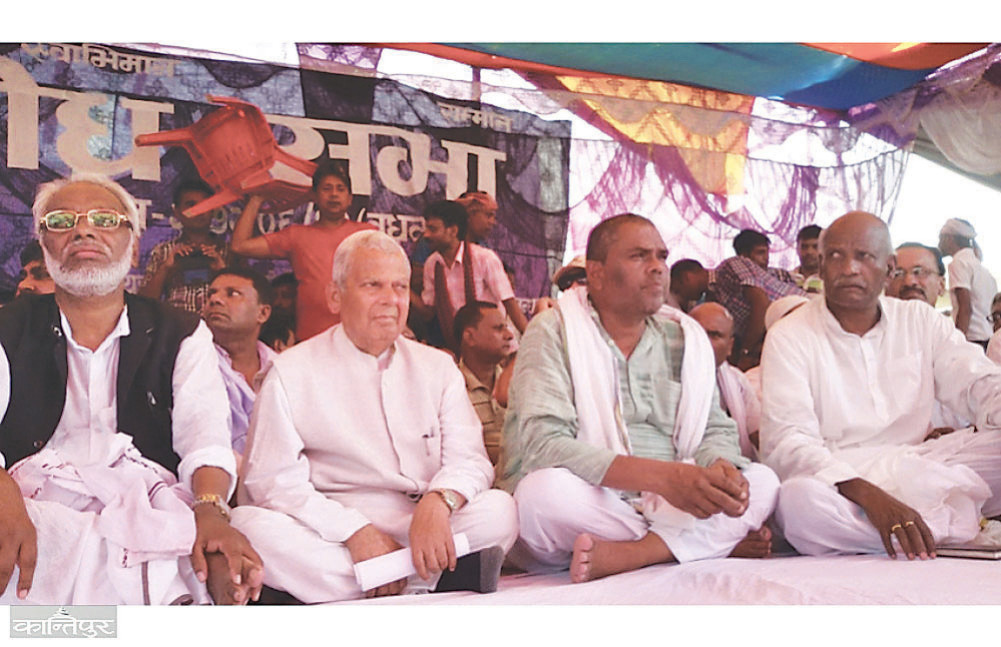
Even those who bow down to 'get a place' in the power, the power has been pushing aside, enticing and encouraging them to understand and weigh the geo-chemistry of Madhesh. The messiahs became so busy with the visible goal of government that they forgot the original purpose they had set for themselves.
We use Google Cloud Translation Services. Google requires we provide the following disclaimer relating to use of this service:
This service may contain translations powered by Google. Google disclaims all warranties related to the translations, expressed or implied, including any warranties of accuracy, reliability, and any implied warranties of merchantability, fitness for a particular purpose, and noninfringement.
The Madhesh movement has gone through a long journey. But those who led the movement remained under the delusion that 'we are the initiators of the liberation of the Madhesi people', they preferred to call themselves 'Messiah'. After listening to the Jaigaan, he also did 'Tathastu' to those standing around. The reality is that by selling the dream of salvation, these so-called messiahs are pushing the deprived community towards 'worship'.
This self-proclaimed messiah expected devotion from the group he favored. Many shops were opened with the intention of getting a monopoly among devotees and competing for worship. There were shivers. But what those who want to be called Messiah forget is that wearing this turban is not like sitting on a golden throne, it is like going into a pit with snakes.
happened as it was supposed to happen. In time, the messiahs came naked. The bond of trust was getting stronger. Madhesh-centric parties eventually became Madhesh-dependent. While the Madhesh-centric struggle and consolidation continued, they emerged in this region to push Kathmandu. Ever since this messiah forgot his identity and followed artificial slogans and names, he did not get anywhere else and lost his 'space'. He wandered around and came to Madhesh to be sheltered. Today's Madhesh dependent parties are not really the power here.
Madhesh is the bed of Nepali politics, where many seeds were planted and germinated. Giving priority to the Madhesi people-centered desire, the dream of removing the internal colonial cobweb was seen later. When the old parties of Nepal were treating the Madhesh only as taxpayers and voters, the process of forming a political party started later on this basis. The clear message given by staying up-to-date with the formation of the
party is that the people of this region are looking for freedom from the status quo. So far no chemical lead has been found to alter matter. It should also be admitted that because of these leaders, movements that have influenced history have been possible, as if they were to touch fire knowingly or unknowingly. The contemporary generation is not ignorant of such politics.
The post-constitutional government understood the opportunity to return to Mauza instead of trying to solve the anger and pain of Madhesh. There was no determination to solve the deprivation faced by Madhesh. The limited process drawn by the constitution was also devalued. The 'fraternity' became so excited that they fell under the spell of their own 'echo chamber'.
We say that Madhesh has its own ahaan, its expression has a special story, then we are recognizing the expression of clay lumps (Mati ke Dhela) in Madhesh. What Kathmandu cares about, Madhesh also cares about, but what Kathmandu cares about Madhesh, Madhesh also keeps a complete account of it. The understanding of the 'other' position on Madhesh is at the ground level. The power circle revels in shocks. The society and literature nurtured by him have become so dominant that in the post-constitutional period, Madhesh remained 'other'.
The start of formal-informal talks about Madhesh in Kathmandu by the Madheshi themselves is to spread tension in the Singha Darbar. Madhesi forces have started to form their own negotiation team. If nothing else, it has begun to take notice of the politics of those hitherto ignored. The media has started talking and commenting about Madhesh politics in its own corner. How many fronts have started to be formed in the situation where there is no pregnancy.
There is a common explanation that the Madhesh movement that took place during the construction of the constitution ended without any conclusion. But producer forces took it as a successful event. They realized that Madhesh's agenda had collapsed according to the changed paradigm of success. This incident threatened the protection of deprived rights and shattered the unity of the Madhesi power. Before and after the issuance of the constitution, a substantial change in character can be reflected in the dominant view of Madhesh. The Madhesi party, which has suddenly left the
movement and entered electoral politics, gradually did not find a sheep as a porter to carry the palanquin of the dominant power. The language, grammar, idioms, voices and slogans of the social justice-discussion created by the Madhesh movement were suppressed. As the slogans and quotes written on the walls were being forgotten in the surge of unrecognized politics, these struggling forces could not recognize the change in their behavior and character. There is no doubt that the Madhesh dialogue that has started now, if nothing else, is showing a mirror to the messiahs for the time being.
Occasional slogans like 'Janasankhya se kam na seyya yaya, Madheshvad ka yi takaja' express the political imagination of the deprived class very beautifully and it defines the elite as the 'other'. Political reaction reveals new slogans.
Although there are few people who hope that the talks between the Madhesi forces going on in Kathmandu will create a new grammar of the country's politics, it is. Hindi storyteller Udayaprakash has a short story titled 'Dar'. That's scary. For wherever he is to go, there is a footprint already made.' This story seems to be accurate about the Messiah. How will Madhesh fall in this way? After all, the Madhesi people have supported us three times in less than a decade.
When a certain class within the same country tries to impose its superiority over others, implements hegemonic norms in the name of national discipline, those who say ``ji sir'' get support. But those who raise the issue of logic and justification, the mind that makes them stronger starts to spread. A community that has been pushed to the edge tends to shrink in on itself and create a mythic world where its superiority is self-evident. Thus the myth of the hegemonic begins to clash with the myth of the deprived community. For this, all parties start searching for the uniqueness of their traditions in real or imagined history.
Gradually such formulas start to become ineffective, through which communication between different parties is possible. The psychology of isolation caused by the lack of communication in the past is working to bring violence in Madhesh now. The legitimate aspiration raised by the Madhesi and all the oppressed people tries to rise with the same force as Newton's law of motion.
When the Madhesi forces are weak, the Madhesi face of the big party is also in Chepuwa. Currently, there is a lack of such people within those parties, who can tell the truth from the opposite sides of the party leaders' intentions. On the other hand, even those who bow down to the power to 'get a place', the power has been taking steps to understand and weigh the geo-chemistry of Madhesh.
The messiahs became so busy with the visible goal of government that they forgot the original purpose they had set for themselves. The objective of ending decades of misrule, making a fresh start in Madhesh, completing the long-neglected social uprising, and ending the centuries-old internal colonialism of inequality, exploitation and discrimination remained behind. Now they have started chanting unity again to save existence.
Madhesi people and their issues are always together, whenever someone shows determination to make their dreams come true, then they get the support of the community. The trend of considering Madhesh as a security crisis area for the Nepali state and acting accordingly is not curbed, the havoc is continuous. The movement between the Madhesi forces since
is not enough in itself. His solidarity will not make another bargain, how to believe it? What is the real purpose of solidarity? How can old slogans and leadership solve the current crisis? Is this the last option to avoid the coming war of eighty-four? It takes courage to fight back.
The biggest challenge facing the political leadership in the current situation is to regain its lost credibility. Keeping leadership free from messiahship. This is the end of messianic politics in Madhesh. Today's Madhesh is looking for a 'friend', not a messiah, who thinks, understands and struggles like him.
Bringing economic-social justice to all regions, communities, castes and classes and genders of Madhesh, which has diversity, is the first priority. On the other hand, there is no place where the efforts of solidarity will get stuck. The authorities are closely monitoring it. But the talk has certainly given the opportunity for self-examination for the first time after the third Madhesh movement. In the status quo, open communication works as medicine.