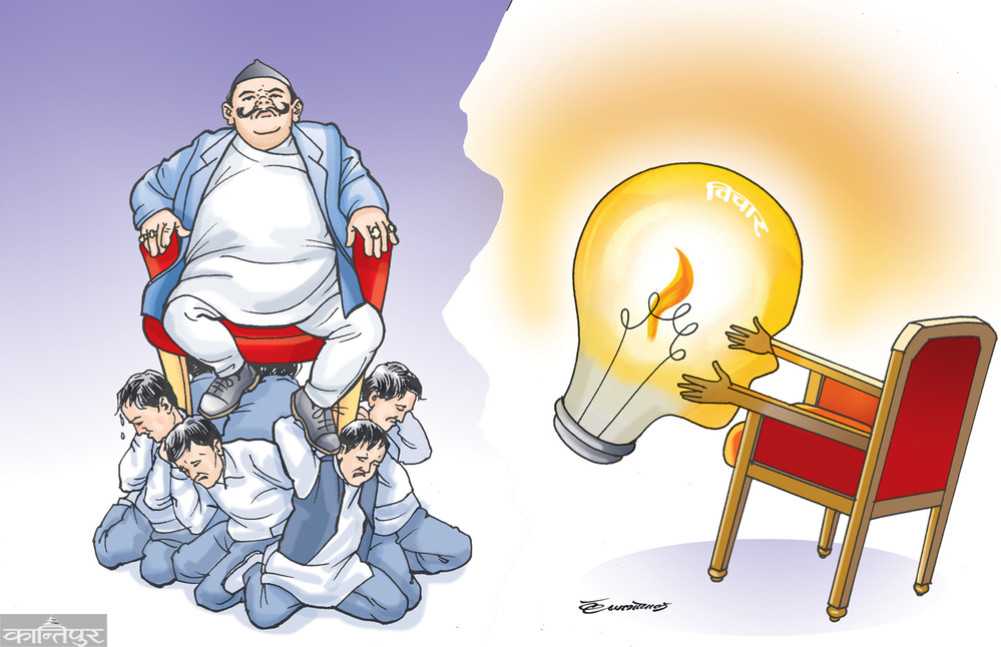
Political commentators are saying that 2025 will be the year of the proliferation of the most inefficient and worst-ruled oligarchy, or of widespread chaos caused by the explosion of discontent.
We use Google Cloud Translation Services. Google requires we provide the following disclaimer relating to use of this service:
This service may contain translations powered by Google. Google disclaims all warranties related to the translations, expressed or implied, including any warranties of accuracy, reliability, and any implied warranties of merchantability, fitness for a particular purpose, and noninfringement.
The adage that even a broken clock shows the correct time twice a day is not an absolute but only an indicative truth. After all, the observer has to decide for himself whether the season seen at the time of non-working is autumn or spring or afternoon or night.
Recently, Chairman of CPN-UML, Khadga Prasad Sharma Oli said that the ideological deviation in the CPN-Maoist center is deepening. It doesn't matter if such an expression is dismissed directly on the basis of the popular saying that 'seeing lice in other people's parts, not even seeing buffaloes in your own parts'. Among the political parties of Nepal, the party with the most ideological deviation is the UML.
The role played by Khas-Arya community's ethnic Mukhtiar Sharma Oli in transforming his party from class, nationality to ethnicity and from the dictatorship of the proletariat to the totalitarianism of the elites cannot be minimized. However, the transformation of UML had already started since Madan Kumar Bhandari established the 'multi-party democracy of the people' i.e. Jabaj as the guiding principle of the party.
The then General Secretary of the Soviet Communist Party, Mikhail Gorbachev, introduced the Nepali version of Glasthnost (openness) and Perestroika (restructuring) in the mid-1980s. It was confirmed by the then Prime Minister Manmohan Adhikari during his visit to New Delhi that the flag attached to the name of the party is not just a 'brand name' like Coca-Cola.
It is also true that to welcome the American ambassador to his then headquarters Balkhu Darbar, the pictures of the five gods of the Communists, Marx, Engels, Lenin, Stalin and Mao, came down from the wall and put them in the basement. After that, the so-called Marxist-Leninist party stopped worshiping the Communist Panchadev in its programs and started singing the song of ethnic greatness and started openly promoting Bahunism.
The history of servant or attendant capitalism in Nepal is old. The fact that trade cannot be sustained without the involvement of Shah, Rana or their relatives and vassals remained until the 1990s. In the name of promoting the national capitalists, the credit for promoting the crony capitalism goes to the minority government of Manmohan Adhikari formed in 1994-1995. Sharma Oli was the Home Minister of that nine-month government.
The businessmen he supported at that time probably haven't left him yet. President Sharma Oli laid the foundation stone together with the rich businessman Meen Bahadur Gurung in the 10 ropni 14 annas in the party central office complex, which is estimated to cost more than 100 crores, the parking lot for expensive vehicles will definitely be bigger than the square or garden where common people gather, that is because UML is now 'Huet Bourgeoisie' in French. The so-called upper middle class has become an ethnic platform.
After that, Sarvesarva Sharma Oli, who accepted the greetings of his workers by waving his hand from Bardali in Balkot, will give Akkalzhukkal darshan to the common people from the Kausi of Maitrinagar Darbar in Kirtipur. The story of UML's deviance is untold. The correct time shown by Sharma Oli is probably not 12 noon but midnight. It is a matter of public discussion that he holds important meetings with Nepal's current political middlemen, from Samant Kumar Goyal, the head of India's 'RA', only after dark.
President Sharma, instead of self-criticism by looking at the mirror, threw the stone at the glass window of the Maoist center, not at the wrong place. Speaking at the 28th memorial meeting of Ramvriksh Yadav held in Parisdanda, Pushpa Kamal Dahal had already admitted that 'deviations have appeared in the party' around 2022, although he has not yet dared to dig into the reasons for such a political eruption. Girija Prasad Koirala tried to bring the Maoists into the parliamentary mainstream. Dahal himself did the act of worshiping the buffalo to bring peace to the planet. But 16 points Sharma Oli has done the work of ensnaring the pioneer of inclusiveness and autonomy in the guise of ethnic pluralism through
conspiracy. Following the footsteps of Dahal Kulbhushan and Chandrasekhar Upadhyay, one of the creators of the Sugauli Treaty, and Shailendra Kumar Upadhyay, a 'communist elite' of the Panchayat period, it was natural that Dahal, a Maoist of Ekta, would also increase his support with the court elements. After the UML pulled the chariot of 'Si Chin Fing Ideology' in Nepal, there was no other option left for Dahal but to take refuge in the Mahakal of Ujjain.
Recently, Shekhar Koirala, an emerging politician of Nepali Congress and the chief claimant of the Koirala family's political legacy, while speaking on the occasion of Krishna Prasad Bhattarai's 101st birth anniversary, admitted that there was a deviation in his party and blamed it on Chairman Sher Bahadur Deuba.
There is no doubt that the main person responsible for the success or failure of the party's activities is the chairman/chairperson, but when the Nepali Congress surrendered the role of the country's ideological leadership to ethnic Mukhtiar Sharma Oli through the 16-point conspiracy, where were the politicians who are turning freely now?
In the month of May 2002, King Gyanendra forced the then Prime Minister Deuba to recommend him and dissolved the House of Representatives and gradually implemented royal-military totalitarianism through Asojatantra and Makaratantra. Girija Prasad, a discredited but undefeated politician, used to say - After getting lost in the forest, we should return to where we left off and start anew. . He accomplished that by restoring and reorganizing the parliament that had been dissolved with bad intentions. At present, no one is seen in the scenario who has the courage to raise voice for the review of the 16-point conspiracy within the NECA line, so the issue of constitutional amendment is seen as nothing more than another ethnic majoritarian trap.
Leadership character
Continuity of ideas lasts longer than people. Since the ideological entrepreneur remains a leader almost for life, the saying 'whose idea is led' is often repeated in the communist parties. Because among liberals vaguely formulated commitments to stable political beliefs and individual freedoms are more important than organized ideology, the role of the president should generally be no more than that of a facilitator.
Neka has also continued the tradition of maintaining the supremacy of the chairman in the party due to having to do underground politics for a long time in a restricted situation. The political parties started by the ambitious politicians who broke away from the Communists and the Congress followed their path, but even the national independent, public opinion or civil emancipation parties that entered the election arena could not be freed from the iron noose of the founder-presidents. Therefore, it is not unusual to think that the trajectory of Nepalese politics is determined by individuals rather than ideas.
Among the qualities of good leadership, integrity, intelligence, energy, foresight, communication skills, understanding to make balanced decisions and determination to determine common goals are considered the main ones. A person who leads any organization, including a political party, should be thoughtful, responsible, willing to delegate authority, inspiring, a team builder and have the morale to reassure supporters in difficult situations.
In selfish and ambitious leadership, the lack of empathy, fear of change, reluctance to compromise with dissenting opinions, high-strung character, confused personality, inability to find the right helper, unbalanced behavior and arrogant nature can be clearly seen. The most dangerous leadership is that of the audacious people who follow the slogan 'Zite Hastinapurko Raj, Haare Chaparimuniko Baash' and have personal ambitions far beyond their capabilities.
Such people view political leadership as a battlefield rather than a friendly competition for the public good, using the seven gates of intrigue—deceit, force, wealth, manipulation, shamelessness, subterfuge, and opportunism—without hesitation. It is self-evident that which politician is the most proficient in the art of breaking through the political maze of Sharma Oli, Dahal and Deuba, who have been Prime Ministers alternately for a decade since 2015.
The plight of the politicians who have lost their self-proclaimed faith in the Madhesh dependent parties, which compete with each other to be the allies of the three main parties of the Khas-Arya supremacy, has become more miserable. From the Terai Congress of the 1950s to the Nepal Sadbhavana Parishad that emerged in the 1980s, 'Madhesh' was not accepted as a political term.
The Madhesi People's Rights Forum established by the leadership of the Maoists and the activism of some civil leaders including Upendra Yadav involved in that initiative only established the word 'Madhesh' politically after 2000. The credit for painting Madhesh and Madheshi vocabulary on the walls of Kathmandu should be given to Prasad Yadav, the mother of Maoists. Upendra Yadav, who emerged in national politics by making the Madhesi People's Rights Forum a political platform, has been running all his election business as a sole proprietor, but his Janata Samajwadi Party Nepal has no attachment to the words Madhesh or Madheshi anymore.
The presence of politicians who separated from NECA, UML, RPRPA and other Khudra Masina parties and formed the Democratic Socialist Party under the leadership of President Mahanth Thakur is limited to Madhesh, but they have not dared to accept Madheshism as their principle. In single-front political platforms like CK Raut's Janmaat, Hridayesh Tripathi's Janata Pragatisheel, Resham Chaudhary's Civil Immunity or Prabhu Shah's Aam Janata Party (AJPA), there is perhaps no need to debate the interrelationship between ideas and leadership.
The state and direction of thoughtless and faith-free politics automatically becomes the possible arithmetic of elections. President Sharma Oli's party, which has no blueprint for the transformation of society, culture, economy and politics, has started selling the slogan 'UMLE's Mission - 2084 Single Majority Government'. In the upcoming elections, not to fight the election together with parties like Congress and UML has become the loudest resolution of the Maoist center.
The job of establishing the 'Mission-84' jargon in the public sphere was done by the over-enthusiastic political followers of Ravi Lamichhane, a pure pragmatist politician who has not even a sign of selling bulls with ideology. The resolution 'not to coordinate with anyone in the upcoming elections' passed unanimously by the Central Committee of NECA is basically a political response to the 'Mission-84' nonsense.
The need for unity or cooperation seen by the Madhesh dependent parties may not be an expression of thought or belief, but a practical political imperative. Perhaps that is why national politics has become an ingredient that increases resentment rather than a force to reawaken hope among the common people. Public clamor suggests the possibility of gradual change, while explosive silence may signal impending crisis.
international scenario
American political scientist Samuel P. Huntington (1927-2008) has discussed the third wave of democratization in the world as well as its 'reverse flow'. Why does democracy, which is considered to be the 'least bad' of the governance systems in human civilization, fall victim to the reverse wave? It is difficult to find an easy answer to that important question. Explanations are presented in different ways. The oldest concept is that of the Greek philosopher Plato, according to which every state and society is destined to undergo a five-stage system of governance, consisting of oligarchy, tyranny, oligarchy, democracy, and autocracy. The king is bound by the aristocracy.
As the aristocracy begins to practice 'prosperity politics' for themselves and their relatives, they are replaced by an oligarchy of emerging elites. If an oligarchy becomes too self-centered, the people throw it out. If democracy becomes a 'system for fools, run by incompetents, by cunning' as seen in some countries including Nepal, anarchy will prevail. Then, under the pretext of ensuring law and order, an outbreak of autocratic rule becomes inevitable. In the modern era, the algebra of democratic elections has made new kinds of equations possible.
has completely shaken the old belief that the conscience of the majority is considered impenetrable. The operator of trumpism in the United States has become anger of relevations, not sexual intellects, but a weak majority in the weak. The politics of humanoids in India's politics, un-cassenger and collective guilt, has been thrive to turn into contempt for religious minorities.
Termocracy is now shaking babies and does not simply come to guard the boots. The Court can lead to a non-chairpirational government to pointed a dictatorial system. Collective insecurity, widespread other hatred and hollow political fishermen can gain legitimacy for indispensibility of their leadership.
Weadhctuary (Platcresi) is conducted to establish a weak politicians by mobilizing the media. Theology (Thai Carcsi) is usually run by power established by other systems. Headers and Nbsp in democracy (Patriconylims) & Nbsp; Power has been identified in the state and society, which is the relationship between the facial and supporter of the sustainable preservative protecer.
lanterns of the source of your own country's resources and property) not very much, but it is difficult to move for foreign support or remittances. Donald Modi in the United States, Volodimir Putin and the popularity of Chinfing in China, the popularity and effects of chinfing in China are growing on growing significant attachment and declining fear.
is saying that political commentators will be said to the extension of or the extension of the substance of disabled and the eruption of dissatisfaction. The importance of jeopardizing respect, communication and struggle will not happen.