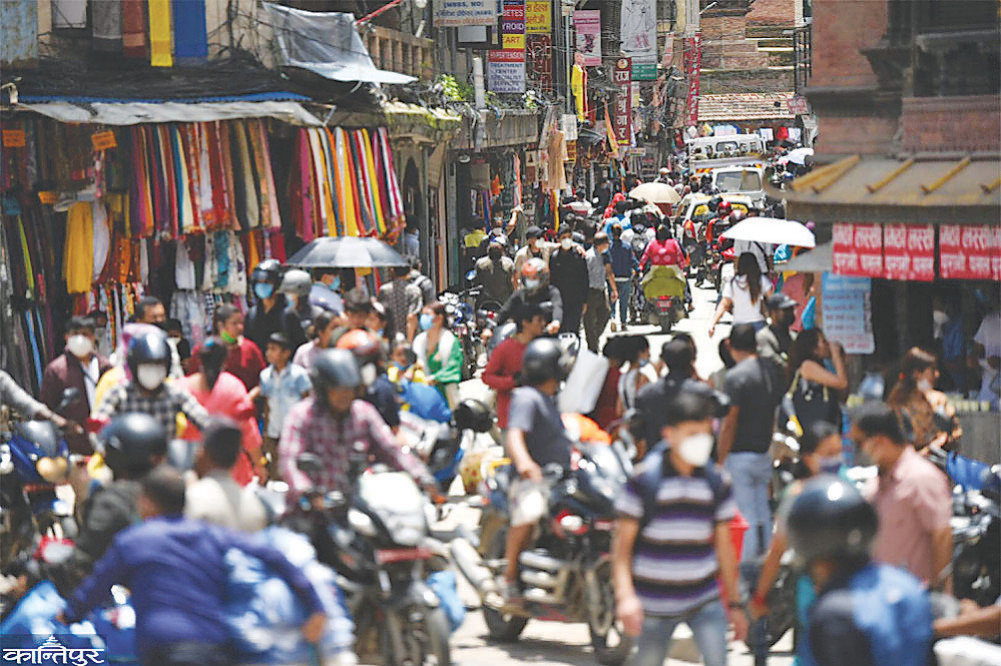
A sudden decline in the fertility rate in Nepal means that the parents' income is insufficient to support the rising costs, education and health of the children. The draft Population Policy 2081 proposes to encourage having three children. Now we will also start the debate towards population growth?
We use Google Cloud Translation Services. Google requires we provide the following disclaimer relating to use of this service:
This service may contain translations powered by Google. Google disclaims all warranties related to the translations, expressed or implied, including any warranties of accuracy, reliability, and any implied warranties of merchantability, fitness for a particular purpose, and noninfringement.
A few months ago, during a conversation about Nepal's declining population growth rate, increasing migration and uneven geographical distribution of population, former President Bidya Devi Bhandari asked this columnist, 'What is the appropriate population for Nepal?' Bhandari was the Minister of Population and Environment in 2052.
At that time, the voice of 'population growth rate is too high, it should be controlled' was loud. She has asked experts in this field including the secretary of the ministry, "What is the population that Nepal needs and you are saying to aggressively control the population?" She said that she has not received the answer to this question yet.
Bhandari, who is directly aware of the changing social and demographic situation of Nepal after being in the post of president for about seven years, expressed concern about the decrease in the population growth rate of the country after the results of the National Census 2078 were announced. Now it is even less.
Although the former president's argument may sound like 'anti-current' regarding the existing population policy, Nepal's demographic debate has started to focus on population growth from population control. In 1959, Nepal adopted a policy of population control informally by establishing the Family Planning Association. In 1965, King Mahendra, in the meeting of the then National Panchayat, announced a population control policy arguing that the country's population growth rate was high, it would cause various problems and hinder development.
After the King's announcement, the family planning program, which was a key to population control, was aggressively implemented. This declaration was documented as a policy in the Third Five Year Plan (2022/023–2027/028). From then till the 15th Five Year Plan (2076/077-2080/81) family planning policy continued in Nepal.
Four years before Mahendra announced the population policy, according to the sixth census in 1961, the population of Nepal was 94,12,996. The population growth rate at that time was 1.64 percent per annum. The total fertility rate means that a woman of reproductive age gives birth to 6.3 children per head. About 6 decades after the Family Planning Declaration Association, Nepal's population has tripled to 2,91,64,578. The population growth rate has almost halved to 0.92 percent. The total fertility rate has further decreased to 1.9.
Coincidentally, the logic of population growth mentioned by the former president is included in the foundation paper of Population Policy 2081. In the Policy Strategy No. 9.2.16 prepared by the Ministry of Health and Population, couples are encouraged to have three children. It is written in the strategy - 'Encouraging all couples to have at least two and at most three children.' The said provision has been removed. Changing the existing policy of the population in the government policies and programs means encouraging more children - although the size of the population is gradually increasing, the rate of increase is decreasing. The real population size of Nepal is small due to the Vaishika movement of youth under various pretexts. Therefore, the population is on the verge of leaving the country due to the control-oriented policy. And, formally, the next debate is focused on population growth.
Nepal is starting this debate at a time when Nepal is on the verge of being upgraded from an underdeveloped country to a developing country. From next year 2026, Nepal is rising to the list of developing countries. Why this context is relevant here is that while the developed countries of the world are trying their best to increase the population, Nepal has to enter a new phase of the demographic issue without reaching that stage. That is, after all the indicators of the developed countries were advanced, only after the people were educated and prosperous, the population started to decrease and the debate on population growth had to start. Although other indicators are weak in Nepal, the fertility rate has decreased from a high point.
Population growth international issue
In May 2024, South Korean President Yoon Suk Yeol expressed concern over the declining birth rate and urged couples to have more children. Named 'Baby Bonus Program', he also announced many attractive benefits for couples having multiple children. Korea is the country with the lowest birth rate in the world. Rapid development
With the leap, the culture of not getting married even if not married and not having children even if married has developed. Korea's total fertility rate in 1960 was 5.9. This sequence decreased to 0.72 in 2023 and further decreased to 0.68 in 2024. This means that for every 100 women of reproductive age in Korea, only 68 are born each year.
President Yol has made a commitment to encourage the birth of children, to extend the period of maternity leave, to give long leave with bonus to the couple to raise children, and the government will take care of the child's education and health. South Korea, which has achieved prosperity through high industrialization and modernization of agriculture, is filling the shortage of human resources through migrant workers.
The problem of declining birth rates is spreading all over the world except in Africa and some Muslim countries. Even developed countries are suffering from this problem. In developing countries like ours, which are on the brink of development, the low birth rate spread globally has been touched by the wind. Japan, the country with the largest population of senior citizens in the world, is also persuading couples to increase the birth rate. The main policy of the Japanese government has been to increase the birth rate for some years.
For this, he has announced a strategy for children's future last year and will spend 3.6 trillion to raise children including education, health. However, Japanese women are not willing to marry and have children.
They argue that women have to spend five times more time than men to take care of children and the elderly. Conversely, men earn 166 percent more than women. That's why women are rejecting the government's policy saying that marriage and raising children will affect their careers and their financial situation will be weaker than that of men.
Countries like Norway and Sweden, which have very low birth rates, have been trying for years to increase the fertility rate by introducing attractive programs not only for women but also for men. Those countries are also implementing programs such as financial facilities and tax exemptions for fathers who have contributed to the birth of children by announcing the 'Daddy Quota' program.
China, the northern neighbor with a huge population, is also making many efforts to increase the birth rate. But did not get success. China, which adopted the 'one child policy' for about 35 years, abandoned the policy in 2015 and urged couples to have two children. It asked the couple to have three children in 2021 with an attractive offer. But the couple did not accept this proposal.
In 2023, India became the number one country by breaking the record of the country with the highest population when the birth rate was the lowest ever in China. In China, which encourages having three children, according to the results of a 2022 survey, only 0.8 percent of couples said they wanted a third child. 38 percent of women said that they do not want to have more children because their careers will be affected by pregnancy and raising children.
Municipality's efforts to increase population
It is seen that the population size is decreasing when it comes to the villages. According to the first census in 2078 after the country adopted federalism, there are 34 districts where the population has decreased. All of them are hilly and mountainous districts. As far as the downward journey of the population is concerned, the annual growth rate of Ramechhap is -1.35 percent. More than half of the 460 rural villages i.e. 250 have a negative population growth rate. Most of them are Himalayan and hilly rural municipalities. Two local levels of Madhes are in negative condition. Out of 293 municipalities, the population of 69 municipalities, including Kathmandu Metropolitan Municipality, seems to have decreased.
In the first phase, the local level whose population has decreased has tried to maintain the balance through internal migration. The local level has conducted a distributive program to attract people to fill the villages that are becoming empty due to high decline in fertility rate and external migration. Cha Thar rural municipality of Tehrathum has adopted a policy of giving 30 thousand rupees to the migrants since a few years ago. In the year 2068, there were 3,636 families and 16,715 population in this rural municipality, in 2078 the number of families decreased to 3,476 and the population was limited to 14,197. According to the census, the annual population growth rate here is -1.57 percent.
Despite the increase in the number of families compared to the previous decade, after the drastic decline in the population, Raksirang Rural Municipality of Makwanpur has conducted an attractive facility for the immigrants in the policy program of the current year. He has called upon people from the surrounding areas to come to his village to settle permanently with the slogan 'Sunder society is our essence.
In the 2068 census, the population of this rural municipality decreased to 25,996 in 2078. The annual population growth rate here is -0.07 percent. The Mahashila Rural Municipality of Parbat has started giving 1 lakh in cash and 6 months worth of food to the migrants. Atharai Triveni of Taplejung, Sunkoshi of Okhaldhunga, Sakela of Khotang and other rural municipalities are encouraging migration to increase the population. The road network is considered as a pull factor in
migration. However, roads in hilly settlements are becoming a push factor for external migration in recent times. After seeing the terrible picture of migration, in 2074, the mayor of Ilam municipality and current federal MP, Mahesh Basnet, introduced a policy to encourage the birth rate. He passed the decision to increase the facility the more times she gives birth.
This decision became a laughing matter at the time. To explain this issue, he gave an interview to a national daily and said, 'Currently, the annual population growth rate in Ilam municipality is only 0.59 percent. During the analysis of five years, the number of children in the municipality has decreased by 4,000. 3,000 senior citizens have been added," he said, "the country cannot run with a centralized mentality. The population has fallen to the lowlands. Due to this, political representation is also migrating towards Terai. Therefore, national and local efforts are needed to balance the population.
Since the country has adopted a policy of population control for a long time, even though the local level is aware of the need, it hesitated to announce a direct program to increase the population. Most of the people seem to have a laughable mentality when bringing a policy program to increase the population. But now the time has come. Even the developed countries did not allow the lack of manpower in the country by encouraging immigration after the population was decreasing. For a long time, despite encouraging international migration (immigration), they have adopted the policy of increasing the birth rate (pro-natalist policy) to increase the population in the country after the population is insufficient.
Our local level is also adopting the policy of bringing in people by moving migration. It can be called a kind of immigration policy. Building a house is like a developed country giving permission for permanent residence. This is a temporary method to bring population balance, but this distributive policy does not provide a solution. First of all, why did people leave the village? Why people marry late and have only one or two children should be identified.
The policy of providing the facilities that people get in places where they migrate should be at the local level. When people's needs are met in their ancestral lands, they reduce their desire to migrate. By analyzing the birth rate and encouraging it in the policy itself, programs such as tax breaks given to couples who have more than two children from the local level, maternity care and facilities in education and health can encourage couples to have children.
Sudden decline in fertility rate in Nepal means rising prices, parents' earnings are insufficient to support children's education and health. Similarly, with the increase in education and employment, women have started giving less priority to the issue of childbearing. After the International Conference on Population and Development (ICPD) 1994 enshrined reproductive rights in women, the right to have children became a matter of women's choice. As the effect of this, the republic rate declred even in Nepal. The state is beginning to increase the proposal to promulgate the proposal of the National Population Policy 2081. & Nbsp;