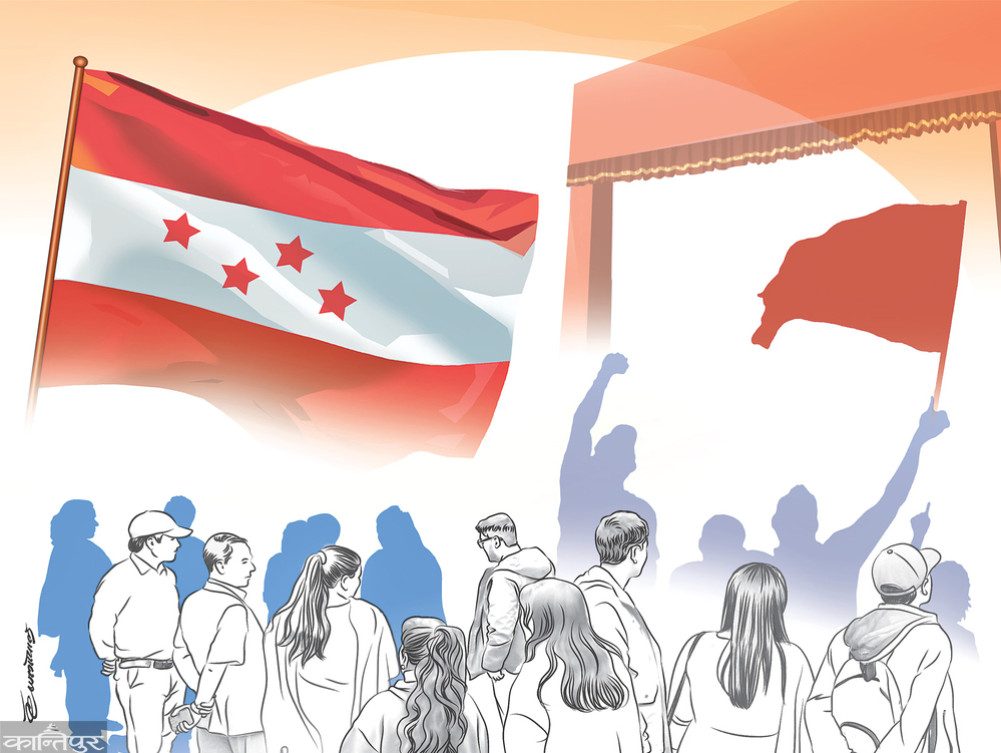
The Communist parties of Nepal seem to use the multi-party system strategically. Despite leaving the communist path, the party's name and working style are still authoritarian.
We use Google Cloud Translation Services. Google requires we provide the following disclaimer relating to use of this service:
This service may contain translations powered by Google. Google disclaims all warranties related to the translations, expressed or implied, including any warranties of accuracy, reliability, and any implied warranties of merchantability, fitness for a particular purpose, and noninfringement.
Since Kul Bahadur Gurung was the only one among the two representatives of Elam who were required to participate in the meeting of Tarun Dal on January 1, 2017, he made me a member of Tarun Dal for that day. On the same day, Prime Minister Visveshwar Prasad Koirala, Ganeshman Singh, Surya Prasad Upadhyay and Krishna Prasad Bhattarai were arrested by the army from the same meeting.
After that we all dispersed along with the meeting. But I never became a member of Nepali Congress . Since I have been keeping information on the history of Nepal's democracy, attacks and counter-attacks since the revolution of 2007 until now, I have some knowledge of each party in Nepal.
In the year 2007, I was studying in Adarsh Vidyalaya, Biratnagar in class three. Even today, the memory of the revolution is still fresh, but it was found during research after asking for its true information and evaluation.
Jawaharlal Nehru, the immediate prime minister of India, made an agreement between the ruling party and the Nepali Congress in order to maintain democratic stability in Nepal and if there was an understanding between the Rana and the new power, the country would move forward with the cooperation of the old and the new. But his loyalty did not work because Nehru himself wrote a letter to Raja Tribhuvan to make Matrikaprasad the Prime Minister in opposition to BP and made him the Prime Minister.
After that, the history of the breakaway within the Nepali Congress and the king taking advantage of it begins. On the one hand, the changes of 2007 made the Nepali people independent, on the other hand, it paved the way for an active monarchy. The Nepali Congress has always been at the center of this battle. As the King was active, the elections were held under the Constitution of the Dominion of Nepal in 2015, compromising on some key issues.
This constitution established a semi-parliamentary system because the constitution was given by the king, which was used by King Mahendra to end the system by using Article 55. This move not only re-emerged the autocratic monarchy but also planted the seeds of the republic. A direct battle between the king and the people began, which culminated in the declaration of Parliament in 2008.
This incident showed the example of Nepali Congress moving according to time and situation because there was no possibility of constitutional monarchy anymore. BP Koirala's 1971 article on monarchy in Tarun Patrika proved that the statement that "If the king does not need the people, then the people do not need the king."
While it is true that Neka has taken many conflicting decisions during the struggle, it cannot be said that he has completely surrendered to it. The compulsion to be sometimes soft and sometimes hot is a continuous process in politics which keeps the party dynamic.
Suvarna Shamsher found that in 1968, the party's decision to support the king overturned the decision taken a year earlier (constituent assembly election) and supporting it, BP and Ganeshman were released and some others got amnesty, but the situation had changed, but the goal of democracy was not compromised at that time. The events after the
made the monarchs themselves ambitious and disobeyed some basic principles of democracy. The Maoist armed conflict played a major role in setting the republican agenda.
This party also took part in the movement after reaching the decision to be converted. Neka was not in favor of constitutional monarchy. Some leaders and activists oppose such a decision of NECA because they cannot move with the times and circumstances, but since that is now history, the only option is to practice democracy well. The party should focus on the effective implementation of public programs and developing the country.
Since this party is connected with the identity of democracy, its ups and downs are very important for groups or individuals committed to democracy. This party should be objectively reviewed in the pre-republic and post-republic background. As NECA's main competition is with new and old parties with different backgrounds and ideological grounds, political upheaval continues.
The ideological deviations of those parties, the strategic partnership and the difference in calling and doing, have a negative impact on democracy. But since the role and orientation of Neka is stable, the change in leadership does not seem to affect its flow. Therefore, in the current perspective, it is natural for those who understand politics to think that the existence of NECA is very necessary for democracy.
Today, the CPN (UML) which was transformed after 2046 and the CPN (Maoist) which was transformed after 2062/63 are the mainstream parties after NCA. But their names and works are contradictory. Leninism or Maoism refers to a one-party system under which opposition to the leadership or open debate is prohibited. The current style and decision of the UML leadership is exposing the fact that tolerance has been lost within this party. The struggle within the Communist Party of Nepal has always been person-centered rather than principled. It is not a new phenomenon that a party gets divided when there is a slight disagreement.
Actions taken against Bhim Rawal, Binda Pandey and Ushakiran Timsena were decided on the basis of such individualistic thinking and it has been proven that there will not be any democratic tolerance within these parties. Pandey's and Timsena's tone of disagreement with Bhim Rawal's role cannot be seen as the same. Party discipline is needed but the party leader's slogan of believing in democracy is not compatible with such actions.
Nepal's communist parties seem to use the multi-party system strategically rather than as a matter of principle. Although politics is considered to be the art of the possible (Art of the Possible) and left the communist path, the party's name and working style seem to be authoritarian.
Khadgaprasad Sharma Oli said that there is no opposition to the leader in China within his own party, so he forgot that the political systems of Nepal and China are not the same. But he never fails to state that he is the most democratic and for this he spent 14 years in prison.
There is no theoretical identification of the parties that claim to have emerged as alternatives to the old parties NECA, UML and Maoist or any other. The Rashtriya Swatantra Party is a product of Ravi Lamichhane's flamboyant television appearances. The exact identity of which has not been done yet.
The slogans of cheap populism, exposure of the government's weaknesses and people's disappointment, suddenly became the fourth party in the election, the group came as a party later. Without considering the leader's background, sacrifice, principles, etc., the people voted for the candidate chosen by Lamichhane in an apolitical manner. Such anger, frustration impulse led some people to local level positions.
Even in Madhesh, the people supported the Janmat Party, showing their frustration with the old regional parties, the power attachment of the leaders and their anger towards their work. Despite the distaste for the Madhesi parties, their agenda is Madhesh-oriented, that is, they are more focused as a regional party. But they cannot come as an alternative to NECA, UML and Maoists. These parties are also attracted towards ruling politics and have overshadowed their agenda.
Even though people are somewhat attracted to CK Raut's Janmaat Party, the possibility that this party will gradually become like others cannot be denied. Since Raut's image of the Madhesi messiah has started to decline, there is no reason to believe that there will be an alternative power in Madhesh. Old leaves must fall to grow new leaves, but only if the new leaves are loud and good can the dominance of the old so-called parties come to an end.
Therefore, if there are some qualitative changes in Nepal's politics in today's context, such changes seem possible only through changes within the permanent party. The acceptability of any political party depends on the dynamism, populist tendencies, cleanliness, competent leadership and principles from within that party. NECA can be the defender of democracy as long as the party has ideological stability and strong leadership. Attrition cannot be stopped by compromising the
principle and implementing a person-centered approach. If the so-called permanent parties are unable to function, it will help in increasing the number of unruly characters and chaotic activities. To keep it running and attractive, the vehicle should be renewed as well as serviced from time to time.
An objective review of today's political parties cannot be based on exaggerated comments on social media. Often there is no truth in such comments. But public awareness cannot be ignored. Today, with the prevalence of communication, public awareness accounts for more good/bad work. At times, such awareness is disturbed by wrong propagation and dissemination of information. Therefore, today's media is like a double-edged sword, so the threat to democracy has increased.
A political frenzy can occur when people are fed up and frustrated with the disgusting and self-motivated actions of political leaders. Although storms do not have permanent effects, they do work to disrupt the system. The events of the past few years have shown the example of even the so-called big parties losing their way under the influence of such storms.
How Ravi Lamichhane suddenly got involved in politics and was able to reach a high position in the government, is as bright as the sun in front of everyone. The leader of the so-called big party confidently advocated in his favor and delivered what he said. The character and weakness of the leaders who deify someone and demonize them all the time has created distortion in democracy. Sometimes it is seen that the leadership is exposed if you don't pay attention to what to say.
I don't think that any party will come forward clearly today as an alternative to the Nepali Congress. CPN-UML is another big party, but looking at its leadership today, the leadership that can come tomorrow, it cannot be said that this party will remain in its current state. The future role of the UML cannot be determined as the tendency of fissures within the UML is increasing and Oli's leadership is becoming ineffective.
Vidya Bhandari's basis for making UML hockey's first team does not seem strong. Just because she is the wife of Madan Bhandari, it cannot be said that her leadership will be influential. The question of who will be after Oli can be a question that will increase the controversy because it is not thought that Oli will leave the field so easily. He has also given hints of this from time to time. There is no reason that another party, Maoist, will easily overtake UML and NECA. Its leaders and activists are privileged and jaded.
Although Prachanda stated that the party has a bright future to encourage its workers, it is difficult to say that politics has turned so easily in its favor. The future of RSVP is more bleak because it is a party based on individuals. The momentary popularity of the leader that led to this party is no more. Even if other leaders have won the election, those who have stuck to Lamichhane's personality (parasite) have yet to test their independent existence. Other parties did not matter.
How was Neka's condition in such a political scenario? Although the current leadership of NECA is not attractive (charismatic), there is no possibility of becoming an idol within this party and comparatively, NECA is democratic, stable and benign than other parties. Although there are factions within it, its credibility is more than others and so is the responsibility. It's hard to find a substitute these days.