If we study the data of the last decade in a proper manner, Nepal is not in the direction of corruption control, but in a more dangerous situation. This shows that corruption cannot be controlled by socialist economics alone.
We use Google Cloud Translation Services. Google requires we provide the following disclaimer relating to use of this service:
This service may contain translations powered by Google. Google disclaims all warranties related to the translations, expressed or implied, including any warranties of accuracy, reliability, and any implied warranties of merchantability, fitness for a particular purpose, and noninfringement.
General Secretary of Nepal Communist Party Netra Vikram Chand (Biplav) claims that capitalism is the source of corruption. In many of his interviews and speeches, he insists that capitalism is the cause of corruption and that corruption will not end until the roots of capitalism are destroyed.
Ghanshyam Bhusal, General Secretary of CPN United Socialist Party, is another leader who has this opinion. Bhusal B. No. In a program held in Kathmandu on August 28, 2081, he claimed that capitalism is the cause of corruption. In November 2021, Tribune magazine published an article by Gareth Fern titled 'Why Capitalism Loves Corruption?'
In the article Fern refers to Britain as the forefather of corruption. He believes that the industrial revolution in Britain ushered in the finance, insurance and legal professions, on the basis of which corrupt practices emerged one after the other. He also argues that Britain exported its culture of corruption to the world during colonial rule.
What causes corruption?
Capitalism is an economic system based on individual property, competition and market freedom. In this economic system, individuals or organizations in the private sector can operate independently for their own profit. Proponents of capitalism say that this economic system leads to increased productivity, innovation and improved living standards.
However, critics portray capitalism as a major factor in corruption, saying that this economic system creates economic inequality, divides society into rich and poor, and compromises morality for private profit.
In most political and intellectual debates in Nepal, capitalism is presented as the cause of corruption. According to those who hold this view, corruption is almost inevitable because capitalism prioritizes private profit. However, an equal number of empirical and theoretical articles can be found for and against it.
Some scholars claim that the idea that corruption only increases under capitalism is wrong. According to them, corrupt practices have existed long before the development of modern capitalism. However, the role of capitalism in its rapid spread cannot be denied. But when studied closely, corruption does not grow and thrive only in capitalist governance. That is, the capitalist economy alone is not a sufficient reason for this.
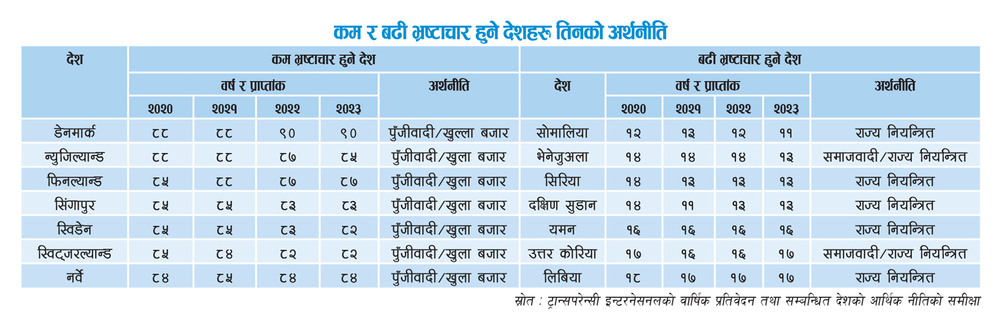
If you look at the last four years of the Corruption Perceptions Index published by Transparency International every year, a different picture emerges. which is presented in the table. The data presented in the
table shows that capitalist democracies with open market economies such as Denmark, Finland, New Zealand or Norway have low corruption. Likewise, the prevalence of corruption seems to be high in countries that have adopted a state-controlled socialist economy such as Somalia, Venezuela or North Korea. This provides a basis for understanding that capitalism is not the only root cause of corruption in the contemporary world.
Even in countries with economic, social, political and administrative conditions like Nepal, the causes of corruption are very complex and multifaceted. Nepal is not a capitalist country based on the Constitution of Nepal 2072.
It took almost a decade for Nepal to constitutionally adopt a 'socialism-oriented' economic policy. The policies, rules, and laws made by the state are still based on socialist-oriented economic policies. But if we study the data of the last decade only
Nepal is not in the direction of corruption control, but in a more desperate situation. This shows that corruption cannot be controlled by socialist economics alone. The situation of corruption in socialist countries like China and North Korea is worse than in capitalist countries. According to the Corruption Perceptions Index published by Transparency International, a country with a score of less than 50 out of 100 points is characterized as a country with a corruption problem.
according to which China scored only 42 in 2020, 45 in 2022 and 42 in 2023. This means that even though China is socialist, the level of corruption in China is high. Corruption has taken root in China at the level of high government officials. According to a recent news report, China has prosecuted 56 high-ranking officials for corruption in 2024 alone. In 2023, there were only 45 officers working in such high positions.
Even in China, which has a socialist economic-political system, the risk of corruption seems to be increasing. On the other hand, countries like Denmark, Finland and Norway are among the least corrupt countries in the world. These countries have prioritized important aspects such as rule of law, strengthening of public institutions, transparency and accountability. These countries have ensured basic needs such as education and health and developed strong social security systems, which have played an important role in reducing corruption.
Corruption is deeply rooted in Nepal's political and economic system. It is not only caused by capitalism, but also by reasons such as existing political instability, weak institutional structure, opaque and irresponsible administration mechanism, neglect of the state in basic issues such as education, health and weak social security system.
Nepal has been in a period of political transition for a long time. Frequent change of government, abuse of power, lack of transparency in the policy making process etc. has led to corruption. Corruption is rampant in areas such as large public projects, roads, hydropower. Shoddy construction work, unnatural delays and budget overruns are everywhere to be seen.
Melamchi water supply project is the most prominent example of this. Similarly, to get public service, it has become mandatory to pay commission or commission. For example, ordinary citizens are forced to pay bribes or bribes to get services from government offices such as shipping and transportation.
A large part of Nepal's economy is based on the informal economy. From large business firms to small businesses, cases of tax evasion are widespread. This is contributing significantly to increasing corruption. Legal structure, enforcement system, transparency and accountability required for corruption control in Nepal have not yet become strong.
There are various legal provisions to control corruption, including the Prevention of Corruption Act, the Commission for Investigation of Abuse of Authority Act, and the Special Court Act. But these are not enough by themselves. These laws have not been amended according to the changing times. The Prevention of Corruption Act has been in the parliament for years and has not been amended. The same is the case with the Abuse of Authority Investigation Commission Act. The conflict of interest law has not yet been enacted.
Institutions established to control corruption are weak. Instead of strengthening such bodies, activities are being done to weaken them more and more. V.No. The authority to investigate and take action related to 'improper actions', which was removed from the responsibility of the Abuse of Authority Investigation Commission by the Constitution of 2072, has not been assigned to any body for a decade. This has led to further chaos. The National Vigilance Center under the Prime Minister has been weakened.
In the country, the culture of finding one's own people is not good. As much as possible, the tendency to look for people of their party or opinion, if not their family, relatives, has increased corruption. The culture of seeing only one's own people as capable has supported corruption. There is a growing tendency to get more professional development and service facilities based on their access to the political and administrative fields. It has elevated the disabled person to the top level of the organization. When seen, these and such questions are very important factors for increasing corruption.
Another argument that capitalism is not a sufficient cause of corruption is linked to its history. Corruption has a much longer history than capitalism. According to historians, the modern capitalist economy began in the fourteenth century.
Hickel Jason's 2017 book 'The Divide: A Brief Guide to Global Inequality and Its Solutions' traces the origins of the modern capitalist system to the 14th century conflict between the landed aristocracy and agricultural producers or slaves. But the history of corruption seems much older than that. Various texts mentioned in ancient times have mentioned about corruption.
In India, the famous policies of Chanakya period and earlier such as Bhishmaniti, Viduraniti, Manusmriti etc. have also mentioned about corruption. Chanakya was born in 370-283 BC. Chanakya has written on various issues related to corruption and extreme wealth. He mentioned that an aggressive policy should be adopted against the corrupt. It is said in Chapter 25 of Kautilya Arthashastras.
Api samika gatirgynatum pattan khe patattrinam.
You don't move with disguised emotions..
i.e. it is possible to understand the movement of birds flying in the sky, but it is not possible to know the feelings of a person appointed to a responsible position of the state to loot or misuse the state funds. This means corruption in the system of governance since before 370 BC. At the same time, it was difficult for the state to detect the schemes of those who misused public resources.
In this way, corruption existed in the governance system even without the origin of capitalism. This also shows that capitalism is not the cause of corruption. If capitalism alone is not a sufficient reason, corruption cannot be controlled by the end of capitalism alone.
Therefore, the notion that corruption is only a consequence of capitalism and that corruption ends with the end of capitalism is misleading. It is necessary to look at the work of corruption control from a multifaceted angle. Regarding corruption control, Gareth Fern also does not hold the view that corruption can be controlled only after the end of capitalism.
He emphasized in his article that more democratic systems should be established and civilized to end corruption. Also, he is of the opinion that by ensuring the participation of all citizens in politics and making every organization strong and empowered, it will contribute significantly to reforms. Nepal also needs political will, strengthening of public institutions, legal reform and active participation of citizens in governance to control corruption.
(Ghimire is an associate professor at Tribhuvan University)

