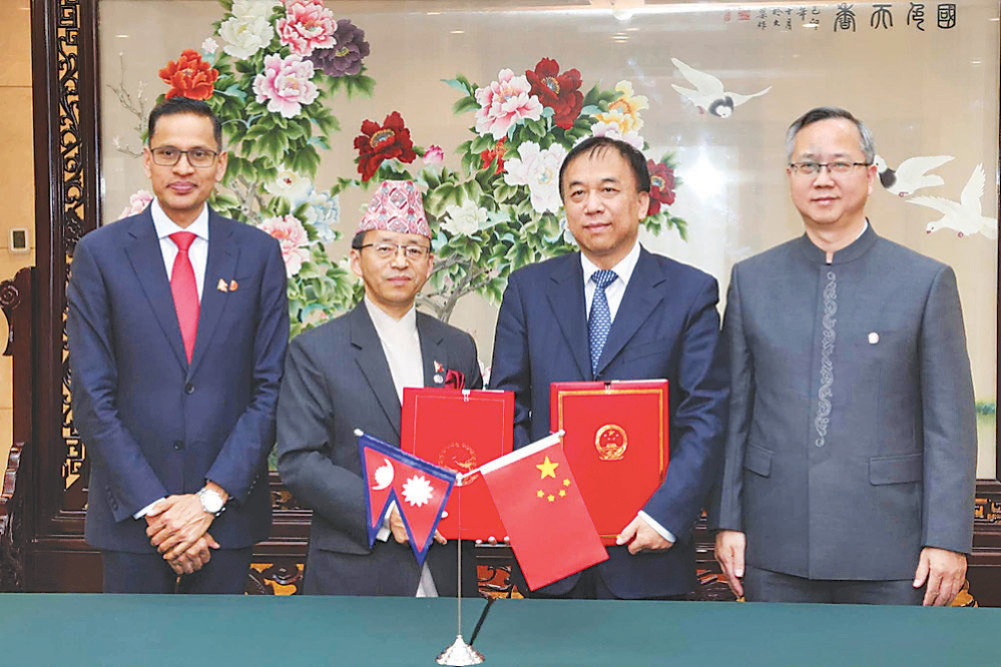
Regardless of what India will say, what the US will say, and whose side it will take, it seems that Nepal has reached a stage where it will end the policy of non-alignment and no one will believe it.
We use Google Cloud Translation Services. Google requires we provide the following disclaimer relating to use of this service:
This service may contain translations powered by Google. Google disclaims all warranties related to the translations, expressed or implied, including any warranties of accuracy, reliability, and any implied warranties of merchantability, fitness for a particular purpose, and noninfringement.
The First World War of 1914-19 was fought between the developed countries over who would seize the markets in the Second and Third Worlds. The second world war was born out of the squeeze of the first war, resulting in internal and external debt traps, inequality and abusive treatment (Hobswam, Eric (1994) The Age of Extremes A History of the World' (1914–1991) Vintage.
After the Second World War, the situation changed, but soon the Cold War began. Some countries became divided in the name of their respective military and commercial groups. Like, the Warsaw Pact group led by the disbanded Soviet Union and the NATO group led by the US. At that time, most of the third-world countries joined the non-aligned movement.
The collapse of the Soviet Union led to the dissolution of the Warsaw Pact and the dissolution of their Council for Mutual Economic Assistance (CoMcN). The US-led G-7, the IMF and the World Bank became influential. Even in the new environment, countries like China, India, South Africa, Brazil, Mexico, Argentina, South Korea became economically and politically influential. They also managed to expand their share in manufacturing and world trade.
As the capacity of the nation increased, those countries sought to share their leadership roles in the United Nations, the IMF, the World Bank, the World Trade Organization, etc. and demanded that those institutions be restructured (Chandrashekhar, C.P. (19 October 2023), How IMF and World Bank Needs Redesign, Not Just Reform, Frontline). But the western countries did not want to hear the demand.
From BOR to BRI
After the global recession of 2008/09, China changed the strategy of export led economic growth (export led growth) and adopted a strategy of internal capacity building with an advanced level of economic growth. In order to increase the domestic consumption of goods and services, China spent 4 trillion RMB, i.e. 586 billion US dollars, in the form of a stimulus package. He spent the money mainly on connecting the developed eastern part of the country and the underdeveloped western part (Chinese Economic Stimulus Program, Wikipedia).
After nearly 4 years of experience, Chinese President Xi Jinping put forward the concept that Europe and Asia, i.e. 'East-West Intercontinental Silk Road' can be built. He added that apart from the old concept of infrastructure development (in other words, the concept of capturing the local market), along with infrastructure development, every country or region should take necessary initiatives to produce local goods and services for the balance of payments in trade. So that no one can exploit and oppress anyone and dependency does not increase. It was named 'One Belt One Road' (OBOR) during the launch of the
programme. After the official launch of OBOR, the construction of new airports, seaports, railways and roads began. China benefited from Europe buying high technology and machinery and Europe buying consumer goods from China. It was not uncommon for high-speed trains and ships to be economical when transporting goods in a short time.
It was not a challenge to the liberal economic order (Liberal Economic Order) adopted politically by the United States and European countries. Therefore, more than 150 countries of the world including Greece, Italy and some countries of West Asia, Africa, Latin America and Europe joined the BRI.
In 2019, the World Bank formed a committee to evaluate BRI activities under the leadership of Michel Ruta. It produced a 159-page report titled 'Belt and Road Economics'. In its conclusion, it is said that by joining the BRI, the cooperating countries will be able to reap great benefits, especially the development of roads and other transportation will reduce costs and help connect the whole world. This program will play a role as a supplement to the insufficient amount of about 18 billion dollars to achieve the sustainable and reliable development goals of developing countries.
But in the year 2020, some tension started in western countries regarding BRI. They accused the BRI of a lack of transparency, withholding of information on conditions, particularly with regard to investment, and of a campaign to trap poor countries in debt. Like, Sri Lanka's Hambantota port construction and financial bankruptcy. But investigation and facts could not confirm the accusation.
According to David Dollar, an American economist working at the Brookings Institution, the BRI fund is actually meant to fund infrastructure development. More than two-thirds of its annual investment is in fuel and transportation, i.e. 50 to 100 billion dollars.
The dollar loans that developing countries receive from this fund are on commercial terms, which are cheaper than private investors and slightly more expensive than subsidized multi-purpose bank loans under Western donors. These investments from China are not only in Iran and Venezuela, which have not been trusted by the West or in the RECIB countries, but countries such as South Africa, Kenya, Tanzania, Indonesia and Brazil have also taken loans as needed (Dollar, David (October 1, 2020) Seven Years into China's Belt and End road).
Boston University's Global Development Policy Center, according to a research report on BRI's 10-year tenure, stated that there are two important benefits: (1) Significant economic growth: Chinese overseas development finance has invested in industrialization and infrastructure development, especially in developing countries.
that looks different from the World Bank as an ancient investor. The bank has been spending more on institutional capacity development, while Chinese financial investment infrastructure development and industrialization investment has been seen as sustainable and reliable. (2) A new model of cooperation in the countries of the South: Chinese investment in the developing countries of the South has provided an alternative to development finance and alternative investment institutions in developing countries, such as AIIB and BRICS Bank.
The report also talked about the risks that BRI would create: (1) A huge pile of debt. (2) Risk of increasing carbon dioxide and increasing air pollution. (3) Threats to biodiversity and tribal displacement. But it seems that developing countries are ready to take risks compared to the benefits mentioned above.
The threat seen by America and India
Initially, BRI was based on 6 principles – (1) Policy coordination (2) Infrastructure adjustment (connectivity) 3) Trade (4) Joint financial investment (5) People-to-people cooperation and coordination and ( 6) Industrial cooperation. There were three important goals of this program - First, while the Western countries were not getting over the economic recession, they wanted to use the capital savings and manufactured goods accumulating in China together with the developing countries of the world.
which eased the flow of manufactured goods and capital which had been blocked due to recession. Secondly, it could have solved the problem of industrial overcapacity. Thirdly, it opened the way for coordination, cooperation and solidarity with the developing countries of the South. According to the World Bank, from 2013 to 2018, 575 billion US dollars were spent on the BRI program, and it is estimated that 1 trillion dollars will be spent on BRI projects from 2017 to 27.
China held forums in 2017, 2019 and 2023 to evaluate three actions after launching the BRI. Many big leaders gathered in these gatherings and many agreements were signed. Representatives of 150 countries and 30 world-class organizations actively participated in the forum, which was organized on the occasion of crossing the first decade. The media reported that the Forum was worth $1 trillion worldwide (Sachdeva, Gulson (2023), 'Ten Years of Virat', JNU SIX).
The success of the BRI suggests that the United States has begun to fear the loss of its global credibility. That impression led US policymakers to launch a plan against China called debttrap diplomacy (Dollar, David (October 1, 2020). Although most countries that borrow from China, they also borrow from Western countries and the three subordinate banks and private banks. Take a loan. No country goes broke by taking a loan. Be it Sri Lanka or Pakistan Other studies have shown that the problem is not only caused by Chinese debt, but that the entire economic policy is wrong (Brötig, Devroh (February 6, 2023) The Chinese Debttrap is a Myth, The Atlantic). The main corridors include almost all the continents of the world. Compared to 1980, the Chinese economy has become 42 times larger by 2021 More than 300 Chinese organizations and state enterprises have spent 843 billion US dollars in 13,427 BRI development projects in 165 countries.
The Export-Import Bank and the Development Finance Corporation were set up under Donald Trump to kill the BRI program. The Wyden administration launched Build Back a Better World, later known as the Partnership for Global Infrastructure Investment (PGII).
It is particularly campaigning on climate change, fuel security, health and wellness security, digital security and expanding private investment in gender equity and equality. In addition, there are MCC campaigns in least developed countries including Nepal (Sacks, David (September 14, 2023) Will the US Plan to Counter Chinese BRI Work? Council on Foreign Relations).
India decided not to join BRI as it would compromise its sovereignty. Especially China-Pakistan Corridor (CPEC) he objected to the construction of the corridor through Pakistan-protected Kashmir. But China has expanded trade, fuel transportation and investment with the Indian Ocean, West Asia and Africa through the BRI. India has also been complaining about lack of transparency and debt trap in BRI in American style. However, India is the second largest investor in China-headquartered Asian Infrastructure Bank.
A memorandum of understanding was signed through a sideline meeting on the sidelines of the G20 summit held in Delhi on September 10, 2023. It was signed by India, UAE, Saudi Arabia, Italy, France, Germany, US and European Union. The agreement was signed to build the India-Middle East-Europe Economic Corridor.
It was agreed to expand railways and sea routes between India, Gulf countries and Europe and build electricity, clean energy and digital connectivity in the countries along those routes. The project was supposed to connect India economically with the West and lay the infrastructure to connect UAE, Saudi, Jordan, Israel and Europe.
The signatories were eager to somehow contain or challenge an increasingly powerful China. But the investment of NATO countries in the Ukraine-Russia war, the pursuit of alternative fuels, the murder of journalist Jamal Khashoggi, the development of an understanding between Saudi Arabia and Iran mediated by China, India's fascination with Russia, etc., do not seem to be able to move forward with that project.
Currently, the war and conflict between Israel-Palestine-Iran-Lebanon is going on in the Gulf (Somya Chaudhary (February 2, 2024) 'Is the IMEC Destined to Fail?' L Journal of International Affairs). Due to this phenomenon, countries of the South should consider BRI as an alternative source for sustainable and reliable development.
BRI discussion in Nepal
BRI discussion in Nepal is not new. Discussions on the BRI project have started in Nepal ever since the current Prime Minister KP Oli visited Nepal for the first time in 2015, and Oli himself had dreamed of a Chinese Chukche railway from Rasuwa-Kaski-Kathmandu and a ship in Narayani and Koshi. Even after that, innumerable conferences and seminars involving Chinese and Nepali academics, bureaucrats and party leaders were held.
In 2017, a Memorandum of Understanding (MoU) was signed between Nepal and China on BRI. But in a long period of almost a decade, the rulers could not come to a conclusion after serious discussion about the choice of BRI project, investment modality and its economic and social impact. Instead, they kept on bargaining as MCC or BRI. India or China kept beating.
This time during Prime Minister Oli's visit to China (November 17-20, 2081), China proposed a BRI implementation action plan with the Nepalese government. But the coalition government proposed a 'Framework for Belt and Road Cooperation' in contrast to the BRI's theoretical conceptual preamble (to cooperate).
Prime Minister's 'Frame Minister's' Frame Copection 'End Coverness' proposes, but China did not accept the subject in Nepal in the project. Therefore, the technical support and China reached Nepal and China will be suspicious, even if it reached Nepal and China in agreement. The Nepali economy has been slow to over more than a decade more than a decade. What is rulers and policies makers priority? How to bear the crisis and risk? What programs are required to move forwardable not to be able to move forward.
is showing the situation to be separated from others as he could not carry his agenda. India will say that the United States will say, as much as partying, and the removal of the opposite of the curve. It is necessary to get free from a party against the Coldue and opposition, not independent and to ensure. Otherwise, sovereignment can also be in danger.