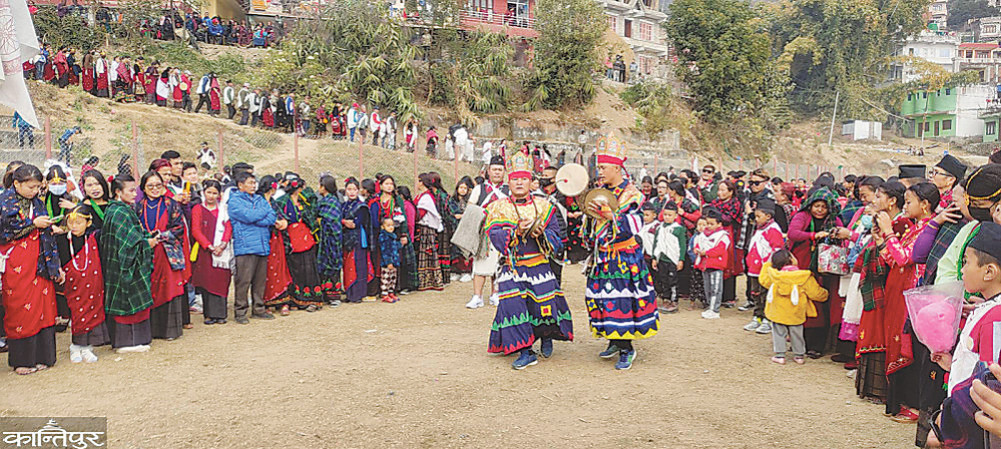
Festivals like Lhosar, Mangi, Mein Thale Dina, Thoten have established the Tamu caste with a distinct identity all over the world. However, it is a matter of concern that distortions have entered from traditional food dishes to original costumes and music.
We use Google Cloud Translation Services. Google requires we provide the following disclaimer relating to use of this service:
This service may contain translations powered by Google. Google disclaims all warranties related to the translations, expressed or implied, including any warranties of accuracy, reliability, and any implied warranties of merchantability, fitness for a particular purpose, and noninfringement.
Gurung is called 'Tamu' in Gurung language. 'Ta' represents thunder, top, horse and axe, while 'moo' represents the sky. In this way, Tamu means thunderbolt of the sky, horse or horse breeder and lekali man. In other words, Tamu is the people who live on the upper part of the mountain of Himalner.
Identity is determined by a person's language, religion, belief, culture, geography, history, etc. The Tamu (Gurung) are scattered all over the world from Bhutan through Annapurna, Manaslu Himchuli Hills to the eastern hills of Nepal and to some extent Sikkim, Siliguri in India. According to the 2078 census, the population of Gurung in Nepal is 543,790.
Tamu's three main scriptures are Pye Tan Lhu Tan (Religion-Culture Science), Kerlo (Genesis Science) and Ngome (Medicine Science). Pye Tan Lhu Tam has a very profound folk saying 'Pye Mhasya Chhya Mhamu, Chhya Mhasya Lhua Mhamu, Lhua Mhasyan Mhi Mhamu'. Which means that 'if scriptures are lost, sanskar is lost, if sanskar is lost, culture is lost and if culture is lost, people are lost'. The entire Gurung Jeevandarshan is directed and operated on the basis of this principle.
You have your own vision of life. Lhosar, Mangi, Main Thale Dina, Thoten etc. are important festivals of Tamu. It is this original festival that has established the Tamu caste with a distinct identity around the world. This year the Tamu Gurung community is celebrating Sapri Lhosar/Lhochhar, bidding farewell to the Mupri Lho (vulture class) and welcoming the Sapri (snake) class. Every year from the 15th of January, a new era begins with a new class in the Gurung community.
The Gurungs also celebrate the 15th of December as the birthday of their Guru Pratham Mahapurush. No matter where you live in the world, people gather on this day in monasteries, khoivos and community houses and organize various programs to celebrate Lhosar with gusto. For the Gurung community, Lhosar is not only the new year, but also the day when they play Seonra (Vailo) and eat Syokain (Forest Feast), perform Sildo Naldo (Symebhume), Khe (Pitru) Ma (Matri) and Falu (King Puja), as well as set the date for financial transactions on this day. It is also celebrated as.
Tamu Lhosar is the faith, belief, identity and whole life philosophy of the Gurung community. Just as the 12 zodiac signs are important in the Hindu scriptures, the 12 lhos (classes) named after animals and birds have special significance in the Gurung scriptures.
Each year in the Lho cycle, after one category is enjoyed, the next year begins as a new Lho (category). The Gurungs calculate their age according to this calendar, and after finding out the auspicious-unlucky, lucky-unlucky, they perform prayers, planetary peace, birth, marriage and death rituals according to the Lama and Pacyu scriptures.
From the night of the 14th of January, especially Gurung youth and Gurung priests stay awake by lighting fire and dancing to welcome the Lhosar/Lhochar of the new Lho and at midnight exactly at 12 o'clock they say goodbye to the old Lho and welcome the new Lho according to the ritual.
This year the Tamu community is celebrating Lhosar/Lhochar by saying goodbye to the Mupri Lho (vulture class) and welcoming the Sapri (snake) class. As usual, this year also on the morning of 15th of January, Gurung dressed up in garb and went to the monastery and Khoivo (temple) to pray and offer prayers at Lam, Pacyu Gurudwara Ripa, Khada and receive blessings from the dignitaries and exchange greetings with each other.
Tamu has rituals, culture, festivals, costumes, beliefs and original food. Earlier they used to gather in the open fields, forests, river banks near the village to celebrate Lhosar. Syonra (bulls) used to eat Syokai (forest food) from grain and cash. The program of that time was the common program of the village. Gurungs were not divided on the basis of any caste or caste. They used to exchange happiness.
The respect and honor shown to the dignitaries was of the highest category. Kandamool, ghat ko jhol, phapar roti were the special dishes of Pus 15. Sildonaldo, Kool Pitru and the guests were first offered nare pa or millet wine. If someone had taken a loan and given it, the loan would have been placed on this day.
The originality of Tamu Lhosar/Lhochar is getting lost lately. Lhosar programs have been transformed into thultula assembly halls and party palaces. Distortion is spreading even in the traditional food dishes and original clothes and music. Masham, Chowmin and Thuppa are taking the place of Tarul and Pindalu. Foreign liquor is now being used instead of nare pa, which is not common in Lhosar.
Women's red or koleji colored velvet choli and same color ghelek, blue patuki, black velvet tikisa and green or koleji malina pachauri have been replaced by glittering lehengas, boutique cholo and ghelek. The clothing worn by men has been limited to a coat and pants.
Musical cheer, volleyball, football are taking place in place of the original sports games, tug-of-war competitions. Khasnepali and foreign music are taking the place of Gurung songs. Original, ideological and creative debate on culture is not possible.
It seems that such programs organized by spending millions will endanger your identity. The time has come for the concerned castes, communities and organizers to think responsibly. Thaanlai tamu sapri lhosarai ashimalan.