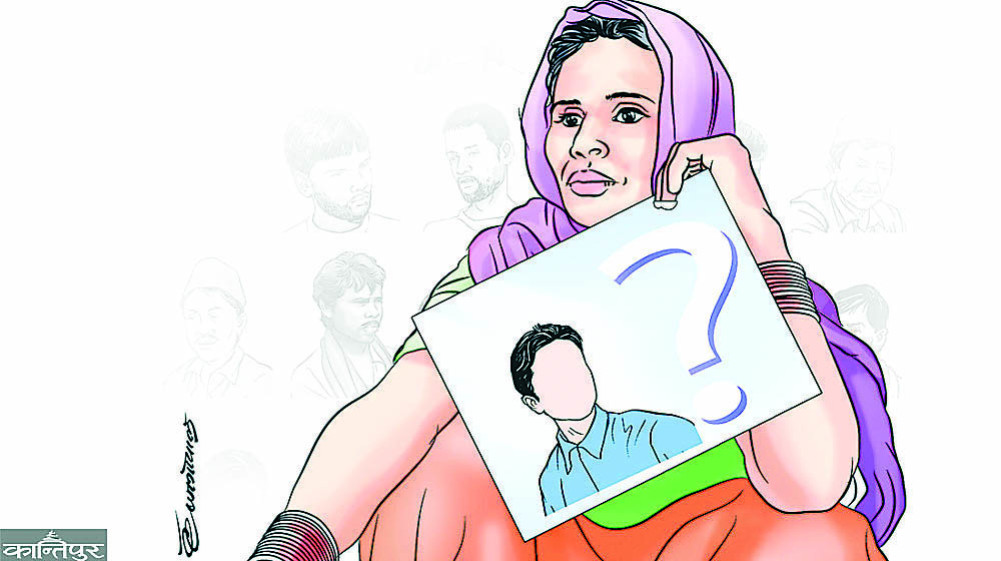
This process will get legal and social acceptance and legitimacy only if the parties can pave the way for forming a commission according to justice and not according to their interests. A ritualistic process cannot make the justice process credible.
We use Google Cloud Translation Services. Google requires we provide the following disclaimer relating to use of this service:
This service may contain translations powered by Google. Google disclaims all warranties related to the translations, expressed or implied, including any warranties of accuracy, reliability, and any implied warranties of merchantability, fitness for a particular purpose, and noninfringement.
The process of giving justice to the victims of the conflict that started in the 50s has stalled even in the early 80s. The committee formed to recommend the appointment of the chairperson and members of the investigation and verification and reconciliation commission of disappeared persons has lost its validity and legitimacy as it could not reach consensus.
The term of the committee formed on November 2 ended on Monday amid failure. Now a new committee has to be formed and a new process has to be initiated. As a result, the wait for the justice of the conflict victims is sure to be extended. At the same time, irresponsible tendencies of the parties have been repeated here as well.
Ever since the Comprehensive Peace Agreement was signed in 2063, the issue of transitional justice has been at the tussle of Congress, UML and Maoists. That is why they did not agree on the agenda of amending the law. The law was amended only after reaching an agreement between them last July.
Therefore, a committee was formed to recommend the chairman and members of the commission. The committee asked for applications on November 23, and 156 people submitted their claims. Among them, the committee had also prepared a 'short list' of 8 as chairman and 32 as members. It was expected that the committee, which proceeded by adopting a process such as receiving
complaints and also watching presentations, would recommend the chairman and members. But the committee failed in its sole mandate.
With the amendment of the Act by Parliament, it was expected that the issue of transitional justice would be freed from partisan interference and proceed through the legal path. However, the committee itself could not be freed from the instructions of the parties. The process has again broken down as the parties try to make the committee, which has the sensitive responsibility of recommending the officials of both commissions on transitional justice, their own political tools. The parties did not seem sincere about the basic issue of
victims getting justice. On the other hand, how can it be, that the parties are trying to paralyze the commissions that are formed on the basis of its recommendation to form a commission that is not even on the ground. Which has again disappointed the victims who are waiting for justice.
The opportunity came again to complete the peace process by facilitating the slow moving process. Because, the law was amended by consensus among major parties. Many national and international organizations and countries who have a deep vision for this have given a positive response.
Their habit of not learning from the past, not being accountable to anyone, was repeated in this context as well. It is clear that they do not want the commission to be formed and function successfully under the leadership of a person who is still standing on strong, credible and moral ground. However, this kind of political sports is a daily undertaking for the parties.
They will suffer the consequences. But this topic is not limited to this. This issue is connected with the expectation of justice for thousands of conflict victims. At least 64,000 complainants who filed a complaint with the Truth and Reconciliation Commission and 3,000 complainants who filed a complaint with the Disappeared Persons Investigation Commission are disappointed again at this time. Parties cannot afford to ignore them. Because
is intended to make the victim fall, more injustice has been done to the victim. The time, intellectual, financial and physical investment of the country is also going without return. As the problem continues, it is getting worse. There is no accounting for the questions raised on the country and the lost image. As the term of the
committee has expired, there is no option now that another committee will be formed and at least expect it to work successfully. A strong recommendation committee is indispensable to create an efficient commission. This process will get legal and social acceptance and legitimacy only if the
parties can pave the way for making the commission according to justice and not according to their interests. A ritualistic process cannot make the justice process credible. Therefore, there is a need for faith at the very beginning of the new initiative for the formation of the commission.