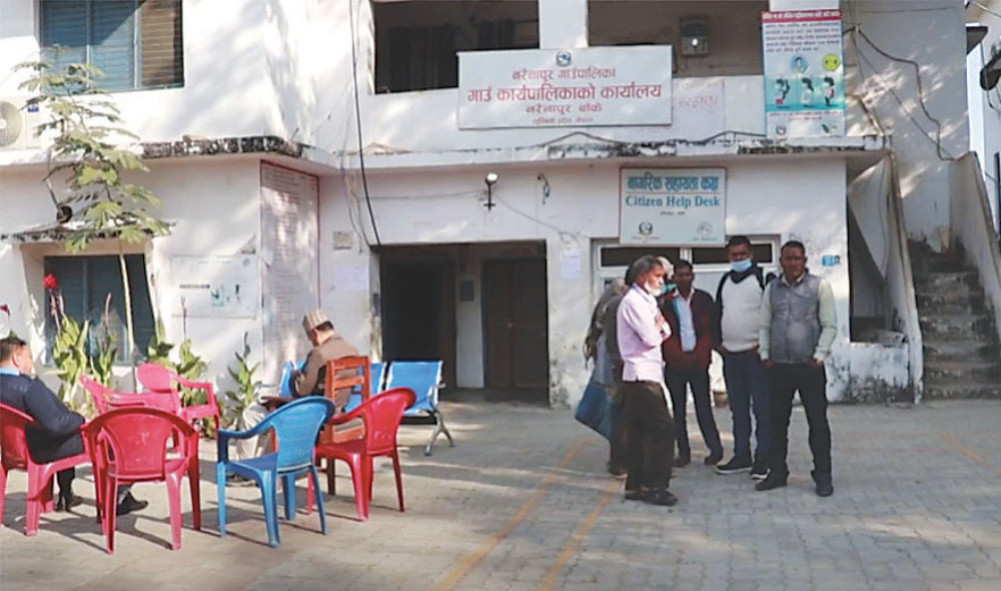
Capacity enhancement of local government is possible only if different training institutes can be operated under the joint investment, ownership and leadership of 753 local governments. Therefore, the next debate should focus on the establishment and operation of separate training institutions under local government ownership and leadership.
We use Google Cloud Translation Services. Google requires we provide the following disclaimer relating to use of this service:
This service may contain translations powered by Google. Google disclaims all warranties related to the translations, expressed or implied, including any warranties of accuracy, reliability, and any implied warranties of merchantability, fitness for a particular purpose, and noninfringement.
The basic structure of Nepal has three levels and its operation is according to the principles of cooperation, coordination and coexistence, according to the constitution. The three levels of government will operate under the Constitution rather than under each other.
There is a constitutional and legal provision to help each other in the implementation of single rights and not to interfere with the rights. But the trend of trying to do all the work by themselves, taking the poor performance of one level of government as an opportunity for another level of government has been seen from the beginning. In this way, the three levels of government are seen as competitors among themselves.
The legislative and executive practice that was used only by the Center yesterday is now at all three levels. Naturally, special efforts should be made to enhance the capacity of provincial and local governments to use these rights effectively. Currently, two institutional structures are functioning with the aim of enhancing the capacity of the local government.
Local Development Training Institute
is a local development training institute for capacity building at the local level. Although the institution has contributed significantly to the capacity development of the local level in various periods, even after the country entered the federal democratic republic, it has not made any effort to operate in a federal structure as per the name. It is not considered necessary to create a mechanism to operate the establishment so that the local government has no ownership and ownership, where only the central body is represented.
There is no basis to believe that the establishment without any participation and representation of the direct stakeholders is working in the interest of the local government and will continue to do so. By transferring the previous training centers to the provinces, the institute has limited itself to the centers only.
has not shown more status and capacity than a branch of the Ministry of Federal Affairs and General Administration. Therefore, this institution established at the center in the name of the local level should be reorganized so that it operates under the leadership and ownership of the local government representative, otherwise there is no point in maintaining this structure.
Provincial Training Institute
With the aim of enhancing the capacity of the provincial and local levels, a joint (basket) fund has been established with the investment of development partner organizations under the Ministry of Federal Affairs and General Administration and the Government of Nepal. The name of which is Provincial and Local Government Support Program (PLGSP). Although the budget was 13 billion and was designed for five years, only 22 percent of the program was spent during the entire period. Due to this, the effectiveness of this program has been criticized.
The local development training institute of Savik, which has a long history, could not save its existence. At present, Gandaki, Karnali and Sudurpaschim have converted the provincial governance centers into provincial training institutes by making provincial laws, while the rest of the provinces are operating under the same name.
Looking at seven years of experience, the provincial training institute/provincial governance center did not seem to be relatively successful. If only 17 percent of the budget allocated from the PLGSP program can be spent, the stakeholders have many questions about the quality and reliability of the work done. The presence of local government in these structures was ignored.
The Ministry of Federal Affairs and General Administration at the Center and the Office of the Chief Minister and Council of Ministers in the provinces are operating under the sole control of the local government, neither can take its ownership and adoption nor proper benefits. Although the process of extending the second phase of PLGSP for another 5 years went ahead, there was no effective presence of leadership and ownership on the part of the local government.
The next debate is different establishment
753 local government's joint investment, ownership and leadership of a different training institute is only possible to increase the capacity of the local government. Therefore, the next debate should focus on the establishment and operation of separate training institutions under local government ownership and leadership. The Third National Congress of the National Federation of Rural Villages, which is the umbrella organization of 460 rural villages, has decided to take the initiative to establish a unique training institute under the leadership and ownership of the local government.
Many countries in the world have become self-sufficient in capacity building by running training institutes with the joint efforts of local governments. The 'All India Institute of Local Self-Government', established by local government officials, educational experts and public administration experts in India, is playing an important role in enhancing local government skills and knowledge.
Institute focuses on capacity building and training programs with the aim of improving governance, efficiency and service delivery at the local level. Through workshops, seminars and courses help officers understand policy, implement best practices and effectively address community needs.
This initiative is making a significant contribution to strengthening democratic processes in local governance across India and promoting sustainable development. With a history of 93 years, this institute is working in close collaboration with central and state governments, national and international agencies.
Brazil's three-level federalism country like ours, the 'Local Government Association' is focused on the promotion of effective local governance throughout the country. Acts as a platform for local government representatives and officials to share best practices, access training and advocate for local interests at the national level.
The Australian Local Government Association is also focused on enhancing the skills and knowledge of local government officials through training programs. It creates a curriculum in governance, management and service delivery, which aims to improve the effectiveness of local councils.
The South African Local Government Association conducts training for municipal officials focused on governance and service delivery. These programs are designed to enhance the skills and capabilities of stakeholders, enabling them to effectively manage local government operations and serve their communities.
Similarly, local government associations/confederations such as the 'National League of Cities' in America, the 'National Association of Towns and Villages' in Japan, the 'Federation of Canadian Municipalities' in Canada, and the 'Local Government Association/Association of Country Councils' in Britain They are running a training institute under their own leadership, investment and ownership for capacity building.
Even looking at international practice, our local government leadership, investment and ownership of training institutes need to be different. For this, the National Federation of Villages in Nepal has already made it a subject of debate by making an institutional decision.
Federation and Nepal Municipality Association can jointly bring and lead the debate on this issue. If these associations/confederations want, they can get all 753 local governments to agree to participate in the establishment of the establishment under their own leadership, investment and ownership.
The amount spent for capacity building from the union, state government and development partner agencies and the share amount of all local governments can be invested in it. Then one training institute at the center and training centers at all provinces (or cluster level) can be run.
In this situation, as a first option, the local development training institute owned by the federal government can be restructured and put into operation in the proposed model through the amendment of the law. That is, making it a matter of debate, one can move on to a better option.
– Pyakurel Rural Municipality is the executive director of the National Federation of Nepal.