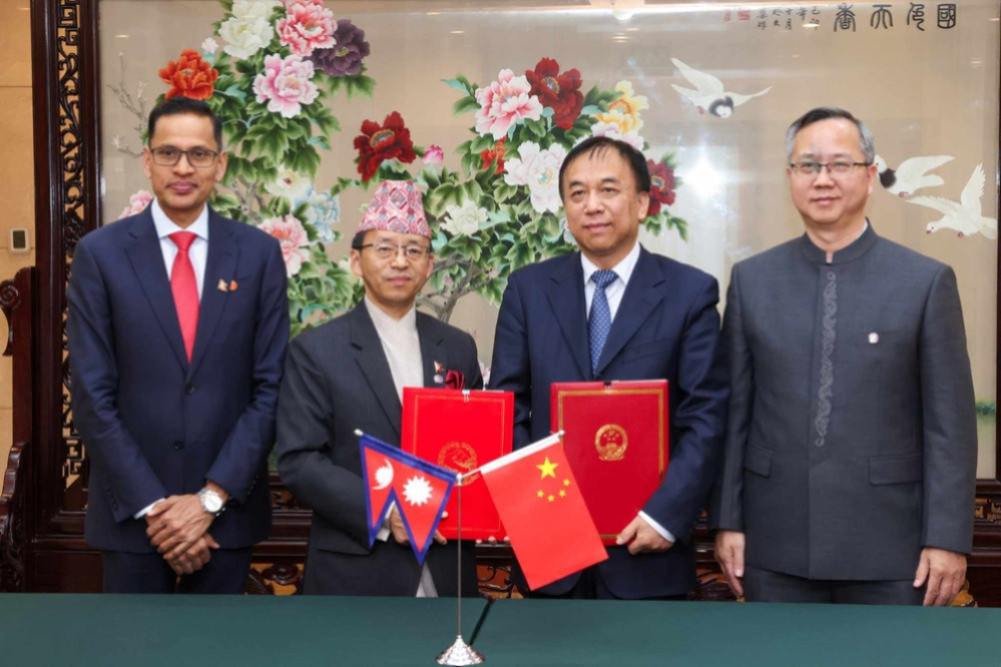
There is no reason to say no to the loan from China under BRI if the law including Nepal's Public Procurement Act is applied to the loan expenditure and the interest rate is negotiated so that it is the same as that of the donor country.
We use Google Cloud Translation Services. Google requires we provide the following disclaimer relating to use of this service:
This service may contain translations powered by Google. Google disclaims all warranties related to the translations, expressed or implied, including any warranties of accuracy, reliability, and any implied warranties of merchantability, fitness for a particular purpose, and noninfringement.
The 'Framework for Belt and Road Cooperation' agreement made during Prime Minister KP Sharma Oli's visit to China has become public. Article 6(4) of the Agreement states that the Agreement is not an 'international treaty'. It is also said that it does not give rise to any rights and obligations under international law. Why is this said?
Some have called the agreement a great achievement and a historic accolade. Some are calling it a debt burden agreement. However, neither this agreement is historical, nor has Nepal been burdened with debt. Both are not correct. Nepal has neither gained nor lost anything from the
agreement. Before going to China, the Prime Minister had said that 'Nepal does not take loans, it takes grants'. While listening to that speech, the 10 projects listed in the agreement were 'propagandized' in the style that China would build them with subsidies and put them in the hands of the real government like 'turn key projects'. However, when looking at the contract, it is "Elephant came, elephant came, and the elephant came". Didn't get even $1 from the deal. On the contrary, when there is a negotiation in the future, the message seems to be that 'don't talk about grants, let's talk about loans'.
According to Article 75 of the Constitution, the Prime Minister is a person with executive powers of Nepal. According to Article 278 (1), they have the capacity to enter into treaties with foreign countries on behalf of Nepal. According to Article 7 (2) of the Vienna Convention on the Law of Treaties, it has full power. Due to the agreement made by the leadership team of a person who has the status of "full power" automatically, the loan of Pokhara Airport construction raised in Nepal could not be waived. There was no talk of giving a 'grant'. So whether the deal is successful or not speaks for itself.
Prime Minister Oli, while addressing the UML's 'Government Rally' on Durbar Marg in Kathmandu, repeated that 'Nepal only takes grants to take loans'. The Chinese ambassador disagreed with the Prime Minister's speech. Maybe Nepal is asking for a grant or not? Therefore, after identifying the project in Article 5(4) without putting the word "loan and grant" in the agreement, it is called "negotiation" after the project. Isn't Article 5(4) kept in the face of Nepal's demand as a 'counter proposal' in the negotiation to do what results from that? The 'minute' of the agreement may have been raised in the
discussion. If not, the talk of 'don't take loans, take subsidies' was limited only to the speech in Kathmandu. The Prime Minister did not dare to raise the issue of subsidy.
This event should also remember the event of the negotiation of the trade and transport agreement with India in the year 2027/028 of the Panchayat period and what was said by the leaders of India when the Nepali team went to the negotiation with India on other issues. At that time there were no separate trade and transport treaties. At the end of the contract period, which was not automatically renewed, it had to be renegotiated. At that time there was no electronic media like today. We should have talked on the phone. Once the negotiations failed. The Nepali team needed the guidance of Singh Darbar. The Nepali team came to Kathmandu by Nepalese ship for instruction. The ship was stationed and took instructions from Singh Darbar. Within a few hours, he flew to Delhi to continue the negotiations. At that time, negotiations were held by insisting that 'equal status' and 'transportation' were the rights of Nepal. Now such things are history.
Another shocking thing, the Nepalese team went to India to negotiate on one of the issues. In the meeting with the three former Prime Ministers of India, it was read in the news that the Nepali team was told to 'Bharat wala namag', ask for whatever else we want, take it. But Article 5(4) of the BRI Framework Agreement should recall the events of those days gone by.
It was Nepal's officially declared policy to 'take only grants without taking loans' from China. It was decided by the Cabinet. But if you think about it deeply, it is like saying 'hot rice to the beggar'. This should be considered unreasonable. These things of Nepali Congress are wrong. It is a valid principle of agreement that 'negotiation' with any country should be based on 'equality and position of strength'. It is the case of Nepal that they only take grants without taking loans, but it is the case of China that they do not accept it. But the matter should have been brought up, right? The framework agreement does not contain the words 'grants and loans'. It seems that the Prime Minister could not bring up the issue of subsidy with the word 'AIDS'.
The people of the four countries of East Asia, China, South Korea, Japan and Taiwan, are "work alcoholics" who speak only what they need, are honest, patriotic and work hard. After saying this, there is no need to say more about the leaders of those countries. On the other hand, we Nepalis are just the opposite. We are used to talking, lying, cheating, corruption, and have no sense of development. It is natural to be a leader according to our culture and environment.
The prime minister repeatedly showed that he is a 'caretaker' government by saying that his period is so many years and so many months at the airport after returning from China. A person in such a situation is known as "Lamdock and Caretaker". No matter what work the Prime Minister goes to, he should go with full authority with fresh energy, faith, confidence, determination and courage. Then he can stick with the other side and grow. 'LamDuck and Caretaker' can't. Looking at clause (4) of Article 5 of the
framework agreement, it does not appear that there has been a fierce negotiation on an equal footing. The world's second power has a bold approach to China in negotiations. On the one hand, we have a prime minister who goes to beg to get 'grant, not loan', on the other hand, he is like a 'lamdak, caretaker'. Therefore, it seems that the Prime Minister has remained silent after agreeing to Article 5(4) of the Framework Agreement due to weak morale.
Before this, the leaders who told the Prime Ministers to go to India 'come without signing any agreement' why this time, even when the Prime Minister is a 'lame duck and caretaker', they did not say anything. Looking at the Framework Agreement, there is another possibility. That said, the invitation to the Prime Minister to visit China did not come from considering Nepal as an important country on the basis of reciprocity. After not receiving an invitation from India, it is public that they asked for an invitation to visit India and China said, "If you come, don't come." Due to these various reasons, the framework agreement showed that the freedom of ``borrowing'' in Nepal was not the freedom of Kathmandu in China.
BRI is not a 'charity' but a commercial loan. There is no such thing as compassion in politics. When reading Article 5(4) of the Framework Agreement, it seems that by taking advantage of the weakness of the Prime Minister's guest on the Nepal side, China is saying that the debt that you said will not be waived, and the grant is not even being discussed at this time.
China and Nepal are two equal countries in principle and according to international law. But most of the provisions of the agreement are "showcase" provisions for Nepal. It seems doubtful that Nepal will be able to benefit from these provisions due to this magnate nature. Article 5 of the agreement should target Nepal. Apart from that, Nepal has to work hard to benefit from other streams. But today's Nepal cannot. Looking at the provisions of other articles in the context of Nepal, it should not be like a billionaire asking a beggar to collaborate on a project. Article 1 of the
agreement is similar to the preamble. Clause (2) contains theoretical matters. Article (3) is not a benefit of Nepal but a liability. Article (4) is an article given to Nepal to show reciprocity and that both nations have equal sovereignty. If Nepal had become a prosperous country today that can maintain the status of the subject mentioned in Article (4), Nepal would not have to expect 'grant'. For Nepal, these arrangements are 'Lal Mohan in the CC for the poor'. For Nepal, 'resources and means' should be completed to comply with these arrangements. Even if only these provisions of the agreement are implemented, Nepal will improve. If there is a hardworking, diligent and honest government, Nepal can benefit from these arrangements. The 10 projects listed in
can also benefit from loans. Section 5(4) regarding grant we have not put the word grant in 'counter proposal' of your grant proposal instead we have put the word 'Aids' in the agreement. The word 'AIDS' is accepted by Nepal as well. Aids is not only a grant but also a loan. We are ready to give loans, but not grants. This may be the reason for the emphasis on 'negotiation' in Article 5(4). Article 5(4) should be understood as China's policy of 'grant not loan'. Another weakness can be said in
negotiation. BRI itself is not bad. The BRI loan interest rate and post-borrowing spending arrangements for 'contractor selection and procurement' have been published in many public media, which are fatal for the borrowing countries. This could have been discussed in the 'Framework Agreement'. Sri Lanka and Pakistan should be remembered when talking about it. It is common knowledge that Sri Lanka will continue to own the Hambantota Port for 99 years due to its inability to pay its Chinese investment debt. Looking at this, if the loan interest cannot be paid in that agreement with Sri Lanka, is the project itself a condition of the agreement that it is considered a 'collator' ie 'mortgage protection'? seems to say. What, I don't know.
In the case of Nepal, if this is the case in the future, if Nepal takes a loan under BRI and the project that is unable to repay the loan is turned into a 'mortgage protection', Article 289(4) of the Constitution states that such an agreement is against the Constitution. Such an agreement cannot be made. Let the thoughts reach towards that.
Another incident, Pakistan's China-Pakistan Economic Corridor, i.e. 'CIPEC', should also be paid attention to today's situation. Pakistan got nothing from 'CIPEC'. China is said to have achieved its own interests. The people of Pakistan are protesting because the debt under 'CIPEC' is borne by Pakistan. Gwadar port reaches China. But because all the goods used in CIPEC are made in China, expert contractors including manpower all come from China, Pakistan could not use "neither domestic goods nor manpower". Hence the media reports that Pakistan suffers. Nepal should consider.
BRI is not the 'marlous plan' and 'charity' of post-war II. It is a business organization. Even when Sri Lanka and Pakistan faced major economic crisis, China did not waive the debt. Had to rely on the World Bank. Keeping these things in mind, Nepal will become Sri Lanka and Pakistan if Nepal surrenders to China in future negotiations under Article 5(4) of the BRI Agreement. To disburse the loan under the loan agreement which is known as 'loan disbursement'. There is a Supreme Court of India case on this matter. The Supreme Court of India has also said that it is not unconstitutional to apply the law of the charitable organization and not the domestic law when carrying out the project by taking the loan of the charitable organization. Due to Nepal's non-aligned foreign policy and China's neighborliness, one should not show unnecessary haste and arrogance to be misled by other countries and not take loans from BRI. The country should be developed quickly by collecting financial resources from everywhere. When agreeing to take a loan with any country, including BRI, there should be no "leaving the momentum".
Nepal's parties are like this - one party is "Ugr Bafadar" towards the south and the other party is "Ugr Bafadar" towards the north. Foreign loyalty affects the country and the people. Therefore, even if we take a loan from China later, Nepal's law including the Public Procurement Act and other related laws will be applied and the interest rate will be similar to that of the western donor countries, if it can be negotiated through negotiations, there is no reason to say that the BRI loan cannot be taken legally. 5(4) of the
agreement is what happens when the 10 listed projects are taken forward through separate negotiations with BRI. But the Nepali people should not forget - these things depend on the government and the negotiation team that will be formed at that time. If the government at that time is "fiercely loyal" to the north and its negotiating team also chooses "fierce loyalty" to the north, Nepal will face high interest rates and Nepali expert contractors, Nepali goods will be inactive. Therefore, Nepalese must be careful.
To date, the BRI agreement has not brought any debt to Nepal and has not promised to take any debt in the future. Whether to take it or not is up to Nepal. Because of that, it will be in Nepal's interest not to have more disputes with China so that it gets irritated.