We use Google Cloud Translation Services. Google requires we provide the following disclaimer relating to use of this service:
This service may contain translations powered by Google. Google disclaims all warranties related to the translations, expressed or implied, including any warranties of accuracy, reliability, and any implied warranties of merchantability, fitness for a particular purpose, and noninfringement.
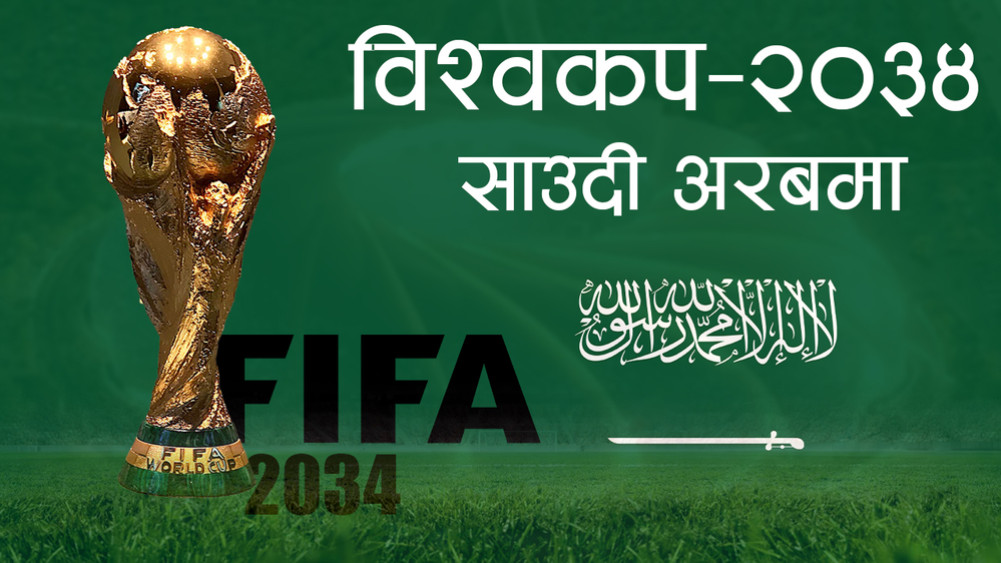
A vote held at FIFA headquarters on Wednesday has decided that Saudi Arabia will host the 2034 World Cup football tournament alone.
Previously, the 2002 tournament was jointly organized by South Korea and Japan, the 2026 tournament was jointly organized by Canada, Mexico and the United States, and the 2030 tournament was jointly organized by Morocco, Portugal and Spain. Prosperity is also a global endorsement. This opportunity for Saudi Arabia, which has already participated in the World Cup football tournament six times and has already decided to participate as the host country in 2034, has made the people there happy, and the benefit of the opportunity created through the preparations it is making is sure to extend to Nepal.
Generally: Hosting a major sporting event is seen as an opportunity to showcase the country's economic progress to the world. This boosts his confidence. The world is more aware of its history, art culture, food, etc. This will help in the expansion of 'soft power'. But for this the financial investment is high. Physical, technical, security management requires tireless efforts. To complete the one-month competition, preparations should start a decade in advance. That's why only the countries that have made the identity of developed and prosperous countries and have flourished football culture would get such an opportunity. However, from time to time, countries outside such indirect circle also get opportunities. The 2022 World Cup was hosted by Qatar. Although not known because of the football culture, the Qatari miracle was revealed to the world during the tournament. The Saudi miracle in 2034 is sure to unfold in the same way. This kind of leadership and trust from emerging nations will help spread the football culture further. Football, known as a popular sport, will become more popular.
At the moment, our concern is with the assurance of the interests of the Nepalese in the opportunity that the Saudis have received. For the World Cup, Saudi Arabia has put forward a plan to upgrade three stadiums in its major cities, Riyadh, Jeddah, Al Khowar, Abha and Neom, and build 11 grand new stadiums. Similarly, 185 hotel rooms, airports, roads, railways and other projects related to modern infrastructure construction have also been announced. Work has already begun on a massive national project aimed at the World Cup, including the Neom smart city on 170 square kilometers at a cost of 450 billion dollars, the Dragon Ball theme park on 50 hectares of land and a luxury ski resort in the middle of the desert. Similarly, the project to build the world's longest infinity bridge over the Red Sea at a cost of 450 billion dollars has been started. The range of expenses he incurs for all these projects is immense. Mainly for this project he will increase the number of workers. This is the first point that Nepalese connect with Saudi and the competition.
There are 13.4 million migrant workers in Saudi Arabia. This number of migrant workers is 42 percent of the total population of Saudi Arabia. There are also four lakh Nepali workers. Whatever infrastructure or other preparations Saudi Arabia will build for the World Cup will create more job opportunities. It is certain that Nepalis will also get priority. This is a natural opportunity, because of the high priority given by Saudi Arabia to Nepali before, it is certain that additional opportunities will also be created.
In preparation for the World Cup, issues ranging from labor rights to human rights will be raised more widely. There was a global debate on the matter at the Qatar World Cup. There are still questions about Saudi Arabia. In particular, issues such as workers' human rights and job security have been attracting the attention of international organizations. His policies have been criticized for not being labor friendly. Qatar's policies were also criticized before the World Cup. But he had improved a lot in the field of labor by the time he reached the World Cup. A similar situation can be expected in Saudi Arabia. If that happens, even after the World Cup, Saudi Arabia will be a more convenient destination for Nepali workers.