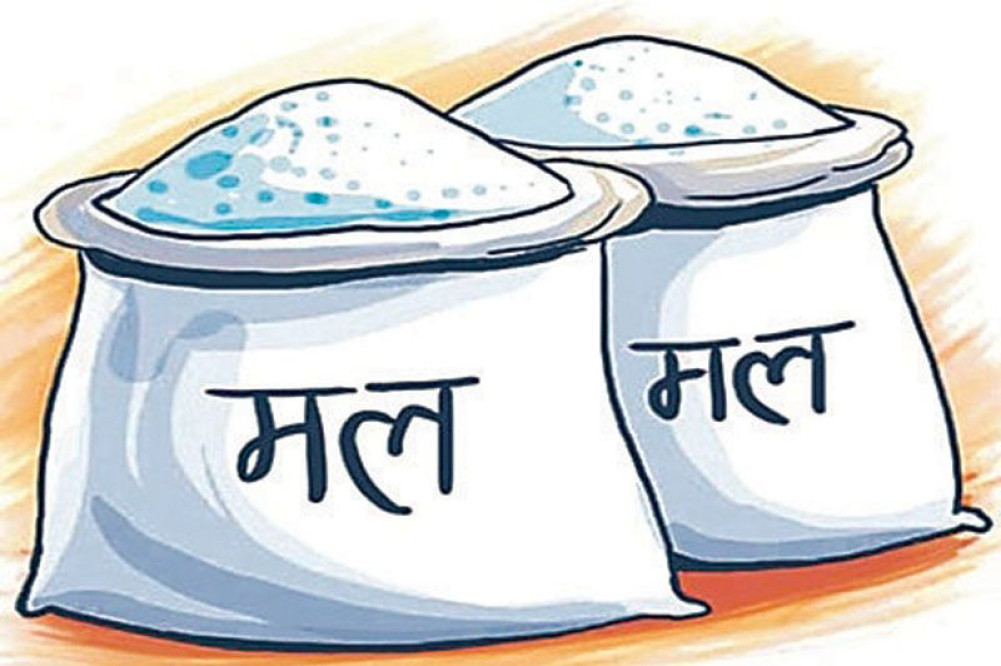
The production process itself is affected by crops that are planted later. In a country where the majority of Nepalis are based on agriculture, the perennial shortage of fertilizer is a matter of great shame.
We use Google Cloud Translation Services. Google requires we provide the following disclaimer relating to use of this service:
This service may contain translations powered by Google. Google disclaims all warranties related to the translations, expressed or implied, including any warranties of accuracy, reliability, and any implied warranties of merchantability, fitness for a particular purpose, and noninfringement.
What to do as an agricultural country! Whenever farmers need chemical fertilizers, there is a shortage. This year, the same fate has been repeated. No initiative has been taken by official bodies to find a sustainable solution.
Due to lack of fertilizer, the regular cycle of cropping is disrupted, which puts farmers and the country's economy in crisis. For example, now is the season for the farmers of Terai-Madhesh to plant winter crops such as wheat, gram, lentils, and mustard, but due to lack of fertilizer, the farmers have not been able to cultivate.
The production process itself is affected by the crops that are grown after the harvest time. In a country where the majority of Nepalis are based on agriculture, the chronic shortage of fertilizer is a matter of great shame.
When farmers do not get fertilizer from the system set by the government, they have to make two choices, one that is compelling and one that is risky. First, they buy from the market at high prices. This creates more than regular and estimated cost of planting any crop. The same is becoming more expensive, but there is more risk in agriculture, which is not guaranteed to return according to the cost. Secondly, farmers in the border areas bring their own fertilizers from India whenever possible.
This obligation is financially insecure and legally punishable. Sometimes it is found that lack of fertilizers encourages organized and organized black market. It has increased chaos.
In June 2079, a truck carrying illegal chemical fertilizers was seized by the Revenue Investigation Department in Dhading and brought to Kathmandu by local farmers. This is a matter of concern for a just and civilized society.
There are two main reasons for fertilizer shortage in Nepal. Firstly, due to negligence of the government, there is a delay in the process of arrival of fertilizer from foreign countries and that is what creates the shortage. According to the government's allocated budget for the purchase of fertilizers, Agricultural Materials Company Limited will be responsible for 70 percent and Salt Trading Corporation Limited will be responsible for purchasing 30 percent of fertilizers.
These two companies import fertilizer through global tender. But this process is prolonged for three to six months. In the meantime, due to fluctuations in the price of fertilizers in the international market, there are also obstacles in the import of fertilizers fixed here. The companies with import contracts are not bringing fertilizers. This has affected the reserves here.
According to the global tender, no action will be taken against the company that does not bring fertilizer even after making an agreement. Instead, the same company will be in charge of the import next time. Experts in the fertilizer procurement process say that this is a game of commission.
Therefore, a company that has committed bullying once should take a decision so that it cannot participate in the tender process again. It is necessary to amend the law so as to shorten the period of months spent in purchasing fertilizer through global tender.
It is also necessary to organize the 'G2G' process and create a situation where regular fertilizer is imported. It can also be learned from the past experience that purchasing fertilizers through 'G2G' reduces the shortage.
Second, after importing fertilizer, it is distributed through cooperatives. Based on the demand of the local level, the quota of fertilizers has been set at the provincial level. In this process, political access will be used and some local levels will get more fertilizer than needed, but some will have a shortage.
There is a situation in the 'Management Management Guideline for Fertilizer Distribution of Grants, 2077' that excess fertilizer cannot be sold elsewhere. As a result, even though there is a stock of fertilizers, there is a shortage and accumulation in some places. Experts say that this is the reason for the current lack of fertilizer. For that, it is relevant to change some provisions of this directive. So that excess fertilizer in one place can be easily transported to the place where it is lacking.
We are not in a position to look for alternatives to chemical fertilizers. Chemical fertilizers are also mandatory from the point of view of our food security. Billions of rupees are spent annually for this. This year alone, the government has allocated 27 billion 95 million rupees for the purchase of chemical fertilizers. Since this amount is released every year, there is a debate about opening a chemical fertilizer factory here.
The government has also been announcing the opening of such a factory through its budget. After studying the cost of installation and operation, production, profit from sales, if there is a profitable situation, it should be able to move towards it.
But before that, arrangements should be made to start the procurement process on time for importing fertilizers, distribute the imported fertilizers equitably and monitor them. If even this minimum right of farmers cannot be secured, it will be very difficult to improve the country's agriculture and overall economy.