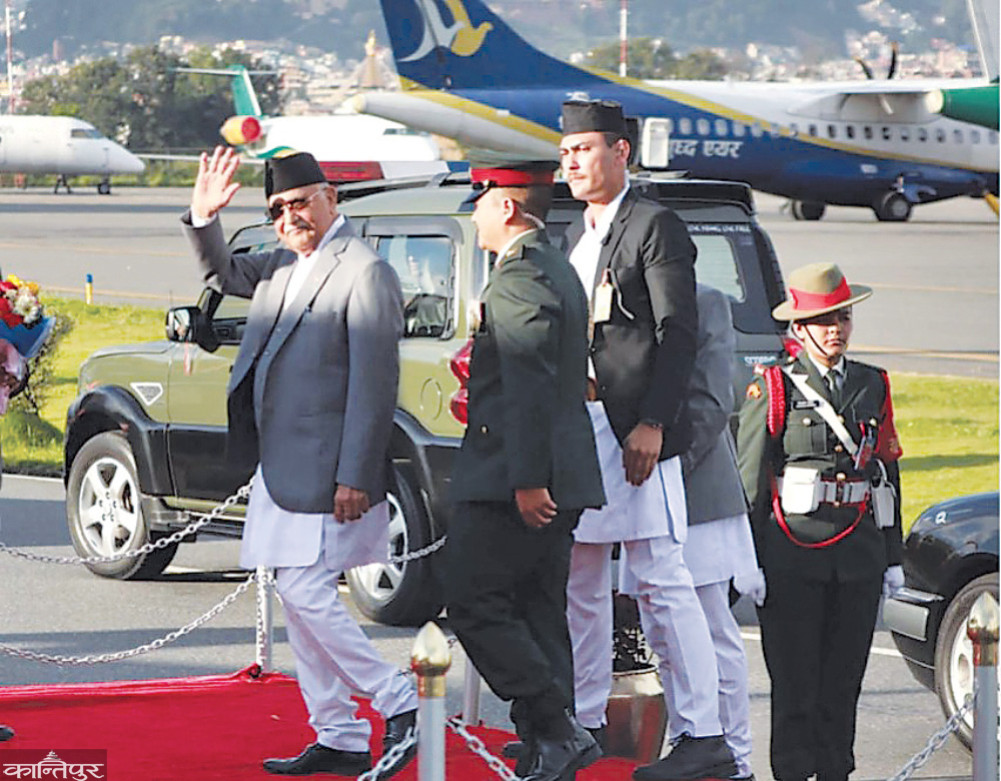
Prime Minister KP Sharma Oli's visit to China started amid hope and doubt, how fruitful will it be, how formal? The accounting will be done after the visit. However, as far as it can be said, the risk of diplomatic 'turbulence' in his flight north is considerable.
We use Google Cloud Translation Services. Google requires we provide the following disclaimer relating to use of this service:
This service may contain translations powered by Google. Google disclaims all warranties related to the translations, expressed or implied, including any warranties of accuracy, reliability, and any implied warranties of merchantability, fitness for a particular purpose, and noninfringement.
Prime Minister KP Sharma Oli is going to leave today for a four-day visit to China with a jumbo team with some doubts and some hopes. Doubt in the sense that, without an official announcement of the visit, it became the subject of 'national gossip' (or debate) for almost three weeks. And, the tour agenda Gizolio.
Debates and controversies on the agenda were not limited to the air-conditioned rooms of Singha Durbar and Baluwatar, but became the subject of gossip in newspapers, online, YouTube, social media and tea shops in Chokchok. These debates/gossips basically centered on the issue of grants or loans when implementing the BRI (Belt and Road Initiative) agreement with China.
In particular, the government should have objectively reviewed the previous agreements/agreements with China and set an agenda for their strong implementation. Why and by whom were those agreements/understandings not implemented? They should have decided the agendas of the visit in such a way as to discourage even China to carry out their implementation by showing their indifference and weakness. However, the debate and controversy about loans or grants finally became a comment that only grants should be taken, not loans, in the BRI implementation agreement with China.
Some experts/analysts have not argued that it is not practical when making a 'position' of taking all loans/grants from other countries and not only from China. However, Prime Minister Oli crawled to BRI after the ruling coalition Congress said it would only accept grants and not loans. The coalition government has informed the Chinese side that it is ready to proceed with the BRI implementation agreement in terms of grants. BRI implements its
Foreign Minister Arju Rana Deuba, who is coordinating preparations for her visit to China, reached Chhendu and informed her Chinese counterpart Wang Yi.
Since then, officials of the Ministry of Foreign Affairs visited the Chinese Embassy in Kathmandu and presented the 'BRI Cooperation Framework'. Experts say the framework, drawn up by leaders of the ruling coalition Congress and UML, only accepts grants for "bottom-line" BRI projects.
In this background, Prime Minister Oli, who went on a visit, has more doubts about what kind of 'response' China will give than enthusiasm and confidence. However, Arju's message from Chhendu has given him some hope. She said after returning from Chhendu that the Chinese were positive to increasing the BRI grant. Oli hopes that China will be "flexible" after an agreement is reached between the two ruling parties to implement BRI.
How effective will Oli's visit to China be, how formal? The accounting will be done after the visit. However, this much can be said now, there is considerable risk of diplomatic 'turbulence' in his flight north. To break the story, Oli has expressed enthusiasm about the visit for public consumption. It is not only Oli who is sitting in the dignity of the Prime Minister, everyone claims that he "believed that the bilateral relations will gain more height from the visit".
Oli has also given a ritual expression that since there is a common vision between the Congress and the UML on the implementation of the BRI, this agreement will be reached and it will further heighten the relationship between Nepal and China. However, the Chinese counterpart, Wang Yi, asked Foreign Minister Arzu to come to Chendu to do strong homework on the implementation of the BRI.
means that as 'smooth' and comfortable as the weather-friendly northern flight will be, there is also a risk that it may be unfavorable in terms of diplomacy. Also, Oli is surrounded by domestic and external adversities.
What are the external adversities of Oli? Oli, who does not press with anyone, does not hesitate to assert his position and ego, is led by the ruling fellow traveler Congress, with enthusiasm in his mouth and innocent expression in his heart, he is under a lot of pressure. While Oli is exerting such tremendous pressure, Foreign Minister Arju who is coordinating his visit is on a carefree 'diplomatic flight'.
Deuba's wife Arju, who has been swearing by her son in the media to prove the accusations leveled against her in the Bhutanese refugee case, is in the hands of the diplomatic reins of the country. However, according to the foreign minister, he is the one who will "lead" the foreign affairs.
However, when the neighboring country prioritizes the foreign minister more than the prime minister, then it becomes a matter of concern. Now, if you see the foreign minister's activity, it seems that he is moving forward and Prime Minister Oli is moving behind in foreign affairs.
India has increased the importance of Arzu by giving 'response' to the foreign minister more than to the Prime Minister. India, which did not invite Oli to visit, warmly welcomed and honored him. Indian Prime Minister Narendra Modi himself gave importance to us, who consider the meeting as an achievement. It was also reported that he arranged the schedule of Modi-Oli sideline talks during his visit to America.
An expert claims, "In particular, Modi wanted to take a photo with Oli and take a photo with Oli rather than having a sideline talk with him." Arju mobilized her channel to create an atmosphere of meeting.
Arju has been at the power center of national politics for three decades. Being the Minister of Foreign Affairs for the first time, she has exercised a lot of informal power, even if it is not as formal as it is now, whether it is in the capacity of 'First Lady' or Deuba's wife. Sometimes he has been criticized as 'defacto PM'. She is a character surrounded by controversy due to her controversial intervention in cabinet formation, appointment, transfer, promotion, businessmen, middlemen.
However, the introduction of the current foreign minister Arju is becoming somewhat different. As she goes to international forums and presents herself confidently in debates, discussions, the experts of diplomacy have started praising her talent.
The role he played through 'rakhi diplomacy' to establish brotherly relations between the Congress party and the Bharatiya Janata Party (BJP) is not hidden anywhere. However, Arju's current 'diplomatic flight' will be fueled as long as Deuba remains in power or even after that, it would be too early to speculate about that. However, as much as the foreign minister is in a favorable position in terms of foreign affairs, the odds are increasing for Prime Minister Oli.
Let's not talk about visiting China from today. Perhaps, if the Chinese are 'convinced' in the BRI framework and the implementation agreement is signed, she will get the same amount as the coordinator of the visit preparation. If there is a situation where the contract is not extended immediately, Oli will have to bear the brunt of the inconvenience. The domestic environment is also not pleasant for Oli.
In order to stay in power, Oli, who was led by the Congress, had to endure the siege of the communists. This is another adversity for him. Whether it is the Madhav Nepali party chosen by itself or the Maoists or other small left components, everyone is angry and dissatisfied with Oli.
RSVP or the right-wing political force, which has emerged as an alternative political force, is protesting against Oli. Most importantly, there is no hope and positive feeling towards the Oli government even from the public level. At the public level, there has been an increase in resentment towards the Oli government. Now, the party line has also started to fade.
The disillusionment of the UML row became more pronounced during its street power demonstration a week ago. Even though the roads were suffering for the common people, UML demonstrated its strength by using 'force from Nawaran'.
Party flag, election symbol flags, workers lined up on the street to boost Oli's self-confidence, who is in a state of fear. However, only a few thousand workers were seen in the street participation of the party with seven lakh organized members. Questions arose, did the UML's poor street presence demonstrate its strength or was it a lost credibility? UML gained power for whatever reasons, are the sources of that power still alive?
The source of UML's power is the popular support it enjoys. In a democratic system, the trust of voters through voting is the main source of power of any party. In that sense, UML is currently the second largest party in the country.
In the last general election, about 26.95 percent i.e. 28 lakh 45 thousand 641 voters trusted UML. In the general election of 2074, more than 32.25 percent i.e. 31 lakh 73 thousand 494 voters voted for him.
In 2079 compared to 2074, voters' trust in UML decreased. However, in 2074, there were slogans and plans between the two major communist parties, the UML and the Maoist Center, for an election blockade and a merger after the elections. CPN 2079, which is made up of UML and Maoists, not only split before the general election, but UML was further defeated.
In this background, the UMLs are satisfied that they have become the second largest party by entering into a 'neck to neck' competition with the Congress amid the division. However, the reality is that as voters' confidence in the UML is eroding, so is its political power. The foundations of public trust in UML are crumbling.
Yesterday UML was the party that carried the case. Now without issue. Oli uses the slogan 'Prosperous Nepal, Happy Nepali', but the people have not much interest or faith in this slogan or issue of UML. At one time, when he took to the streets with the issue of progressive nationalism, he attracted people towards UML.
The UML, which talks about the people's livelihood, cries out for nationalism and democracy, is now in the maze of 'fake nationalism'. Otherwise, the head of the intelligence agency will be laid the red carpet in Baluwatar, otherwise the slogan of ultra-nationalism will be raised. Due to the tendency of the current leadership of the UML to adopt this double standard, the base of the UML is declining.
If you flip through the political reports and various documents of UML, there are leaders who claim that their party is the most organized party organizationally. If we remember the early days of the open environment after the political change of 2046, the above claim is close to the truth. The practice of internal democracy in UML was something that others should learn from. The party system operated on the concept of collective leadership.
The UML was associated with the lower caste people on the issue of livelihood. The cadre ranks were the source of strength of the UML. He not only had the ability to mobilize workers, but he also had the ability to mobilize people through workers. The lower middle class people were excited to participate in the program called by UML yesterday. But now that excitement has turned into a compulsion. UML has reached the difficult situation of having to take 'hired workers' to the streets by arranging bus reserves and food.
Oli will have to bear the weight of this failure now that UML is moving towards industry politically. From the outside, it seems that UML has followed Oli's plan. No one seems to dare to speak against Oli there. Whoever criticizes becomes a participant in the action. On a recent day, a former minister and MP was saying in the office of the UML parliamentary party, "Even the walls have ears here. You never know when the leadership will be tricked.
That's why you should speak slowly.' He added, 'Even though you see Oli's one-shade rule from the outside, the opinion is getting stronger that you should find an alternative to him within the party.' In other words, not only in Oli's domestic politics, but also in the house, the days are approaching. How much can he adapt to the external adversity seen before that? It has been a matter of waiting.