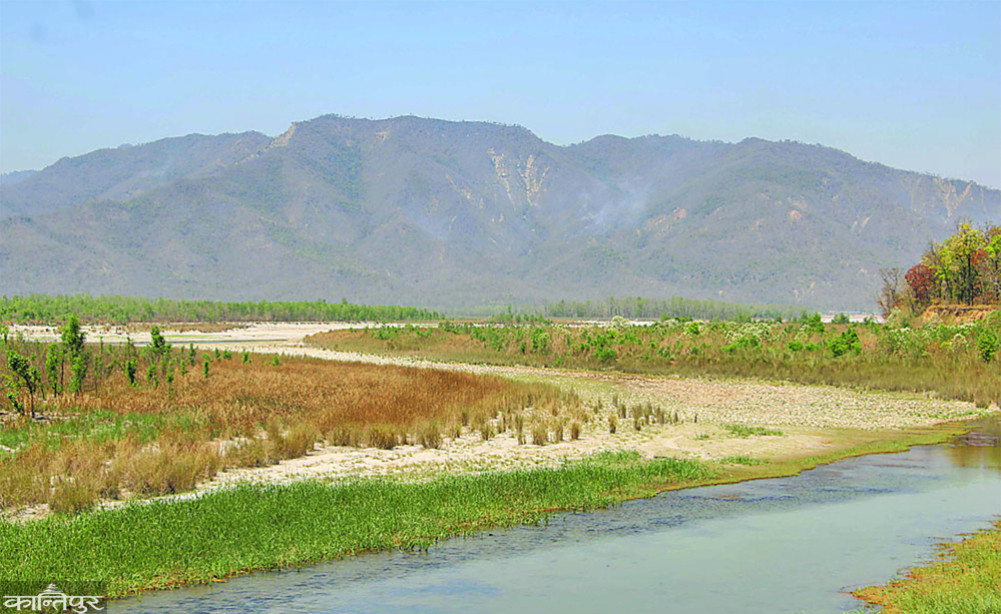
The river has been turned into a canal, but in the name of beautification, a poojaghat or crematorium has been built. When do we think about rivers? When a flood-disaster occurs, then we start thinking about the river in public discussion. Dying river means the end of local quest, tradition, economy, coastal ecological balance.
We use Google Cloud Translation Services. Google requires we provide the following disclaimer relating to use of this service:
This service may contain translations powered by Google. Google disclaims all warranties related to the translations, expressed or implied, including any warranties of accuracy, reliability, and any implied warranties of merchantability, fitness for a particular purpose, and noninfringement.
The most fertile land of my village Sarlahi Balra is called 'Dhab' by local residents. A river was born from there - Bhorhar. Its arnish dripped with juicy roots. It contained twelve months of rain, which went further and joined the Bagmati river. That river was not long but it was a basket of wealth for the surrounding villages.
Until the 1940s, it was irrigated by making dams through public donations. Today its Nissan is neither on the map nor in the bag. The river was killed, washed away. Now the story survives only in folk memory. There is no dawn today, but what effect did it have on the livelihood of this area? There is no one who can tell you about it carefully. But what is seen is that, Jajas let the river die from among them, there is no long-term greenery in their lives.
This picture is not only of the village but of Madhesh, it belongs to all of Nepal. Whoever has the power, whoever is dominant, tries to take away the rights of the weak from afar and abuse the natural means for himself. This is the current trend.
'Chhathi maiya hoi na sahay' Now the Chhath festival has reached the hill. Every generation can worship Chhath on the banks of rivers and ponds, for this the reservoirs will survive. There should be awareness among the common people so that they can appreciate the dignity of the river. If a river-pond is preserved in a village, it is synonymous with the humanity of that particular area. The society that worships this Chhath should introspect.
People's lives were once centered on the river, now it seems that the era of river oblivion has come. In this whole change, the change in the relationship between man and nature and the role of the state as an institution are to be considered. Efforts to move forward in coexistence with nature and the importance of human life participation and companionship in the environment should start from individual conceptual understanding and move towards collective concern.
In such a case, dialogue with river-policemen long involved in the field of ecology, while respecting local knowledge traditions and collective intelligence, can be an important step. We are growing in the mindset of 'borrowing now and paying back later'. As much as the population of Nepal is now, how much will be added to it in the next fifty years? Climate change is a dire reality. People's lifestyle is in danger, because we have run into the trend of increasing GDP.
Environmental journalist Ramesh Bhusal has written in his book 'Chalbato: Kailash to Ganga', it is a sociological observation of the places traveled. From the origin of the Karnali River in Tibet to the Ganga in India, what has been the effect of modernity and development on Nepali society in particular?
Where and how much is Karnali's place in society? Those stories of walking and sitting on the edge of Karnali, i.e. from head to tail, lead to a world where Karnali plays an important role. But this river is as neglected as it is among the inhabitants of that region. As much as there are those who love it, it is also constrained and restless.
It shows the continuity of Karnali, even the alienation of modern development. This book sheds light on the problems of Karnali apart from its beauty. Myths, legends and characters prevalent in folk life about Karnali have been exposed. The words of Ramesh Bhusal, who wrote the story of the undammed river Karnali, are appalling - 'Man has not only added himself to the earth, he has also added many other things. He is building his empire by killing others. In this way, he took away the river as a source.'
Nepal is a country of rivers. But when do we think about the river? When a flood-disaster occurs, then we start thinking about the river in public discussion. We look at the pictures of fair river ghats of various festivals and rituals through different means. Sometimes the river comes fresh in our memory with the news that the river is dirty, exploited or the bridge is not built or incomplete.
Even when there is an accident on the river bank, the river is remembered. Otherwise the river has disappeared from our daily schedule. While the history of rivers in Nepal is the evidence of the birth and rise of that culture, which today is called 'Samasik culture'. These rivers are direct evidence of the multi-lingual, multi-religious and mixed Nepalese culture.
Which river is said to be unmarried? Who was called Mai? Which river is more expressive in folklore? Behind this lies centuries old country knowledge. Dying river means the end of local quest, tradition, economy, coastal ecological balance.
Who writes and speaks about the river? It can be classified into four types. The first water biologist, who views water resources on geopolitical and donor trends. Second, water workers, who are active in areas such as river management, water supply and
They think about the river according to their lot. The third is water-oriented, who see the climate crisis as a connection and see water as an emerging market. The fourth is Panidharmi, who views rivers, society and sociology as a broader canvas. Amphibians are seen like the lights of Dibia in the rain of aquatic life in Nepal. Research on rivers that assesses the role of communities is sparse. The
movement is also going on in connection with the river special. In some it seems to be farming and in some it is also a resolution. In the name of river management, after the construction of embankments and dams for hydropower has increased, there has been increased concern and interest on the part of the community. After many governments came into existence, they lost their sense of exclusive rights over the river.
This government has started to consider itself as the master of the fate of the river, it seems that the laws made by it try to control the sovereignty of the river. This results in the removal of the community from the life cycle of the river. Aspects like the movement connected with the river, sanitation, construction of bridges, ban on exploitation, encroachment control, stake in hydropower projects have been discussed more.
Overall, river discussion is weak. Rivers are not effective in public discourse. Just as there are small and big in geography, the sovereignty of a country is not big or small. Similarly, the size of rivers does not make a difference in its existence and identity.
Local and state governments should show initiative in documenting the river. Profiles have been extracted in various places, but only their names are mentioned in them. Gathering information about aspects such as reciprocity between rivers and communities, changes in the river's catchment area, knowledge of Raithane, water level comparison, 'oral history' about floods can be factual from the local level. There is no elite in
rivers. The place where the river is, has its own importance. Now the small rivers themselves are victims of discrimination. Compared to many big rivers of Nepal, the small rivers are deep in the memory tradition of the local residents. It was hoped that after the government came, the land of the river would get justice, but in practice, encroachment has been institutionalized.
Some religious people in India have come forward to save the river. We tend to have more river conflicts as a political laboratory. The sign of the river and politics is criss-crossing. But the question is, did politics do justice to the river or not? Indiscriminate exploitation of sand, protection of land mafia, construction of permanent structures in the river flow area are affecting Sasana river. The community that has grown up and survived along the river has been made secondary to the issue of alternative socio-economic balance. A river, whether small or large, is a living entity.
He who tries to get merit from the river by calling it 'Maiya' does not listen to the cry of the river. As far as it can be seen, there is no water in the river, it has turned into a canal, but in the name of beautification, a poojaghat or cremation ground has been built. The impact of the changes in the ecology of the river has hit the riverside residents more. The watershed area of the river has given existence to the original lifestyle, economic system, language and culture. The difference between the inhabitants of Koshi and Karnali establishes this fact.
Dawn no longer wakes up. The obituary of Bhorhar Khola can bring dawn in the river-citizen dialogue even if it is a little bit!