We use Google Cloud Translation Services. Google requires we provide the following disclaimer relating to use of this service:
This service may contain translations powered by Google. Google disclaims all warranties related to the translations, expressed or implied, including any warranties of accuracy, reliability, and any implied warranties of merchantability, fitness for a particular purpose, and noninfringement.
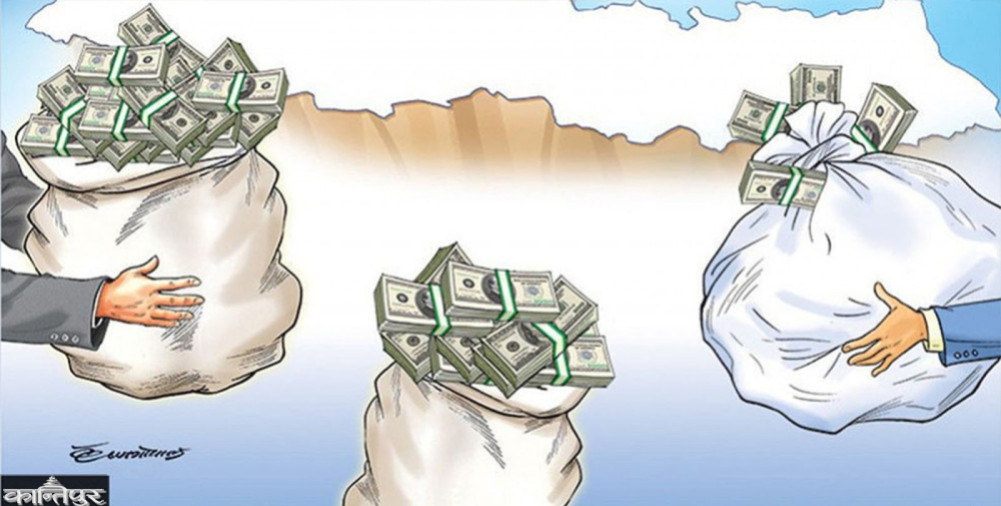
Public debt outstanding by the government has reached a new high. According to the data up to October, the sovereign debt has reached 25 trillion 18 billion 50 million in which the external debt is 12 trillion 65 billion 89 billion and the internal debt is 12 trillion 52 billion 16 billion.
Whenever the details of such loans are made public and the debt-share of Pratinepali is discussed accordingly, the question arises - are we making good use of the loans? Past, present or future government administrators or policy makers cannot ignore these questions. It is imperative to have a serious debate about public debt. Public borrowing is a natural process for
infrastructure development. Any country may have inadequate sources of income to meet its national development aspirations, hence the natural need for international grants and public loans. Grants and loans not only bear the burden, but also promote bilateral relations and various regional and international cooperation. Skills and techniques are also transferred through this process. There is no set point at which country will borrow at what percentage. So far, Nepal's outstanding public debt has reached 44.14 percent of GDP. Even rich countries tend to borrow up to a higher proportion of their gross domestic product (GDP). Countries determine debt limits based on their economic structure, background and development potential. The main concern is whether the loan has been utilized or not and whether the project has been built or not?
In the last financial year, the size of the capital expenditure allocated for development has started to exceed the size of the debt management. For the current financial year, the government has allocated 3 trillion 52 billion 35 billion for capital, and 3 trillion 67 billion 28 billion for financial system. This means, the debt taken by the government has started to be spent on current expenses as well. On the one hand, capital expenditure has not been spent as per allocation. The loan interest had to be paid. On the other hand, public loans taken for specific purposes have not yielded encouraging returns. Considering all these situations together, it is high time that we review our financial situation.
We are constructing projects like airports, roads, fast tracks by taking external loans. The latter projects do not answer positively. Let us look at the example of Pokhara or Bhairahawa Airport, we have the experience of operating them. A long list of such projects can be prepared. But the conclusion is that the selection of the projects to be built with loans should be examined to see how much return it gave, whether such projects were linked to qualitative economic contribution or not. Taking a loan is not the problem, the main question is what we are spending that loan on. Therefore, there is a need to unite to review the big projects built on loans and prepare a future strategy. Because the more we add to the debt now, the basis and convenience of borrowing in the future will decrease. It is necessary to be restrained without reaching that state.
Appropriate, relevant and profitable projects should be made even with loans. Just be aware that there is no corruption, quality is ensured, unnecessary costs are not increased. Basically, if the economy is to be kept safe, some common strategies need to be adopted. Increase income or decrease expenses. The search for ways to increase income is still going on, but it has not reached a satisfactory point. On the other hand, it seems that the government is not paying attention to reducing expenses. There is no government plan especially in current expenditure control. Instead, reports that suggest ways to reduce costs have been kept. In conclusion, if the government, political parties, civil servants, policy makers develop the ability to estimate the returns of the projects to be constructed by taking loans and take loans only for such plans, it will give us positive benefits. Otherwise we will fall into debt trap.