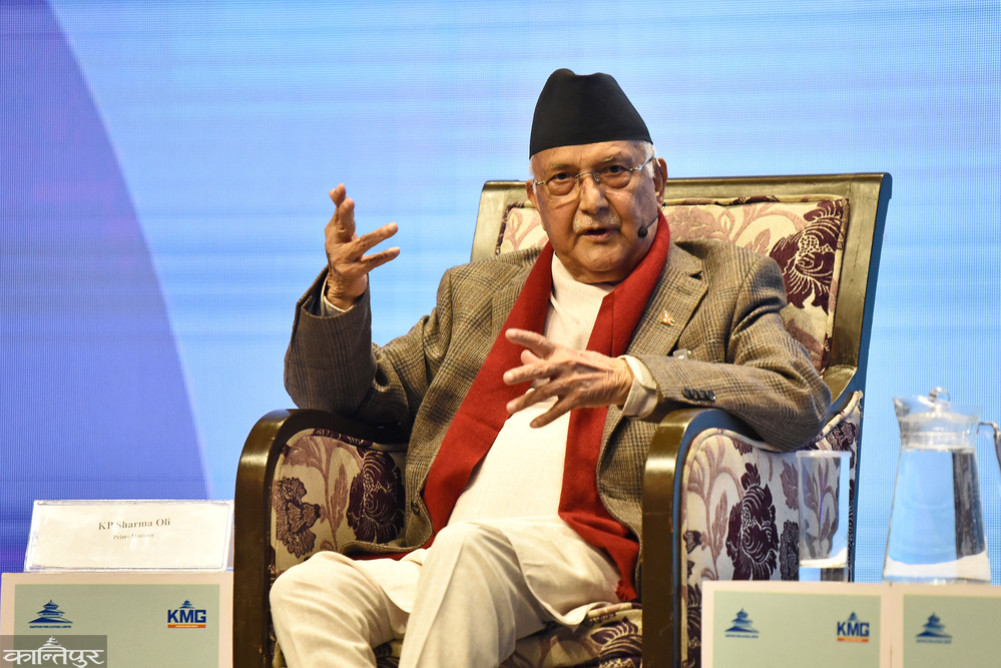
To go when invited by one of the two neighbors without receiving an invitation from the other is in itself inferiority complex and devaluing the relationship with the respective country.
We use Google Cloud Translation Services. Google requires we provide the following disclaimer relating to use of this service:
This service may contain translations powered by Google. Google disclaims all warranties related to the translations, expressed or implied, including any warranties of accuracy, reliability, and any implied warranties of merchantability, fitness for a particular purpose, and noninfringement.
With the announcement of Prime Minister KP Sharma Oli's visit to China (December 2-5, 2024), its southern waves have intensified. There is a campaign going on from inside and outside to claim the 'tradition' of going to India as soon as the Prime Minister is in Nepal, and to compensate for the visit to India, which did not happen this time, by reducing the importance of the visit to China.
Let's say, a big mistake is being made by Nepal and now Nepal is waiting to face some big punishment for this. Ironically, the Nepali media, diplomatic circles and the intellectual world are more excited than the Indian media and diplomatic circles in creating such commentary.
Those who don't like the alliance of two big parties in the country and are disappointed because they think they can't destroy this alliance are hoping that the government will change after Prime Minister Oli's visit to China. Looking at their enthusiastic expressions and unexpected activities, one can understand how deeply the psychology of connecting domestic politics with external aspects has been built. Those who beat their chests saying that Prime Minister Oli and Indian Prime Minister Narendra Modi will not meet in New York last month are now active in the debate of whether to visit China first or visit India first in the psychology of 'egg first or chicken first'.
Which country to visit China or India first depends on circumstances, not on any law or 'tradition'. Earlier, when KP Sharma Oli visited India twice when he was Prime Minister, no sky fell and now no sky is going to fall even when he visits China. It does not mean that all the problems with India will be solved with the first visit to India. There is an example that no joint statement was issued between the two countries during Prime Minister Oli's first visit to India (February 16-24, 2016). When the Constitution was promulgated by the Constituent Assembly in Nepal, India, which had blocked it for four and a half months by 'noting' it, neglected to put words in favor of Nepal's new constitution in a joint statement. India itself must have felt something from that.
On the one hand, the comment that Prime Minister Oli is going to China after not receiving an invitation to visit from India is being vigorously built, on the other hand, there are allegations that Oli is trying to play the 'Chinese card' by visiting China first. Both these conflicting beliefs are not in favor of our sovereignty, independence and national pride. Because, going when invited by one of the two neighbors without receiving an invitation from the other is in itself only inferiority complex and devaluing the relationship with the respective country. All that remained was the Chinese card, which in today's age no one would believe. It only reflects inferiority complex, overconfidence in certain powers, and self-deprecation. The terminology used during the Cold War has proven itself irrelevant in today's diplomacy.
Former Prime Minister and Maoist Chairman Pushpa Kamal Dahal is the most dissatisfied and angry with Prime Minister Oli's upcoming visit to China. Publicizing the belief that he should not have gone to China without going to India first, he gave an interview to an Indian newspaper to convey a direct message to India and said, "This is the immaturity of the government led by KP Oli." ...KPG is going to China for a bilateral visit but it seems that this visit is more to play the China card, which is wrong. ...Oli must take care of Nepal's special relationship with India before going to China. This should not have happened.'(The Hindu, November 14, 2024). That is, Oli should not have gone to China without going to India. It is a matter of surprise that such a statement comes from the three-time Prime Minister of Nepal, the 'Maoist' president and the leader of the opposition party when no Indian can directly and openly say that the Prime Minister of Nepal should not go to Beijing without visiting Delhi-Darshan.
In order to understand this objectionable and offensive expression of Pushpa Kamal Dahal, two contexts related to his visit to China as the Prime Minister should be remembered. First, when Pushpa Kamal Dahal had to go to China for the closing ceremony of the Beijing Olympic Games (August 23-27, 2008) when he was the Prime Minister for the first time, after returning from there, he canceled his visit and announced his commitment that his first political visit would be to India. Dahal, who does not hesitate to say that he was removed from power because he went to China first, was immediately exposed by this incident and he is still in the same mindset.
Second, he used the Washington route during his official visit to China (September 23-30, 2023) after becoming the Prime Minister with the support of the Nepali Congress. Without understanding the relationship between China and the US, which is moving from intense competition to rivalry, or to win more trust of the US, Dahal, as the Prime Minister of Nepal, arranged a way back from the US across the seven seas to go to neighboring China. This time too, he probably wanted to see Prime Minister Oli go to Beijing via Delhi, after which he did not complete, he has started giving expression to disrupt that visit.
India certainly wants the Prime Minister of Nepal to visit his country first. Not only today, he has described in detail in his 'autobiography' how much effort India had made to make the first elected Prime Minister BP Koirala visit India 64 years ago after receiving an invitation to visit China. However, today is not that time. Even if there is work to be done, there is no need to travel, there are various communication technologies available.
It has become a matter of history that Nepal was once completely dominated by Indians. Nepal had no currency, Indian currency was official, Indian staff sat in the cabinet meetings, King Tribhuvan's private secretary was an Indian citizen, Indian representatives were included when the Nepali delegation went to other countries, Nepal's education was run by an Indian board, Indian soldiers were stationed on the northern border of Nepal.
So much so that in the year 2007, an agreement was made in Delhi between Raja, Rana and Congress to bring democracy to Nepal. Today, there has been a lot of change in the situation, neither India can expect such a thing, nor even Nepal can think of it. However, some of our politicians, diplomats and intellectuals are still not free from that 'hangover' and are still in the mindset of 'Bharat First'. That's why they are happy to promote the Prime Minister's visit to China without visiting India as 'spoiling relations with India'.
Undoubtedly, India is our closest neighbor and the two countries have a special and vast relationship than any other country. However, this does not mean that after becoming the Prime Minister of Nepal, one should not go to Delhi to submit the certificate of office to obtain legitimacy. Saying this means maintaining India's hegemony over Nepal psychologically and not allowing national pride to expand. We are not in any way in competition with India, we are not and cannot be India's adversary. Also, this is equally true - we are not a 'client state' of India and we do not want to encroach on India's 'sphere of influence' as some new commentators say.
India is huge, is in the race to become a world power, is becoming economically strong and is trying to make its place in the international arena. We have no objection to this and will not remain so, rather we will continue to cooperate. However, the affairs of Nepal are run by the Nepalese themselves, it is in the interest of India itself to say that they should not interfere in it, to avoid unnecessary controversy and criticism. It is not a pleasant thing to bring India into controversy, whether it is without understanding it or not. In today's changing world, the fact that coercive diplomacy is failing needs to be taken seriously by major nations.
Prime Minister going to China will not solve all issues with China. However, when purely technical and mundane issues such as where to visit first become the main topic of discussion, the visit itself becomes overshadowed and agendas are not discussed at all. We have many serious issues with China. Since Xi Qingfeng came to power with more power than his predecessor, how much benefit has Nepal been able to take?
How much Chinese investment has entered Nepal? Why Nepal could not get the support announced by China itself? And how can Nepal identify with the growing ambitions of China, keeping in mind the geopolitical situation? These are the topics that should be debated. However, there is an ironic debate, why is the Prime Minister's first visit to China? Can Nepal repay the loan taken from China or not? This is just putting aside the subject matter and focusing only on details.
Let's face it, even if Prime Minister Oli had visited India before, there would have been no shortage of criticism. Some people are not happy when the two big parties in Nepal try to give political stability by forming an alliance, some people are unable to digest KP Oli. And some are engrossed in their livelihood under the guise of supposed scholarship.
And if Prime Minister Oli's first visit was in Delhi, they would have said - 'Have you seen Oli?' didn't fall A nation cannot take any decision by being stimulated or influenced by such things. Nepal cannot and should not complicate diplomacy by inserting China in the middle of talking to China and India in the middle of talking to India. This visit to China is expected to be free from that.
Nepal has two huge neighbors, which have their own place and priority in the international arena. They are big and their ambitions are big. Nepal has no competition with it, no resentment. Geography itself is directing us to have balanced, friendly and harmonious relations with these two countries on the basis of mutual benefits.
No government, party or leader of Nepal is allowed to ignore this geopolitical establishment. Before we think that we can win the trust of another by teasing one, they will understand. Therefore, it is necessary to focus the debate on what will benefit Nepal when visiting one country rather than creating waves by connecting with another country.