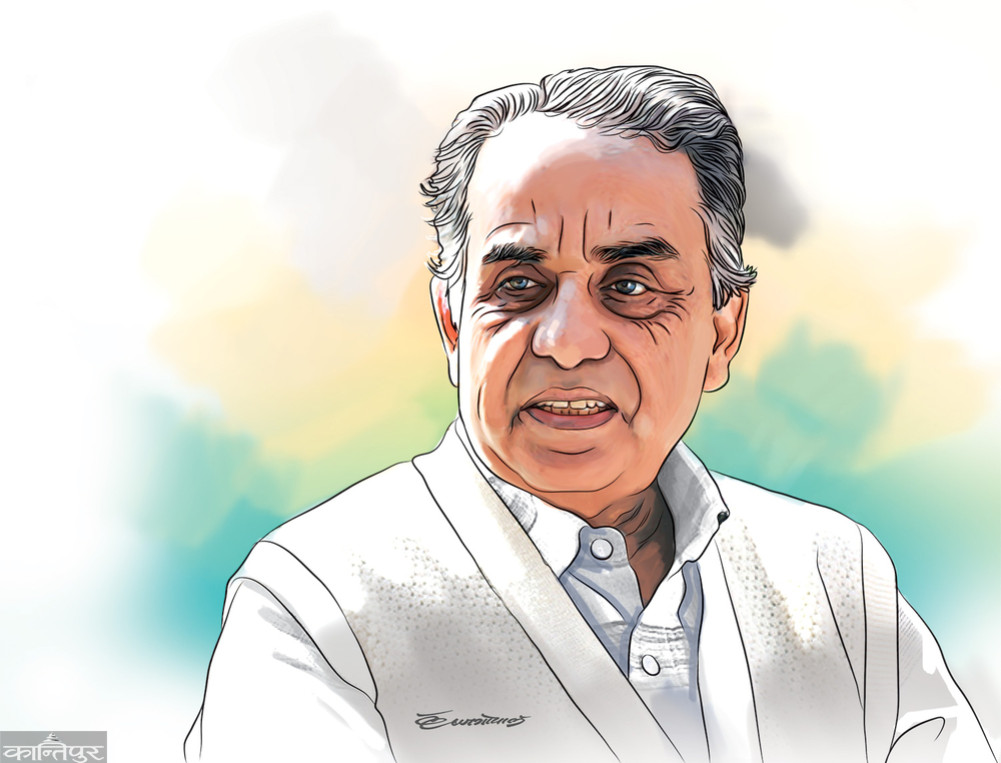
No one could challenge Daman Dai's self-esteem. He never enjoyed the 'joy of power'.He was always obsessed with facilities. He was a Karma Yogi.
We use Google Cloud Translation Services. Google requires we provide the following disclaimer relating to use of this service:
This service may contain translations powered by Google. Google disclaims all warranties related to the translations, expressed or implied, including any warranties of accuracy, reliability, and any implied warranties of merchantability, fitness for a particular purpose, and noninfringement.
When he met Daman Dhungana on Saturday morning, his face lit up. There was no smile on his face when he returned after treatment in Delhi. He was a bit enthusiastic when talking to me. The voice was faint. Bhupadidi (Bhuvan Dhungana) said – It is slowly getting better. Now you go to the bathroom yourself.
At 2:58 pm on Sunday, my friend Radheshyam Adhikari called – Daman dai was not there. This was unexpected news for me. I rushed to the frontline hospital. After seeing his mortal body, I could not stand there. I thought - a great democrat from the country has merged into zero.
My closeness with Daman Dai dates back to childhood. I grew up in the Adarsh Vidyashram opened by Daman Dai and his friends. His father Kedarnath Dhungana was a lover of education. We village children used to learn math and English with him. He had serious interest in our education. Daman Dai Lakka was already young at that time. There was a kind of authority on his face. We hesitated to approach him. But as we grew up in his shadow, our hiccups disappeared.
At that time we were not aware of Daman Dai's political involvement with the Nepali Congress. His liberal father knew this. It was a matter of happiness for him. Father himself was also interested in politics.
Daman dai once told me – Dada-didi (parents were called Dada-didi in Daman dai's house) used to call me chairman. Whether my nature is lazy or not agile, whether I sit thinking about something or what to say, if someone asked me something, I would get up and ask someone else to do the work. Seeing my nature, they would have called me chairman.
Daman Dai's life was not as easy as people thought. He had a very struggling life. He was an undaunted warrior. He also did active journalism. He was associated with Gopaldas Shrestha, Maniraj Upadhyaya, Govinda Viyogi, Manindraraj Shrestha. He worked for a long time in 'The Commoner', an English daily published under the editorship of Gopaldas Shrestha. He was also involved in Nepal Samvad Samiti, the first news agency of Nepal. During his lifetime, he also translated articles from foreign newspapers. He was a poet and prose writer. In a romantic mood, he used to mutter – 'One evening of my life was spent with you.' He worked very hard to organize the student movement in Nepal. Navraj Subedi, elected president of Tribhuvan University Students' Union from the democratic group, was removed from the post by passing a motion of no confidence against him after Daman Dhungana's leadership attracted him to the panchayat system of Raja. None of today's senior leaders are immune to Daman Dai's influence. Shankar Ghimire, Kamal Chitrakar and Daman Dhungana dominated the democratic politics of Kathmandu when the panchayat adopted a harsh policy against the democrats.
Daman Dai was a tireless warrior of the Nepali democratic movement. The freedom of the individual was dearest to him. He used to say that the fight for freedom is not to fight for anyone, but to fight for oneself. Because you and I live together, freedom has become yours and mine too. Organization is needed when we enter socio-political life, struggling for the natural rights with which man is born. A person thinks that he is himself first, and then his family - children. If we stay together, whoever is hungry will feel that hunger.
Daman Dai used to say - As I understood parliamentary democracy during my studies, if the parliament is strong, it will do all the work. Budget making, program making, policy making, law making, all these things are the daily life of the state. Even state rulers who were not elected by the people did that. However, Parliament should do the job of expressing the voice of the people. Parliament is the party that makes the government accountable. That is why democracy is a responsible system. There is not much difference between a one-man dictatorship and a democracy. We have seen that even the democratically elected Prime Minister is authoritarian and totalitarian.
After the 2048 elections, a newspaper reported why Daman Dhungana did not become a minister. Daman dai told me about that news, it was a 'sarcastic' comment that he did not take to me as I did not support Girijaprasad Koirala. But Daman Dai never violated party discipline as long as he remained active in the party. He was given a ticket by the party and he won in the name of the party. In the election, Daman Dai won from Kathmandu alone from the Congress. He also had a slight claim that Kathmandu should be represented. Later he became the Speaker of the House of Representatives. He established the belief that the government belongs to the ruling party and the parliament belongs to the opposition.
He really became the 'Chairman' of the Parliament as Dada-Didi said. The first most powerful speaker after the National People's Movement 2046 restored constitutional monarchy and multi-party democracy.
Daman Dai had a deep philosophical consciousness. He enjoyed intellectual discussions. At the same time, while analyzing contemporary politics, he once said that the most dear thing of a man is his life. Normal hunger and cravings are common not only to humans, but also to dogs, cats, tigers and foxes. People are ready to fight and resist to save their lives. Yes, they may lack awareness. It is the responsibility of the state to spread that awareness. An independent media monitors the work of the state and spreads awareness and knowledge. Taking charge of lives without spreading awareness is a ridiculous move by the state. The real thing is that no one has been able to solve the major problems of the country.
A revolution happened, okay. Parliamentary democracy came. That was not enough. Republic came. Yet there has been no transformation in the structure of the state today. In terms of tradition, the transfer of state power has taken place, but the transformation of the state has not taken place. Why has the transformation of the state not been able to take place after repeated struggles, revolutions and rebellions? The reason is clear.
He believed that some political ideologies that started in Britain and France in the seventeenth-eighteenth century are not at all suitable for the so-called third world. So far we have not been able to move beyond that ideology. Mohandas Karamchand Gandhi tried to make a fundamental change by understanding the Asian situation in its true sense. Karl Marx strongly criticized the parliamentary system. However, Gandhi has criticized the parliamentary system in a more serious language. Gandhi said that all the power of the state should be given to the people.
Although I did not always participate in Daman Dai's thought-journey, I was never unfamiliar with his democratic ideas. In terms of political thinking, there was no room for disagreement with Daman Dai.
His studious nature and knowledge strengthened him. No one could challenge his self-respect. Daman Dai never enjoyed the 'joy of power'. He was always obsessed with facilities. He was a Karma Yogi.
Writing your brother's 'Avichyuri' with your own hands is a brutal task. The memories are so many, it is impossible to record them in this small memory. With Daman dai I have experienced both sorrow and happiness together. He will be missed in my life.