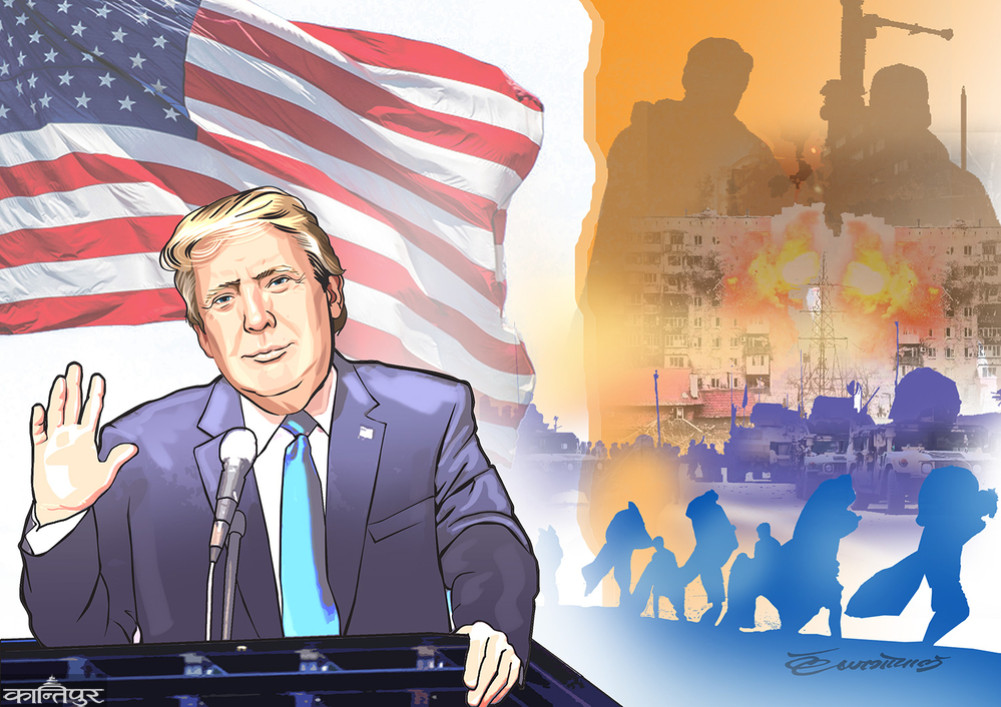
There is no alternative to rational politics and democracy in the dark world environment
We use Google Cloud Translation Services. Google requires we provide the following disclaimer relating to use of this service:
This service may contain translations powered by Google. Google disclaims all warranties related to the translations, expressed or implied, including any warranties of accuracy, reliability, and any implied warranties of merchantability, fitness for a particular purpose, and noninfringement.
The year 2024 has been an unprecedented year in terms of elections. Because more than half of the world's population voted in more than 70 countries this year. Not only has this year been a pivotal and historic turning point for global trade and geopolitical stability, it has also warned of heightened risk and instability around the world leading up to the US election.
As soon as the counting of votes began, New York Times columnist Brett Stephens, a staunch critic of Trump, warned, "Focus on avoiding the nightmare rather than fulfilling the dream." Focus on making sure China doesn't try to take over Taiwan, Iran doesn't get a nuclear weapon, and Russia doesn't move on with Ukraine. It would be wise for you to prioritize these threats. (Stephens: November 6). This is the biggest concern for the world that the US claims, but what form Trump's dalliance with Putin and his earlier commitment to end the Ukraine war will take is anyone's guess.
Populism divides society into 'people' and 'anti-people' forces. Populism itself does not depend on right-wing or left-wing ideology. It shows a tendency to accept one or both of them and to oppose them. Populism is famous for its unique communication and expression style. A charismatic leader, who appeals directly to the masses. It is considered a threat to democracy. Often it is anti-authoritarian and anti-democratic institutions. On populism, scholars such as Gino Germani, Turcuato De Tella, and Ruth Bodak warn of destabilizing democratic structures by promoting divisive rhetoric, protectionist economic measures, and authoritarian approaches.
Likewise, scholars such as Ernesto Laclau and Chantal Mouffe have interpreted populism as a form of politics that brings the needs and demands of the basic people to the mainstream by challenging the dominance of the authoritarian class. They have popularized the neo-Marxist idea that populism can further promote democracy by engaging people in political discussion, demanding justice and equality. Among historical examples of various forms of populism, the American New Deal campaign helped save American democracy from the Great Depression of the 1930s rather than the authoritarian threat. In the same way, Bernie Sanders, Warren, Podemos and Syriza are among those trying to protect and defend democracy in the current populist map. Hungary's Viktor Orbán's party is a right-wing politics with a narrow nationalist and anti-immigrant streak. Among left-wing populists, Greece's Syriza and Podemos, Bolivia's Bolivarian campaigns of Allende's focus on solidarity and internationalism have advanced their advocacy of immigration-friendly and more inclusive policies. But now the dominance of populism seen in the world is a right-wing 'paranoid dictatorship' far away from these two ideologies. (Richard Hofstadter: 1964)
A prominent history professor at Columbia University recently conducted an in-depth study of the rise of Trump and his highly skeptical outlook and political style. "American politics has often been an arena for angry minds. In recent years we have seen the activity of angry minds, mostly among the extreme right, who now Trump has shown in the 'MAGA' movement, how much political influence can be gained from the hatred and zeal of a small minority. The mentality behind it is certainly not new and not necessarily right-wing. I call it the 'paranoid style,' because no other word can adequately express my sense of intense exaggeration, skepticism, and conspiratorial imagination.'' was written—when Donald Trump was just graduating from high school—and the Columbia professor in the quote above was actually describing the Barry Goldwater movement. Hofstadter's article was published in November, the month of the 1964 presidential election. In the years since 2016, that article seems very relevant. Although the paranoid style is always around us, its importance sometimes increases and sometimes decreases. It shows a tendency to remain invisible on the political spectrum for long periods of time and re-emerge at unexpected times. There is hardly any doubt that Donald Trump is the main leader who has no choice.
populism's appeal
Thousands of policymakers, pundits and Nobel Prize-winning scientists are among those who worry that this year's elections will lead the world down a turbulent path. This year's first election can be considered the opening and closing of uncertainty, from the January vote in Taiwan, which is legally considered a Chinese island, to the latest U.S. election. The world has been shaken by the populist dominance displayed in a territory that represents nearly 55 percent of the world's GDP, including the most populous countries on all six continents. From India to Mexico, through Austria, Tunisia, Indonesia and El Salvador, there is a sense of panic that populist waves are about to sweep the hemisphere. The populist trend has taken root in the last decade of sociologist Hofstadter's words 'paranoid 'trend' has brought social unrest and geopolitical instability to a climax.
As the geopolitical order established after the Second World War is changing, the US election, which is considered the leader of the world, should have increased the possibility of pushing the world in a chaotic direction and made the small, unstable and weak democracies around the world even more alarmed. As Taiwan's DPP escalates tensions with China, Trump's indecisive style has simultaneously unsettled Taipei, Beijing and Delhi. The American-Chinese extreme competition, Russia's attack on Ukraine and the Israel-Hamas war and the American election over the corpses of those massacres can be considered to have created a situation to give such war and brutality a more aggressive form. According to Ruben Naizd, Chief Economist of North American Affairs and Political Risk, social and political risks have increased rapidly around the world this year, pushing the overall human environment into uncertainty and instability.
The confusion of political change
The current socio-economic environment has brought to the surface the feeling of dissatisfaction with the existing government. The uncertainty and instability of the election period will increase for at least the remaining 4-5 years. The alarming rise of populism stands as a warning for rational liberal politics. This trend has been steadily increasing since 2010. The electoral success of Geert Wilders of the Netherlands and Javier Milli of Argentina at the end of last year sounded alarm bells. It won't be long before Modi's persistence in India, Putin's cataclysmic promotion and Trump's preparations for democracy around it become palpable. Much of the outcome will depend on what form Trump's crackdown on immigrants will take.
The state of the economy has an impact on immigration policy. Trump's predecessor, George W. Bush, had a relatively favorable policy toward Mexican immigrants at the beginning of his term. In 2000, Republican presidential candidate George W. Bush attracted Hispanic voters with promises to expand legal immigration and legalize illegal immigrants. But the events of September 11 completely changed the context and strict immigration policies were implemented in the name of security and the war on terrorism.
When looking at the number of illegal immigrants deported in 2001 and 2002 based on actual deportations from 2003–2006, the Bush administration appears to have deported 1.1 million 653 illegal immigrants from the interior of the United States. According to scholars Baxter and Navaresteh, compared to deportations during Trump's presidency, there were only 325,660 during Trump's tenure. But this time he has made the main slogan of encircling the country and driving him out of the country.
Consequences
A stalemate or unimaginable aggression in the war between Russia and Ukraine could change the geographical map of the world. The recent BRICS summit in Kazan added five new members. There are serious concerns about how the pace of BRICS expansion will clash with US interests. Dissatisfaction with the Biden-Harris administration has spilled over to Trump, not only will Trump's 'mass deportation' of what will happen to the Arab, Muslim and other races and communities within America, but also the form of the genocide in West Asia is beyond imagination. Trump has brought far-right policies into the political mainstream.
When all the leaders take into account their political and social situations and exaggerate their conservative beliefs and adopt extreme attitudes towards immigration, it is certain that America and Europe will suffer the most. That the Continental Alliance, which was the forerunner of liberal democracy, is so far removed from liberal democracy is in itself an awe-inspiring situation. Bernard Guetta, a liberal member of the European Parliament, has warned that there is an "ideological unity between the extreme right in Europe and Donald Trump".
Europe's successful extremist right-wing leaders have succeeded in aligning themselves with Trump. Hungarian Prime Minister Viktor Orbán wished Trump electoral success. Italian Prime Minister Giorgia Meloni has established a direct relationship with a potential Trump administration through billionaire Elon Musk. Political analyst Susanna Wegh, who studies the threat to democratic values from the German Marshall Fund in Berlin, suggests that "institutions, politicians and citizens need to identify ways to move in this direction."
An analysis of the election results of nearly two dozen populist parties over the past 20 years reveals that the American presidential system presents challenges and opportunities different from the parliamentary structures prevalent in Europe. Hungary's Fidesz and Italy's Brothers of Italy are leading the country.
The far right has emerged as the first party in the Netherlands and Austria. Germany's Alternative for Germany (FD) has taken over the state of Thuringia. The supposed security provisions in France's presidential system have so far prevented Marine Le Pen from seizing power in Paris, but have left the country's parliament insecure and dysfunctional. After eight years in power in Poland, Law and Justice lost its majority, and a pro-European coalition led by former prime minister and European Council president Donald Tusk has come to power.
But he has begun taking tougher anti-illegal immigration measures. Right-wing populists such as France's National Rally and Britain's Reform UK are pushing the legal system down a violent path with significant public support. In the context where most of the populist parties have achieved electoral success and are deeply affecting the large population of the world, now that America has become its leader, what will happen to its policy of 'world based on rules', a serious question has been raised.
Since the migration crisis from Syria in 2015-16, the UK's Brexit referendum and Trump's enduring populism have reached a turning point in world politics. Hungarian Prime Minister Orban has erected a fence on the southern border, and now Trump is set to extend his old campaign to the border with Mexico.
Meloni makes a deal with the Albanian authorities to deport illegal immigrants. In Europe, Orbán and Meloni offer two different models of how far-right leaders run their administrations. During Orbán's 14-year tenure, his political agenda has become more extreme, which can be considered a full-fledged adoption of 'non-committal democracy'.
According to an investigation by Bloomberg, Meloni has adopted a centralized strategy after coming to power to appease his core supporters and Italy's bond holders. He has looked at Mask as the main coordinator for potential cooperation with the trump with the closer cooperation. ... As a President, whose generalist trends, he will try to centilize power. (Wargenan Wars: 2024)
in Btern of the main election that the main elections that happened this year, Lular Raj Silvae, Lular's redemption is a popularist example of Lula Silva in the Labor and Brazil. A neighboring country, Sri Lanka, has been added to the horizontal place. The continuation of Maduro and the US administration of Carakas in Venezuela should have made a ringwood in the world vigorously. Nelson Mandela's party ANC assessment with the Chaldist Varryvadist Party, the three decades of the long-decade Vervist Party has been fixed by white dominance.
that is similar to that happens to be tormented that at Pakistan, so there was a new meeting to be made in Pakistan. Later last time, UML-Congress has been on the last time, last time. All these incidents are decrolted limited to the limited socialist politics in a person's political politics, which is limited to the alleged interest politics in a personary healthistic interests. There is no such options, even if it is a dark world environment.