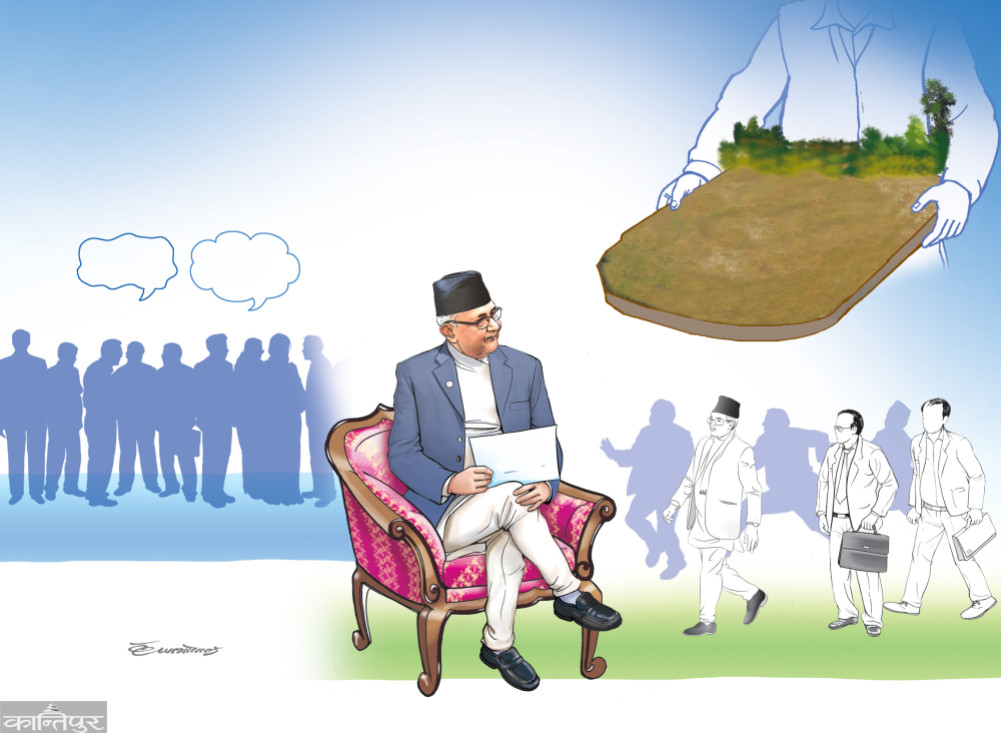
Grumblers hesitate to take action until the prospect of success is clear. Politicians celebrate Tihar confidently.
We use Google Cloud Translation Services. Google requires we provide the following disclaimer relating to use of this service:
This service may contain translations powered by Google. Google disclaims all warranties related to the translations, expressed or implied, including any warranties of accuracy, reliability, and any implied warranties of merchantability, fitness for a particular purpose, and noninfringement.
Prime Minister Khadga Prasad Sharma Oli's political legitimacy remains the same, but his social acceptability is decreasing day by day. At one time he was considered as the accepted tribal mukhtiyar (tribal chieftain) of the Khas-Aryas. Although the officiality of the co-operative fraud case is under investigation, Ravi Lamichhane is questioning his role as an ethnic watchman from within the custody.
Meen Bahadur Gurung, the owner of Bhatbhateni supermarket, may have been a CPN-UML worker in the past, but the act of accepting a land 'donation' for the party office from a disputed businessperson has caused more harm than good to President Sharma Oli, which is also clear from the court's ban on the transfer of land rights. By trying to force himself with the 'Grand Mayor' of Kathmandu, Balendra Shah, he has reduced his official height himself.
In the past, Sharma Oli, who has easily escaped from controversies such as Yeti, Omni and Giribandhu Tea State, is likely to be overwhelmed by the ambition to build his party's palace during his tenure, just like the beautiful white minaret and the 18-story observation column of Damak. As the hold and grip of the Balkot palace on the permanent power that has been in place since 2014 is slowly decreasing, it is almost certain that after Sharma Oli steps down from the throne of the executive head, the crowd that will look towards Bardli for his 'darshan' will thin out.
is the law of nature as it rises, rises, falls and falls. Therefore, there is no need to be worried about Prime Minister Sharma Oli's ooze and intensity. In the current scenario, there is no one who can give assurance, inspiration and encouragement to the dominant Khas-Arya community of Nepal to face the possible difficulties with determination, if not the entire nation. Whether
is a potential situation or an existing situation, its functional roots are to be found in the recent past rather than the distant past. A staged royal-military coup that began with the dissolution of the then House of Representatives in 2002 culminated in 2005. Sher Bahadur Deuba, who got justice from the Gorkhali king and became the nominated prime minister, and the UML, which participated in the government under the pretext of half-baked regression, were ousted from their positions in a disgraceful manner within a year. There was no alternative to a broad consensus to free the economy and politics of the country from the physical terror of the Maoists on the one hand and the psychological terror of the imperial-military power on the other.
In times of national crisis, establishing harmony between opposing views becomes inevitable. After the declaration of the Republic in 2008, the parliamentary practice of the party and the opposition had to return to its rhythm. After the death of Girija Prasad Koirala in 2010, there is no old man left to remind the politicians of the new republic of the meaning and essence of constitutionality and 'full democracy'. Even though the condition and date of the death of the Constituent Assembly was fixed through the court by making reference to the slogans of the sponsored crowd on the streets, no politician could muster the courage to give a logical answer to such a decree. According to parliamentary tradition, the outgoing government is responsible for holding fresh elections. But there is no doubt that due to the internal power struggle within some parties, bitterness and mistrust between various parties and decisive external interference, with the decision to hold the election of the second Constituent Assembly through an unconstitutional mechanism, government ad hocism has been strengthened.
In February 2014, the chairman of Nepali Congress, the largest party in the parliament, Sushil Koirala, formed a government together with his main rival, the UML, which was the second milestone in the direction of institutionalizing governmental ad hocism. Girija Prasad did not allow Congress to be 'UMLized' even though he participated in the government under his leadership. Since the new chairman of the Congress does not have the moral strength or political wisdom to stop the compelling attraction and deadly pull of ethnicity, even though Sushil Koirala has been sitting as the official Prime Minister since 2014, not only the government officials but also some ministers have started the trend of appearing in Balkot and taking instructions.
The 16-point conspiracy of 2015 is the decisive event that ends the ruling party and opposition concept, which is considered indispensable for parliamentary practice. A national consensus was needed to deal with natural disasters like the tragic Gorkha earthquake. But in the conspiratorial exercise of covering up the opportunity for political gain, Sharma Oli abandoned rescue, relief and rehabilitation work and proceeded to promulgate a temporary constitution on the fast track, because there was no other way for him to become the prime minister as per the condition of cooperation with the Congress. UML's Hartakarta knew that within the Nepal Valley, who believe in
conspiracy, kanekhushi is more powerful than facts and logic. When some indigenous and some foreign indicators and directors started spreading rumors to Maoist surveyor Pushpa Kamal Dahal, perhaps he also felt that if the constitution cannot be made now, it will never be made. Vijayakumar Gachchdar was a Madhesi icon who stamped his fingerprints saying Fagat Sakshi Kinara Sadar. The June 2015 16 Point Conspiracy was in fact the foundational document that institutionalized ethno-nationalism.
The subsequent brutal suppression of the third Madhesh rebellion, the demarcation of the Indian border and the announcement of the controversial constitution gradually strengthened the governmental ad hocism in the name of consensus politics. It is a strange thing to sometimes go to Tukka due to the certain, uncertainty that arises naturally among powerful people, otherwise no one can make a realistic estimate about the possible trajectory of Nepalese politics.
Uncertain stability
Usually, any newly formed government is given an introductory period of 100 days to get used to it, and only then its direction and condition are assessed. Prime Minister Sharma Oli, who has been in office for at least the third time, is not entitled to such a facility, so his 100-day performance report that was made public recently or the comments made on it are nothing more than a ritual. Using the language of UML President Sharma Oli, his leadership has come to be considered as 'a poor government'.
Gorkha was unable to escape from the earthquake and during his first tenure, the Bhotekoshi flood created controversy. His second term will be remembered for his massive mismanagement of the Covid-19 pandemic. It is certain that he did not go to America to "drink water buffalo", but after returning from a tour, in the situation of heavy rains, landslides and landslides, the negligent answer he gave to the journalists was like a slap in the face. He is confident that no matter what he says or does, nobody can do anything to him in the post-2015 ad hoc scenario.
No matter how much the cultural or social importance declines, there is no one who can touch him in the economic and political system of which he himself is the chief designer. When the Indian Prime Minister Narasimha Rao was accused of buying MPs to gather support, he replied - 'Iss hammam mein sab nage hai.' Although politics is not a bathhouse but a workshop, but it is equally true that the lives and clothes of those who work there get blackened.
Congress has accepted the leadership of Prime Minister Sharma Oli under the pretext of stability. Corruption, even by creating fake refugees, may sound like the script of a horror movie about a decadent society. Involvement in misappropriation of small savers deposited in the cooperative is also evidence of moral turpitude. However, the Congress cannot do anything to the Sharma Oli government, because if the structure collapses after withdrawing its support, there is a risk that the structure of the Congress, which is rotting from within, will also be buried in it.
Both middlemen are dominant within Congress and UML. The biggest donors of both parties are the same. Although the dominance of Bahuns in the UML and the dominance of the Chhetris in the Congress is clear, ethnically, the Khas-Aryas are the main voters of both parties. In matters of foreign policy, both parties tend to lean towards the western camp. In economic politics, both parties have become supporters of the radical free market. In the matter of secularism, perhaps the UML is somewhat more liberal than the Congress, otherwise both parties have made the slogan of 'one language, one disguise, one ethnicity, one country' their mantra. Sharma Oli is confident that he will continue with the Congress to sustain the government ad hocism after 2014.
Even though the CPN-Maoist Center is formally the main opposition in the Parliament, there is nothing left of the mathematical numbers, moral strength, theoretical basis or political power to oppose the NECA-UML alliance with its president Pushpa Kamal Dahal. He may have had some compulsions, but by joining the 16-point conspiracy, he completely abandoned his political stance.
In 2018, he handed over his future to Sharma Oli by merging his party with the 'Nepal Communist Party', which was first formed to be dominated by UML and then abolished by the court's decision. Standing on the shoulders of Congress and UML in turn, even if personal gains are achieved, political heights do not increase. It is a strange thing to be roared from the Houses, streets, auditoriums and conference halls to show your party's presence, but Dahal must now be taking seriously even within his own party. It is a tragic aberration to lose the acceptance of a major politician who has a huge investment of the nation as a whole. Chatkis like Ravi Lamichhane, Balendra Shah or Hark Sampang can emerge miraculously overnight, but no matter how bright they are, their ability to scatter light and heat is inherently limited.
After 2014, no Madhesh-dependent party has the courage to oppose the government in which the Congress or UML is involved, even though they have lost their ability to be involved in major scandals within the ethnic power structure. It is impossible to escape a room full of dust without a stain. If the parties that have supported the Congress and the UML in a supporting role, they will chase them from the mountains if they take to the streets, no one in Madhesh will believe them.
Public opinion, civil liberties or other small political parties are like private platforms set up by ambitious politicians for transactions rather than resistance. India's socialist thinker Ram Manohar Lohia has a much-quoted saying - 'If the road is silent, then the parliament will be a stray.' The dictionary also defines 'awara' as 'disregarding home, family and society'. In a country where the constitution is promulgated by the whip of party directives, devotion to one's leader, let alone home, family and society, is sure to be considered higher than one's own long-term interests. The indifference and deafening silence towards the stable stability of the state and society should give an impression of the impending crisis, but the citizen activists who can give warning signs and believe from all sides of the mountains and Madhesh are nowhere to be seen in the contemporary scenario.
Balanced instability
An example of the belief that it is relatively easy for MPs to speak the truth free from the whip of party discipline is Amresh Kumar Singh. He probably said in the first meeting of the current House of Representatives after breaking the circle of his mother party Congress and being elected as an independent. However, both classes do not live in this country. While the eaters are forced to go to countries including Malaysia, Qatar. Those who eat go to America, Australia. His deep observation based on the classical Marxist theory of polar class division opposite
reflects the reality on the ground. But the categories of ``Gari Khane'' and ``Basi Khane'' born together with those who eat when they eat and those who eat have been influencing economic politics based on the free market more. According to Albert Ott Hersmann, a scholar of political economy and a scholar of development economics, when an economic or political enterprise declines, there is no other choice but exit, resistance or loyalty—the title of his book is 'Exit, Voice, and Loyalty'.
Since resistance to strong power is difficult and risky, the proletariat below and the elite above prefer to go their separate ways. The majority of the middle class revels in loyalty, no matter how much they thrash about behind closed doors. In any country, the community of people who raise their voice and show their presence, who stand up against the status quo to discuss the correct solution is extremely small.
According to the middle class, small businessmen, employees of financial institutions including cooperatives, middle government officials, drivers, small-scale farmers, or regular income guaranteed office or domestic helpers can fall into this category. Although they are working people who can make ends meet, the range of thinking of the lower class people is extremely limited due to the lack of savings, the limitations of the present and the uncertainty and anxiety of the future. Even if you do your direct employment risks, the sound does not make sounds.
Marx and Anjels are ready to sell the higmat and their service) to say that the highest collector, the high-service), does nothing in the streets of the rotting power. This consequences of dearly politics, insults, insults, sufficiency, sufficiency and collectiveism and collective self-sustainability of death. The restless statement of the eating the largest benefits of balance is stated that the largest benefits of unbreakable instability is. The highest class (Auth bourgeoisie, who is on top of large entrepreneur, vasty profession, is closer to their self-rapidity for their own selfishness. Upon walking in the city, the Maoists were in the face of him in 2006.
-BREAK MURNING RENTAL, CAVERS, CAFFERS, CAFFERS, CAFES, CAFFERS, CAFFERS, CAFFERS, CAFFERS, CAFFERS, CAFFERS, CAFAGE and land). He likes politics, he likes a teacher to abuse the politicians. They ask - a civil society is, and to sleep with alcohol. Storeups, remittance economy, expanding and establishing the criteria of the young people in the young-country of youth, not the case of the current statement of the criteria of the criticism of the criteria for the criterion of the politicians. Grumblers hesitate to take action until the prospect of success is clear. It is a politicized festival. And, the light of highlights that the colleague frequent agriculture ready to suffer with silent consensus can spread to life.