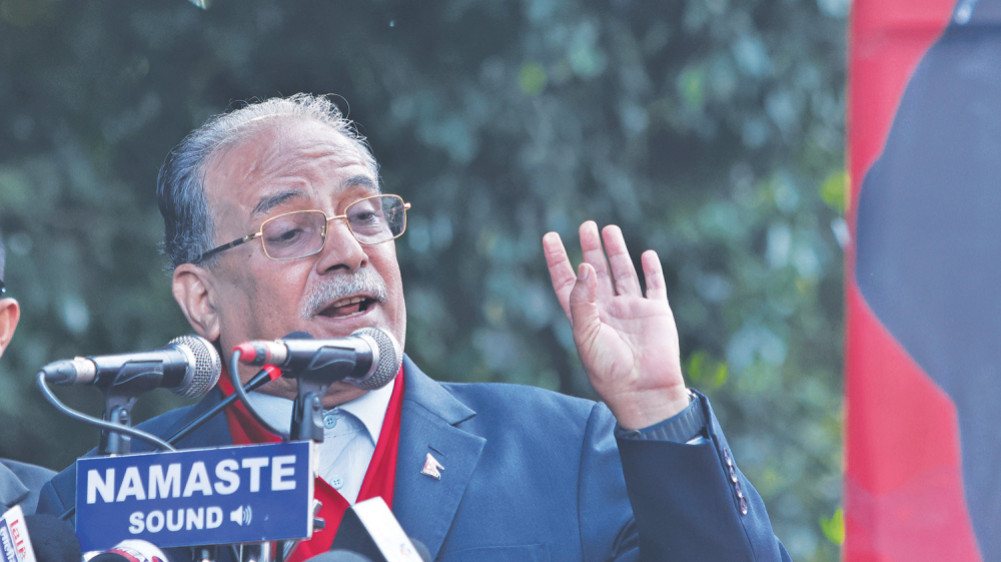
Because of Dahal's style of working with one while cooperating with the other and his mentality that he is the only one, the country has become a victim of political instability, and his party has suffered more than that.
We use Google Cloud Translation Services. Google requires we provide the following disclaimer relating to use of this service:
This service may contain translations powered by Google. Google disclaims all warranties related to the translations, expressed or implied, including any warranties of accuracy, reliability, and any implied warranties of merchantability, fitness for a particular purpose, and noninfringement.
CPN (UML) President KP Sharma Oli-led government has not yet completed 100 days, and there are rumors of a change of government on the part of the Maoists. The talk of changing the government started by the Maoists to destabilize the two-thirds government formed by the two largest parties of the country, Congress and UML, with the main slogan of political stability, is an indication of the unstable state of mind of the Maoists themselves.
Despite the total attendance of 11 percent in the House of Representatives, the Maoist leadership has now become restless after the magic of 32 seats did not last long after two major parties UML and Congress fought each other. Sometimes in the name of opposition party fronts and sometimes in the name of street demonstrations, his restlessness and impatience is being manifested in public. Pushpa Kamal Dahal has woken up from his slumber after the dream of Congress-UML fighting and remaining as the prime minister for five years has been shattered despite the agreement of half term with UML. After all-round failure, erosion of leadership, continuous downward journey of the organization and isolation with its own fellow travelers, Maoists have started to adopt the failed and old formula of street struggle.
Contesting elections together with Congress (079 November 4), forming a government together with UML (079 February 10), again sharing the main posts together with Congress (079 February 10) and remaining in power again together with UML (080 February 21) after its purpose is over. The Maoists who got 'success' took a clear policy of utilitarianism - UML should cooperate with Congress and Congress should cooperate with UML but not give up power. After the Congress-UML merger on June 17, 2008, the two big parties clashed and stayed in power, and now it has become increasingly difficult. The attention of the Maoist leadership has not gone anywhere else except that if they can put foam in the power coalition, they can fill the cracks of power again. As a result, without any issue or context, the Maoists have tried to create a dilemma for the street movement. At present, Maoist is trying to hold the path of divisiveness to create a commentary that the Congress-UML could not do anything even if they got together by blurring the political environment, creating instability, hindering the economic activities and negatively affecting the psychology of the citizens. The unstable and opportunistic tactics of the
leadership have made the Maoist party a force not to be trusted. There is no other leader in Nepal except Pushpa Kamal Dahal who can immediately turn from where he has reached without any reason. The country has become a victim of political instability due to his style of working with one while cooperating with the other and his mentality that he is the only one who is weak. It is because of this instability that he does not hesitate to call himself 'active', that Pushpa Kamal Dahal has become isolated from everyone and has reached the streets from power. The leadership's opaque lifestyle, alliances with undesirable elements and apolitical relations have rendered the Maoist party irrelevant in national politics. What will be the condition of the party if the workers consider such a leadership as an ideal after a leader who publicly expresses that everything other than guns and money is an illusion? If you look at today's Maoists.
After Maoist joined the peace process, Maoist joined 11 out of 15 governments in 18 years since 063. Maoists led the government four times by Pushpa Kamal Dahal three times (065, 073 and 079) and once by Baburam Bhattarai (068), while in the government of Khilraj Regmi (069) two employees have participated indirectly by sending ministers and six times in the government led by others. After replacing Pushpa Kamal Dahal in 2006, Madhav Kumar Nepal became the government led by the Maoists who sat on the streets with the slogan of alleged civil supremacy, and after the 070 election, Laj could not go to Sushil Koirala's government. Apart from that, the Maoists who stayed out of KP Sharma Oli's government amid controversy in 078 are now in the main opposition after forming a government under his leadership in 081. Unable to accept that the government and the opposition are two sides of the same coin and the majority in a democracy is a natural thing to form a government, the Maoists have understood their removal from power as a coup d'état, a 'coup' or being deposed. The Maoists, who have been enjoying power since the beginning of the peace process, are not only worried about where their downward spiral will lead them in the days to come.
The Maoists understand very well what their condition will be if they fight the elections alone. In 2074, the Maoists, who won 36 seats directly when they contested the elections together with the UML, halved to 18 seats in 2079 in collaboration with five parties including the Congress. When the Congress-UML announced that they would fight alone in the 2084 elections, the Maoists were shocked by it. When someone is fighting an election without standing up for someone,
Maoists have no idea what their condition will be. Because, if there is no agreement with five parties including Congress in 079, the statistics show that Maoist will be limited to 5 to 9 seats directly. Because, out of 165 constituencies, the Maoists have gained a lead in 9 constituencies proportionally. Out of that, only five constituencies (Gorkha-2, Rukum East, Rukum West, Rolpa and Kalikot) have been won by the Maoists in the House of Representatives. He did not win directly in the two constituencies (Sarlahi-3 and Mahottari-1) that got more votes proportionally and UML won, while Congress won in Gorkha-1 and Democratic Samajwadi Party in Sarlahi-1. What the above figures show is that if the Maoists had contested the election alone, it would not have been possible to achieve a double-digit victory. On the one hand, he has not been able to directly protect his own public opinion and on the other hand, the rest of the winnings have been possible only because of the Congress and other alliance partners. In such a situation, the present is challenging for the Maoists, the future looks even more frightening.
The future of the Maoist party is in the greatest crisis. Most of the leaders-activists who fought the 'people's war' yesterday have become rich, the remaining ones are gradually getting tired, inactive and depressed. There is no new attraction in Maoists. There are no other Maoists today except those who joined the war yesterday, those who lost their family members and those who benefited when the Maoists were in power. From Mohan Vaidya, Baburam Bhattarai, Netravikram Chand to Ram Bahadur Thapa-Lekhraj Bhatt, the Maoist has come to its current state, shrinking and shrinking. Janardhan Sharma is seen as the latest victim of the practice of being treated in the sense of 'Gathgadi Takeko' as soon as he raises a little voice within the party itself. The commotion within the party when they demanded internal elections because of Pushpa Kamal Dahal, who has been ruling continuously for 35 years without competition, reflects the psychology of the Maoist leadership. There is no freedom to speak against autocracy and patriarchy within the party that claims to have removed the monarchy from the country.
Rather than attracting new generation people, those who are in positions have no other purpose except to use Maoist for their own benefit. Maoists who are afflicted with the disease of not seeing their own brothers-nephews, sons-daughters, husband-wife and those who benefit financially when the opportunity comes are finally in a fast pace of decay due to this reason. Of course there is one person at the head of the party. This means that the party is not his family and private company. Many must have remembered an incident that happened in Maoist some time ago. Urmila Aryal was the vice-chairman when the Maoists got the Speaker of the National Assembly in collaboration with the UML. Because she is educated, has become a minister, is the incumbent vice president and is also a woman, many naturally assumed that she would be made the president by the Maoists. However, that did not happen. President Dahal's brother Narayan Dahal got that opportunity, who was not elected by the Maoists but was nominated as a member of the National Assembly in an independent capacity by the President and did not even have his term left. How appropriate is it to show the spirit of the movement that has woken up in Sri Lanka and Bangladesh against familyism in order to inspire others? When looking for the roots of those who get opportunities, get appointed and get promoted in the party, it ends up in the family.
Pushpa Kamal Dahal has sometimes brought forward the issue of Samajwadi Front in the hope that his lost supremacy can be returned and sometimes he has discussed the unity among former Maoists. Baburam Bhattarai is the latest victim of the tendency to get along with whoever he wants and not care when his interests are fulfilled. In return, Dahal did not allow Baburam to remain in his own party by elevating Mahendra Rai as per the prior agreement, apart from party unity. Now, even if there is unity among the former Maoists, it is unlikely to create any enthusiasm. Because, in terms of public opinion and credibility, none of them can come true.
Gone are the days of politicking with loud speeches, impossible dreams and unproven allegations. Because, everyone has seen/experienced everyone. Maoists cannot justify what they failed to do when they were in power and what remains to be done. If the Congress and the UML really fight the elections alone, the Maoists will be confined to the place where they are sentimental about the old days. No, if the main two competing parties seek the help of Maoist to level each other and form an alliance in the elections, then again his share of the power market will be high. Therefore, the future of today's Maoists is largely out of their hands, it has been blown. Rather, it depends on the policies that UML and Congress will adopt in the 084 elections. For that, the Maoists have to break the current power equation and they have been using force since Navaran.