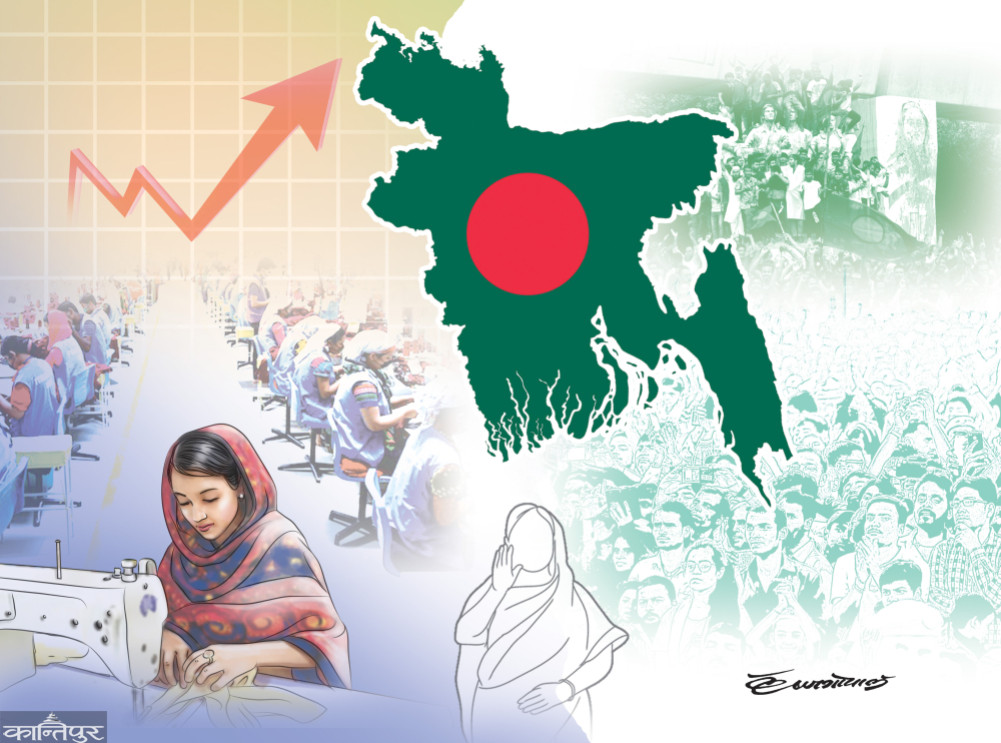
A major cause of political and social unrest in Bangladesh was the lack of government accountability and good governance
We use Google Cloud Translation Services. Google requires we provide the following disclaimer relating to use of this service:
This service may contain translations powered by Google. Google disclaims all warranties related to the translations, expressed or implied, including any warranties of accuracy, reliability, and any implied warranties of merchantability, fitness for a particular purpose, and noninfringement.
Bangladesh was called the dynamic economy of Asia. He was about to become the next 'Asian Tiger'. That is why, four years ago, through an article, I made a call to leave the gossip of Singapore and Switzerland and look at Bangladesh.
There I noted that Bangladesh's economic success was due to strong economic growth and significant poverty reduction. But has Bangladesh's economic success been overstated? Was the story of Bangladesh's export-driven economic growth wrong by economists? Before answering these questions, let us analyze what the 'drivers' of political and social instability were from an economic point of view.
While working at the International Labor Organization (ILO) in Geneva, I created the Index of Social Instability. which assessed social instability in member states of the ILO. Fiscal austerity was adopted in Europe in 2009–10, leading to popular discontent in southern European countries Portugal, Italy, Greece and Spain. The Index of Social Instability remains a useful tool for measuring instability. Since 2010, ILO has been publishing it regularly.
After the Great Recession of 2007-09, many countries launched fiscal stimulus packages. These were expensive for government budgets. Many countries in Europe withdrew fiscal stimulus measures to curb the growth of social debt. This time is also known as the 'debt crisis' of the Eurozone. Greece, Portugal, Ireland and Cyprus in this zone defaulted on their government debt. They were forced to pay off the debt without the help of the European Central Bank and the International Monetary Fund (IMF).
The inability of many countries to attract foreign capital and large financial deficits was the cause of the debt crisis in the European region (Euro Zone Debt Crisis). They could not devalue their currency because they used a common euro (currency). They were forced to cut their government spending. It killed ordinary people. This increased unemployment, food prices and income inequality. As fiscal austerity was quickly introduced, great social instability emerged in the region. Many governments were overthrown and new political parties came to power.
Similarly, governments changed in the Middle East region for various reasons. The ousting of Tunisian President Ben Ali also led to an increase in unemployment, food prices and income inequality. Egyptian President Hosni Mubarak was also overthrown for this reason. Other rulers in the region were also scared of the possibility of a coup. At the time, I was working on studies for the ILO. A book released at the time detailed Ben Ali's overthrow. I made a presentation on the Index of Social Instability in Tunisia on behalf of the ILO delegation. People liked that framework of the ILO to understand what happened in Tunisia.
People's view that their quality of life is decreasing can lead to social instability. To understand this, it is necessary to understand the factors of social instability. Previous economics and political science studies have identified six reasons. Apart from that, there may be other reasons, which are under study. But 6 reasons for Tapasil are seen in different studies
1. Inequality in income and guarantee of injustice: view of economic and social differences, increasing social exclusion, which have a negative impact on social cohesion, which leads to social instability.
2. Fiscal consolidation (consolidation) and budget cuts: austerity measures lead to political opposition and social instability.
3. Increase in food prices: Increase in food prices is also due to political and social instability. A direct example of this can be taken as 'Arab Spin'.
4. Common people cannot express their frustration due to the autocracy of the state and the lack of democratic system. The use of the police and the military suppresses social instability, but the lack of understanding of the causes of instability increases instability and disrupts social cohesion.
5. A growing population of educated but disaffected people: As many young people who are educated and unemployed do not find areas of economic potential, programs of conflict and agitation are created. Such incidents took place in the Middle Eastern and Southern European countries of Greece and Spain.
6. Prevalence of mass media: According to previous studies, the influence of radio shows dissatisfaction. Today's Facebook and Twitter (X) have become widespread. It is clear that the prevalence of mass media is a cause of social instability.
The reasons mentioned above were sufficient in the student movement in Bangladesh. Due to which Prime Minister Sheikh Hasina was forced to leave power. Due to the concentration of political power in one person and party, it was easy to identify the root cause of all economic crises. The autocracy of the state is the main cause of political and social instability.
Bangladesh under Hasina
When Sheikh Hasina was Prime Minister, Bangladesh experienced impressive economic growth, which was 6 percent per year. His government should be praised for various economic reforms. For example, priority was given to the strengthening of infrastructure, including the regular availability of electricity, the construction and expansion of highways and railways, and the construction of ports. During his time, garment industries flourished, textile exports skyrocketed and surpassed other countries in Asia.
According to the definition of the United Nations Industrial Development Organization (UNIDO), the garment sector is considered as a low and low technology manufacturing sector. These types of export-oriented manufacturing were established and moving up the global value chain, medium-tech industries such as pharmaceuticals, plastics, basic metals and high-tech manufacturing (electronics, automotive) also began to export.
Bangladesh's experience and its readiness to grow the garment industry and move it up the value chain can be a useful lesson for Nepal. The main reason for inclusion of Bangladesh in the world market is the availability of export oriented products. Export-oriented manufacturing industries are also important in that. Bangladesh has excelled in readymade garments and is among the leading exporters of readymade garments globally. According to the World Trade Organization, the share of ready-made garments exported from Bangladesh in the world market in 2019 was 6.8 percent. It was only 4.8 percent in 2011 and further reduced to 0.6 percent in 1990. The garment sector now employs five million people, 80 percent of whom are women.
Bangladesh's GDP surpassed India's per capita income in 2023. From 2003 to 2010 and early 2020, Bangladesh's GDP grew rapidly. Economic growth had a positive impact on the education and health sectors. Women have a big role to play in Bangladesh's success story. Many women became educated and effectively engaged in various occupations. On the Human Development Index, which reflects a nation's health, education and standard of living, Bangladesh ranked above India and just below Sri Lanka. Despite this economic growth, Bangladesh's other indices such as political rights, political pluralism, civil liberties, governance and personal freedoms were all deteriorating. The 2024 general election is an example of the collapse of the political right. In this only 'Awami League' effectively participated in the general elections.
Even before Hasina's ouster, Bangladesh's economic success story was showing some signs of trouble. Bangladesh's economic growth was limited to 3.8 percent in the second quarter of 2024. This was a sharp decline from 9.3 percent in 2022 and 7.1 percent in 2023. The government's projection for 2024 was 7.5 percent, which was very different from what the government said and independently projected by the World Bank and various organizations. The government last January estimated GDP growth at 6.5 percent. It was much more than an independent launch.
Bangladesh's economic woes were evident in 2022. Because despite warnings from IMF and other international organizations, economic austerity was not adopted in Bangladesh. Even as the government secured new loans, the country's debt burden increased. Bangladesh's external debt exceeded $100 billion for the first time in 2023. The government was forced to repay contracted loans by borrowing from debt service institutions. This seriously affected Bangladesh's foreign exchange reserves. In April 2024, foreign exchange reserves were lower than suggested by the IMF. Similarly, non-performing loans of the bank increased by 10 percent. Bangladeshi banks have given fabricated figures after being pressured by the IMF to reduce non-performing loans. As a result, confidence in the bank has decreased.
Although the government initiated measures to improve the institutional problems in the banking sector, they were not fruitful. Efforts were made to merge the weak banks with the big banks but that too did not help much. Banks close to the political leadership benefited from this reform, misappropriating public assets. In 2022 and 2023, Bangladesh's economic situation worsened and it seriously affected the middle-class and poor people. Government figures put inflation at less than 10 percent, but food and other essentials were higher. While food and oil prices were falling in other countries, they were higher in Bangladesh. In 2023, the government increased the prices of gas and electricity several times. From which began the plight of the common Bangladeshi citizen. According to a 2023 survey, 37.7 million people experienced moderate and severe food insecurity. Many families took loans to meet their daily food needs. In the 2023 survey, the rate of youth disengagement from employment, education and training reached 40 percent, up from 30 percent in 2016/17.
Bangladesh's worsening economic situation and worsening social, economic outcomes have affected governance. It proved false that the economy is improving at the cost of democracy and a unified political system. Fourth of the six causes of economic instability, government accountability is an important factor. A major cause of political and social unrest in Bangladesh was the lack of government accountability and good governance. During Hasina's reign, governance changed from democratic to autocratic.
Economic situation after the movement
2024 After Hasina's exit in August, the country's economic prospects look positive. The fundamentals of Bangladesh's economy are strong. Despite the recent economic slowdown, the country's economic growth has remained at 6 percent. This is considered rapid growth. According to ADB's September 2024 forecast, Bangladesh's economic growth in 2024 is expected to be 5.8 percent, second only to India in South Asia. The economy of Bangladesh is completely dependent on the garment sector. But for the past few years, it has tried to expand by giving preference to pharmaceuticals, electronics, shipbuilding and agricultural industries.
Bangladesh is still a country with a young and active population. An increasingly educated and skilled youth workforce can engage in new medium and high-tech manufacturing sectors. Factors that have transformed Bangladesh from a low-income country to an industrial powerhouse in South Asia are still substantial. Prof. Mohammad Yunus, who is currently the head of the interim government. He is committed to economic reforms, the impact of which is already beginning to be felt in the economy. The government has already started to manage the loans. It works out financial losses and increases revenue. Reforms have been initiated in the banking sector, thereby increasing credibility and bringing transparency to financial institutions.
Currently Bangladesh's GDP is $455 billion and is estimated to reach $750 billion in 2029. Its market size makes it an attractive destination for investment. Realizing this, the interim government is taking all possible measures in every sector of the economy to keep economic growth strong. According to the latest estimates of the Asian Development Bank (ADB), Bangladesh's economic growth is expected to be 5.1 percent in 2025. This is lower than previous years, but still higher. Economic growth had slowed since before July due to a decline in industrial output. Production in the manufacturing sector, especially in the ready-made sector, will further decline. The reason for this is the impact of the movement on factories and ports. There is a strong financial and monetary policy, which controls inflation. But it brings decreases of consumption and investment demand. Inflation has been assessed in
2025. The strong monetary and financial policy is brought, it can happen. Central banks in Bangladesh have succeeded in increasing the potential potential potential of inflation. The government plans to limit the financial statistics confinement in 4.6 percent of GDP. He aims to increase revenue and limit expenses. Current Expenses appears to increase 8 percent and capital expenditure of 8.2 percent. The goal is to fulfill 63 percent financial losses from internal debt. Due to repeated political instability, the Interim government plans to review the budget of revenue and the integration of the expenditure. The government will also adopt various ways to escape the tax base.
is still the prospect of economic risk in Bangladesh. The Interim government has created a commit to addressing it. Its main work will be recommended to evaluate the financial status of the country and recommend a large measures for economic stability. To move forward and rely on the last revenue reform, the balanced government finance, low interest rates, proper exchange rate and diversification of economy.