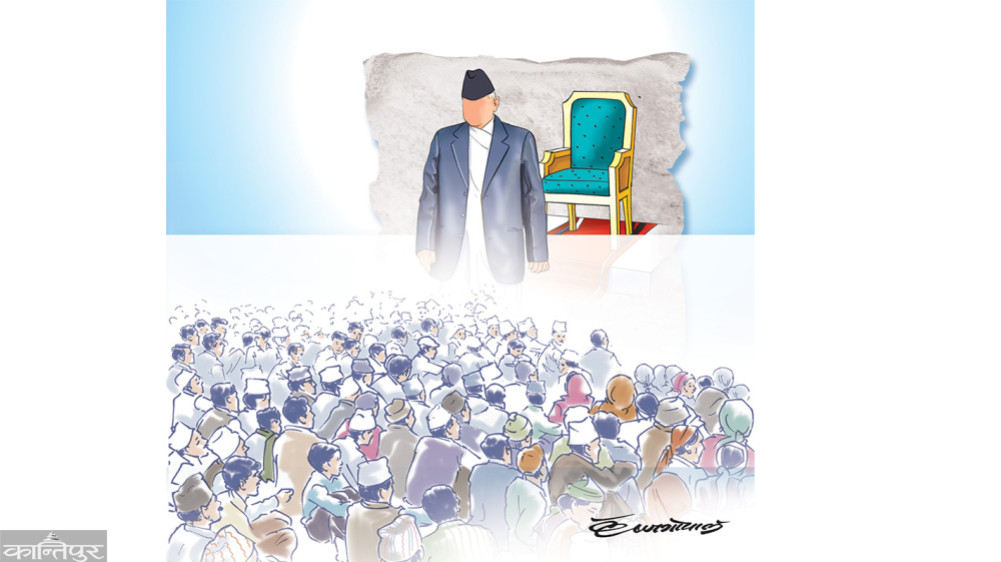
Democracy is not governance, it is good governance. Not power, but responsibility. In the context of Nepal, the most complex problem has been accountability and governance. There is a democratic system, there is a constitution, there are parties, there are also three levels of government. But there is no governance and accountability.
We use Google Cloud Translation Services. Google requires we provide the following disclaimer relating to use of this service:
This service may contain translations powered by Google. Google disclaims all warranties related to the translations, expressed or implied, including any warranties of accuracy, reliability, and any implied warranties of merchantability, fitness for a particular purpose, and noninfringement.
There has been a debate in Nepali politics for a long time whether democracy is a system and institution or leadership. Although more than three decades have passed since the establishment of democracy, such a debate is becoming more relevant due to institutional development and economic development not meeting the expectations of the people.
Now, it seems that the common comment that 'stable government and powerful leadership is needed' is becoming popular from the masses to the intellectual community. It was not unusual for such commentaries to grow in popularity at a time of political instability and misrule. The fact that such comments are becoming popular is a message of the erosion of democracy, which is a worrying issue for the health and future of democracy.
However, such a debate is happening not only in Nepal, but globally. Especially in underdeveloped and developing countries, unstable politics, post-conflict and democratic transitional period, such a debate is taking place. There are two 'schools of thought' which are prevalent in political science debates namely system and institutional and leadership oriented. So even political scientists are divided. In the context of Nepal, is the system-based and institutional-based model appropriate or leadership-based? Are systems and institutionalist and leadershipist theories contradictory or complementary? Therefore, studying and researching such theoretical questions to reach concrete conclusions is inevitable from the point of view of the future of democracy.
systems and institutionalized
Democracy is a system, methodology and process. If the democratic institutions are functional and effective, the system will develop and only if the system is developed, the system will develop. Therefore, democracy is not only a system of government, but a way of life. If the government, party and state bodies cannot assimilate it as a way of life, then the question mark will be raised on democracy itself.
Therefore, democracy is systemic and institutional. Democracy is methodical and procedural. In a democracy, the government is not powerful, it is accountable to the people. Democracy is not governance, it is good governance. Not power, but responsibility. In the context of Nepal, the most complex problem has been accountability and governance. There is a democratic system, there is a constitution, there are parties, there are also three levels of government. But there is no governance and accountability.
'Advocating powerful and popular leadership while devaluing systems and institutions' is a misguided commentary by populists and totalitarians. If the democratic institutions are not effective and functional, authoritarian and totalitarian rulers are born from the democratic system. Although empowered by the institutional development of democracy, none of the presidents of the United States have been totalitarian or dictatorial. Visionary leaders like George Washington, Abraham Lincoln, Franklin Roosevelt laid a strong foundation for democracy and economic development. If not for strong systems and strong institutions, Donald Trump's tenure could have been a disaster. But even if Trump wanted to, he could not weaken democracy. If the president was made powerful without the institutional development of democracy, as in Africa and Latin American countries, American democracy would crash many times.
Unfortunately, on the one hand, the institutional development of democracy has not been possible in Nepal, on the other hand, democratic, constitutional and public institutions are not strong and capable. At some times and in some contexts, there have been conflicting relationships and conflicts between the executive, the legislature and the executive. Therefore, these institutions are also losing the trust of the people. Because democratic institutions are not strong, competent and functional, the government, party and leadership are also not accountable. Likewise, the credibility of the media, which is considered as the fourth organ of the state, and the civil society and intellectual community, which warns the government, parties and state agencies, seems to be falling. What could be a bigger irony for democracy?
Constitutional bodies such as the Human Rights Commission, which guarantees human rights and the rule of law, the Election Commission, which conducts elections in a fair and fearless manner, and the Investigation Commission on Abuse of Authority, which controls corruption, are the arteries of democracy. But these organs have not been able to function autonomously according to democratic values and the concept of the constitution. Even the constitutional bodies have been paralyzed by making them like tools of the government and the party due to the appointment of controversial characters based on unwanted political participation and political urges and party closeness. This ironic situation has been created because the leadership's intentions are bad.
is not incarnational, visionary leadership
In Nepal now, it seems that illusion is more than vision and propaganda is more dominant than performance. It seems that the populist and stuntist tendency to be 'popular' and 'heroes' by attacking the mainstream, middle way and liberal values is on the rise. Parties, characters and trends that cultivate despair and trade dreams are mushrooming. But they have no vision, idea and policy except protest, anger and abuse.
It seems that the sons of Hitler's Propaganda Minister Joseph Goebbels, the pioneer of the propaganda theory that "a lie can be established as truth if it is repeated a thousand times," appear one after the other. There is no healthy debate and discussion on theories, ideas, policies based on facts and figures on social media, only accusations are made on the basis of falsehoods. It seems that the misleading commentary of the one who scolded the loudest is being established as a revolutionary. Is
the visionary leadership that the people are looking for, or is it incarnational and miraculous? Leadership is not a magician or miracle dad. People also need to be freed from illusions of magicians, miracles and stunts. Those who propagate miracles and magicians are not democrats, they are populists, totalitarians, liberals, authoritarians. From Hitler, Mussolini, Stalin, Ceausescu to Trump are different avatars of such magicians, populists, communists, authoritarianism.
But Goebbels-style propaganda is not populist, totalitarian, authoritarian, visionary, energetic, responsive, strong-willed, clean image and transparent lifestyle leadership is necessary. Therefore, we need vision, not illusion, and performance, not propaganda. The conclusion of the author of the book 'The Myth of Strong Leadership', 'Not a powerful ruler, but a visionary and responsible leadership', is the need and solution for Nepal.
People are looking for heroes and superheroes but villains and villains in the guise of heroes and saviors seem to dominate. In search of a hero and great hero, people sometimes silently supported Gyanendra, sometimes they gave unexpected mandate to Prachanda. At times he saw a ray of hope in Ravi Lamichhane, Balen Shah, Hark Sampang, who waged jihad against the youth, untested and mainstream party and leadership with a non-political background.
So the people installed them through elections. But because these and similar parties, characters and trends have repeatedly cheated on the sentiments of the people, extreme dissatisfaction, anger and resentment have been created towards politics, government, party and leadership. After the reality of the new so-called parties, characters and tendencies of conflicting backgrounds were exposed, the people became disillusioned with them too.
Now the situation of the people has become like a fish that has escaped from a fish tank. The proverb that "whosoever comes to Jogi, his ears are torn" has become a legend. It has been widely commented that 'Congress, UML took five years to deteriorate, Maoists deteriorated in two years, the new so-called party did not take even one year to deteriorate'. But people's faith in the old party and leadership has not returned. If a visionary new leadership is not installed in the near future after fundamental reform, transformation and transfer of leadership to the old parties, the prospect also seems dim. Therefore, the latest scenario that is developing seems that after the failure of populist politics, Nepal may now be heading towards anarchy.
People should come to a conclusion about a party only by studying its history, contributions, ideology, policies and programs, current performance and future vision. Likewise, leadership should be evaluated based on merits and demerits based on criteria such as vision, past background and future policies and programs, political and contribution in their field, honesty, transparency, public image. One should make an objective and rational decision, not by believing the emotive expressions of populist and anarchist characters and trends.
The vision and contribution of Nelson Mandela, Lee Kuan Yew and Deng Xiaoping, symbolizing three characters of different systems, are appropriate references when evaluating leadership. Due to Mandela's struggle, democracy was established in South Africa. Mandela played a historic role in economic development by institutionalizing liberal, pluralistic and inclusive democracy. Lee Kuan Yew managed to take Singapore from the third world to the first world by taking an unprecedented leap in terms of economic development during his tenure through authoritarian rule that devalued democracy.
Similarly, Deng Xiaoping was successful in laying the foundation of miraculous economic development by adopting a liberal economy in Communist China. Therefore, economic development takes place as an exception even in non-democratic and communist systems. But what the Nepalese people are looking for is a visionary and imaginative leadership like Mandela who will realize the dream of development and progress on the foundation of a liberal, democratic and pluralistic system. Therefore, systems, institutions and leadership are not contradictory, but complementary. Because democratic and visionary leadership is necessary for institutional and economic development of democracy.
Acemoglu and Robinson's theory
Daron Acemoglu and James Robinson, the authors of world-famous books such as 'Economic Origins of Dictatorship and Democracy' and 'Why Nations Fail' and winners of the Nobel Prize in Economics announced this week, have given institutional development the highest priority. The authors, who have been studying and researching Africa, America, Eastern Europe and Asian countries, have expressed the opinion that functional, effective and strong institutions are prerequisites for the success of democracy and economic development. They have not only advocated political institutions for the institutional development of democracy, they have argued that economic institutions are equally important for economic development. He expressed the opinion that political and economic institutions are complementary to each other. Therefore, the system and organization are not only related to the future of democracy, but also necessary from the point of view of economic development.
The conclusion of their research based on theoretical concepts and practical facts about democracy and economic growth and development is - 'In countries where political and economic institutions are strong, autonomous and functional, democracy has also been successful and economic development has also taken place in those countries. . But in the countries where it has not happened, democracy has been falling into an accident and there has been no economic development.' But if the state agencies are exploitative, the conclusion has been drawn in 'Why Nations Fail' that there will be an adverse effect on economic development. Acknowledging this reality, Acemoglu and Robinson suggest developing liberal political and inclusive economic institutions. Therefore, they have concluded that only economic development and advancement will ensure the long life of democracy.
India-Pakistan message
The history of India and Pakistan is relevant in terms of success-failure of democracy. In 1947, India and Pakistan became independent from the British colonies and democracy was established on the same day. Due to the institutional development of democracy, Indian democracy did not crash, except for the 21-month crisis period during Indira Gandhi's tenure from 1975 to 1977.
First Prime Minister Jawaharlal Nehru was a visionary, democratic and liberal leader. Nehru built the foundation of modern India by developing democracy institutionally. He was able to bind a vast and diverse country like India to the formula of unity through a democratic system. Like the UK, India's democracy and parliamentary practice, which follows parliamentary democracy, is considered one of the best practices in the world. But after Narendra Modi became the Prime Minister, democracy is decaying, that is a separate topic.
But due to the lack of institutional development, Pakistan's democracy, including the military regime, crashed time and again. Pakistan has not always been a full democracy in reality, even if it is on paper. About 75 years of democracy, which was established by 1977 to 88 and 1999 to 2008 to three times 2008, was moved by the military rule.
then is that even though a civil government is in the cover, is really the puppephan of all armies. The army is allowed only after a puppy and ends up. No If you are relevant from power. Neither the Elepe Commission is independent in Pakistan, nor other bodies of the state including the synagogue. According to the principle of democracy, there is no experiences of power, democratic institutions are not alive. Even today, the government, the ruling party, the army, and the court have been defining democracy to be their own adaptations and have been ruving non-government in the name of democracy;
Nepal is not a written constitution in the UK as a secondary of appropriate model model-Break parliamentary democracy. The principle of parliamentary supremination (Parliamentary Shipmentary Supriemacy has been followed by a long period of time. The parliamentary supremacy system in the UK had a success because of the development of democratic values, traditions, laws, people, people, people, and democratic institutions.
but constitutional democracy (Constitutional Democracy), constitutional supremacy (Constituous Summism) and constitutional liberties) need to follow the principle of constitution. Due to the unsuspecting such principles, democracy has been cracted times in the past. What is clear in the constitution in the constitution, what is its favoramic-based opinion with the government, party and leadership, if the principle of parliamentary supremacy followed? Democracy will be made through Parliament through Parliament. & NBSP;
is in government, party and leadership. There are problems due to lack of democratic culture, political instability, endless power, corruption and vice. These problems are inherently inherent than the system and institutions than the organization and the working style of leadership. But the parties and leaders are facing the mid-failure to cover up their failure and covering their failure to cover their failure. But it is a group failure of the top leadership of the major parties, not even opportunities or constitution. & Nbsp; The
people, civil society, the intellectual community should also continue to continue questioning government, parties, leadership bodies. As the question and news, the more questions, parties, leadership bodies are responsible. Therefore, the distress led by Asaomul, Robinson and Brown are the solution to the twenty-first century political and economic problem. This is also the need for Nepal and that is also the desire for the Nepali people. Therefore, it will be a verse to follow the same principle and model. No If it is not an unimaginable accident. & Nbsp;