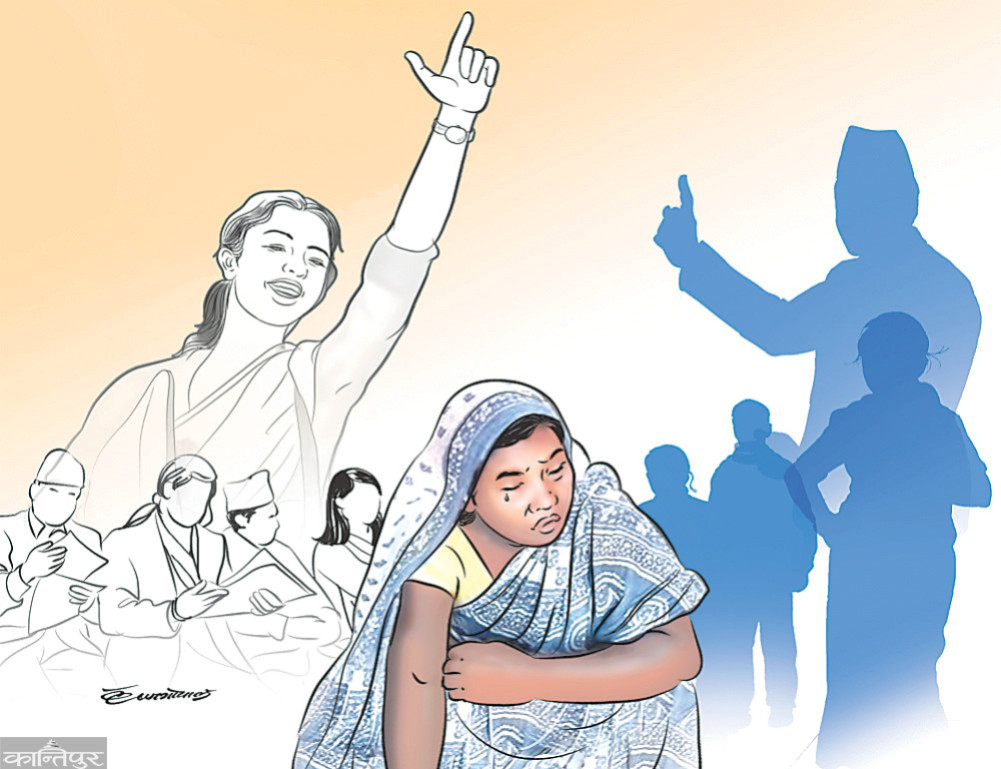
The root cause and basis of the caste system is Brahmanism. Some people talk about eliminating the Dalit problem, it is just an illusion. The end of caste system and untouchability is possible only with the end of Brahmanism.
We use Google Cloud Translation Services. Google requires we provide the following disclaimer relating to use of this service:
This service may contain translations powered by Google. Google disclaims all warranties related to the translations, expressed or implied, including any warranties of accuracy, reliability, and any implied warranties of merchantability, fitness for a particular purpose, and noninfringement.
A few years ago, famous singer and musician Yash Kumar raised a question during an interview - 'Sati system ended but why the caste system was not done?' Films like 'Batomuniko Phool', in which he acted, were very popular among Nepali viewers and listeners.
Similarly, advocate Kunjani Pariyar also raised the same question while speaking on the podcast of Sudhir Sharma, the former editor-in-chief of Kantipur daily.
Pariyar didn't just question, but also stated that the abolition of sati is an important reason why the caste system is still alive. His argument says that because the ruling community's mother, wife, daughter, i.e. women had to be burnt alive along with their husbands, the practice of sati was ended. However, the caste system survived until now as only the Dalit community was forced to become untouchable victims. In particular, the argument of advocate Pariyar is close to the truth, but the basis is incomplete. This article What is sati practice and how did it end? In addition, the focus will be on finding the factual and historical basis of the question why caste system and untouchability could not be ended or not.
How was the practice of sati ended?
The practice of sati was a cruel practice prevalent in ancient India, Nepal, etc., in countries or societies with Brahmin Chaturvarna religion or Arya Samaj, in which widows were burned alive along with their dead husbands. The literal meaning of Sati is a woman who sticks to the truth. In ancient literature, four 'criteria' were prescribed for becoming a sati. First, Anvarohana means climbing the pyre with the dead husband. Second, co-death means dying along with the dead husband. Thirdly, cohabitation means going with the dead husband. Fourth, Anumaran means giving up one's life after receiving the news of the death of the husband who is in migration. The relationship between husband and wife is strong and sacred while alive, and with the aim of maintaining such relationship after the death of the husband in the afterlife and reincarnation, efforts have been made to perpetuate the practice of sati. The unique affection, sacrifice and sacrifice of a widow towards her dead husband is reflected there.
When did Sati practice begin in India? The answer to this question is not without controversy. Some historians agree that the Indo-Aryan caste (community?) was familiar with the practice of burning widows alive on pyres with their dead husbands before their arrival in India. Because the countries of Central Asia were already familiar with the practice of sati. A mantra of the Rigveda states that a woman is sleeping with the body of her dead husband, and then she is addressed as 'Woman arise, come again to this world.' In the light of this quote, some scholars accept that the practice of sati was prevalent in the Rigvedic society. Some of these types of quotations are also found in Uttara Vedic literature. In the Atharvaveda, a widow climbs a pyre with her dead husband and is then instructed to come down from the pyre. On the basis of these limited and symbolic witnesses, there is no strong ground to disagree with the argument that the practice of sati cannot be assumed to be in vogue in the Vedic period.
Due to the lack of women in that period, the practice of sati is believed to exist only symbolically and not in practice. As proof of the scarcity of Aryan women in the Vedic period, the Rigveda mentions a 'relative scarcity of goddesses'. There is also a description of Arya caste being nomadic, wandering, premature death of women due to natural conditions and adverse weather in new places.
Sati is believed to have been practiced in India since the 4th century BC. According to Greek accounts, from the time of Alexander's invasion, the practice of sati became prevalent in some districts of India, that too in the ruling clan. Jodhpur Records 810 AD. It is mentioned that his wife Sampaldevi went to sati with the Rajput feudal lord Ranuk. The Bhanugupta Eran Pillar Inscription of Madhya Pradesh is the first record attesting to the practice of sati in India. Sati was abolished in 1829 by the tireless efforts of Lord William Bentick and Raja Rammohan Roy of British India. In Nepal, on June 25, 1977, Prime Minister Chandrashamsher Rana announced the end of the practice of sati.
What is caste system?
The main source and basis of caste system and untouchability is Purusha Sukta of Rigveda, where four varnas are system. It is mentioned that Brahmins originated from Brahma's mouth, Kshatriyas from his chest, Vaishyas from his stomach and Shudras from his feet. It should be noted that here the columnist has used the terms caste system and untouchability. In the beginning varna (colour) was the system and it was determined on the basis of karma. That is, character change was possible based on work. For example, Vishwamitra, a Kshatriya, became a Brahmin, while Harishchandra, a Kshatriya, became a Chandal. However, there is no instance in history of Shudra changing into any other varna. When the varna system was transformed into the caste system, then the caste system was established based on birth (not karma).
is the conclusion of Bhimrao Ambedkar's tireless research and research - the caste system that started in the Vedic period had not turned into untouchability even during the Buddha's lifetime. Ambedkar believes that untouchability was introduced only around 400 AD. After the death of Tathagata Buddha, Brahmins declared cow slaughter as a great sin. In ancient times Arya, Anarya all ate beef. Slaughter of cows is not prohibited in any religious scriptures including the Vedas. In Manusmriti (11/59 to 66) cow slaughter is described as upapataka (petty sin). Upapataka includes teaching/studying for a salary, having sex with a drunkard, consuming garlic, etc. Among the sins, killing a cow is also included.
India There is a river flowing through Madhya Pradesh, Charmanvati. One of the 16 great kings of the alleged Satya Yuga was a Kshatriya king, Rantideva. According to the Puranas and the Mahabharata, two thousand cows were slaughtered daily in his restaurant to serve the guests. The raw skin of that cow was kept in the kitchen. A river was formed from the heated water from that raw skin. Since the river was formed from the water coming out of the leather, it was named Charmanvati. At the beginning of the 4th century, after Pushyamitra Shunga assassinated the Maurya emperor Brihadratha and counter-revolutionized against Buddhism, cow slaughter was declared a great sin. From the same period untouchability was imposed on the caste system. Hence, a deep connection is found in Buddhism, the counter-revolution on philosophy, the ban on cow slaughter and meat consumption, and the untouchability pact on Shudras.
end
Brahmanism has three foundations—caste system, patriarchy and fatalism. Girl-marriage Even before the first menstruation of a girl child, giving kanyadan is considered a religious act. In the beginning, the ugly, social ostracism was imposed on widows. Its purpose was to maintain the control of men over women's marriage, sexual relations and other personal rights.
The remarriage of a widow after the death of her husband was prohibited for this reason, as she matured in age and conscience, there was a strong possibility of non-caste marriage or intercourse. If a woman gets married to a non-caste or other religious man, there is a danger of ending Brahminism. When it was found impossible to completely avoid the possibility of remarriage even by depriving widows of their rights, making them ugly, a conspiracy was hatched in the name of religion to burn a woman alive along with her dead husband, i.e. sati practice.
The root cause and basis of the caste system is Brahmanism. Some people talk about eliminating the Dalit problem, it is only an illusion. The end of caste system and untouchability is possible only with the end of Brahminism. So the practice of sati was ended but the caste system was still alive. Ambedkar's belief is that girls/men should be given the freedom to choose their own bride and groom. Inter-caste marriage is sufficient to end the caste system.