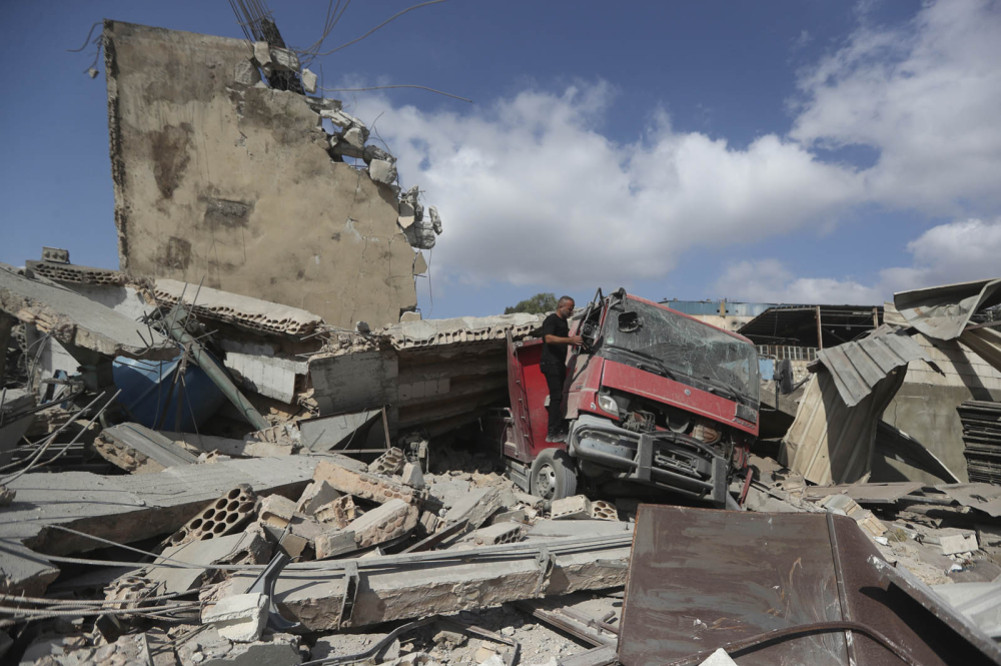
In countries such as Syria, Yemen and Iraq, intervention by external powers has fueled internal rebellions, civil wars and crises rather than fueling them.
We use Google Cloud Translation Services. Google requires we provide the following disclaimer relating to use of this service:
This service may contain translations powered by Google. Google disclaims all warranties related to the translations, expressed or implied, including any warranties of accuracy, reliability, and any implied warranties of merchantability, fitness for a particular purpose, and noninfringement.
Alvin Toffler spent five years doing intensive research on the subject after writing his 'Future-Shock' commentary in 1965. During that time, he socialized ideologically with Nobel laureates, hippies, psychiatrists, businessmen, economic forecasters, philosophers and teachers.
As a result, he wrote a book called 'Future-Shock'. It is considered to be the oldest socio-political-economic research book. It was reprinted eight times in the 1970s alone.
Alvin concludes – 'Future-Shock' is no longer just a distant potential threat, but a real disease of the world, so it will come as a huge shock to many people already suffering. In other words, that shock is also a disease of change.
London Daily Express' comment about the book that "Alvin Toffler has caused a tremendous shock in Western society" has been proven over time. Alvin warned, 'We are very ignorant of how humans cope in the most rapidly changing environment ever.' On the contrary, another group flees from change, he doesn't even know why he is fleeing', the context is not more clearly seen in the current American hegemony world order and the Middle East, Africa and European countries are forced to surrender?
The charge that America's vast wealth has been extracted or stolen from the world's poor is not just a slogan raised by anti-American and anti-globalization protesters. The incident, which has become the main subject of books and articles by established scholars in recent times, has been explained by the increase in the defense budget imposed on NATO members, and the economic sanctions imposed on countries including China. America is now called the New Rome or the New Dominion in the language of the Chinese.
With the growth of knowledge, the rules of the game and the players in the world as a whole are becoming different. The conclusion that the future of wealth is also becoming different. Alvin Toffler has depicted a world-order in crisis through the book "Revolutionary Wealth (2006)". Before that, he wrote the book 'Third Wave' in 1984 and predicted that a multipolar world with a third world would be conceived from within the fog of two polar worlds.
But Middle East scholars have revealed that the concept of Third Worldism has already become irrelevant. The hope and belief that the anti-imperialist armed struggle, empowered by international solidarity, would not only advance the national liberation of the suffering people, but also make universal liberation possible, prevent the division between the rich countries of the capitalist West and the poor countries of the Global South, was quickly shattered.
As early as the 1980s, after Iran surrendered to the reality of an oppressive Islamic theocracy and the Palestinian revolution was trampled by the Lebanese civil war, the Israeli invasion, and intra-Arab conflict, the broad and abstract concept of the Third World sounded the end of the bell. (The Fate of Third Worldism in the Middle East, p. 548, 2024) But although no one can predict what shape the world will take as it moves towards multipolarity, the time has come to write 'End of the History, Last Scenario Waiting for a New Beginning' to answer Fukuyama's advocates of a single capitalist world. is
The Middle Eastern term coined by Alfred the Great in the 19th century was coined by the British-Indian administration. The exact boundaries of the Middle East region are difficult to define. But generally the Middle East is known as the present day Israel, Iran, Syria, Turkey, Saudi Arabia, Egypt, UAE, Iraq, Lebanon, Qatar, Yemen, Jordan, Oman, Bahrain, Kuwait and Cyprus.
Its area is estimated to be 3.5 million square miles. The area extending from the Arabian Sea in the south to the Black Sea in the north, from the mountains of Iran in the east to the Mediterranean Sea in the west is considered as the Middle East. The region is separated from Europe in the north by the Caucasus Mountains and is connected to Africa in the southwest.
also covers the Central Asian and South Asian regions in the East. It is not difficult to understand that its geo-strategic importance is so complex because it is surrounded by seas. The Black Sea, the Mediterranean Sea, the Persian Gulf Sea, the Caspian Sea, the Arabian Sea, the Aegean Sea and the Red Sea are also areas of geostrategic competition in the Middle East.
As Israel approaches one year of military operations in Gaza, a group of American medical workers returning from the war zone has issued a warning that the death toll in Gaza may be far higher than official figures, possibly four times or more.
In a letter addressed to President Biden and Vice President Harris, 99 health workers have stated that more than 189,980 Palestinians have died in Gaza during Israeli military operations. This number is about 5.4 percent of Gaza's population. Israel has killed one out of every 20 people in Gaza in less than a year. This is the 'lowest estimate', the actual death rate may be much higher. (Truthout.org, 4 October 2024)
The letters from health workers forced to witness the Gaza massacre appear to have been written in blood and tears.
'President Biden and Vice President Harris, we must be able to show you the nightmares that plague so many of us upon our return, the dreams of children maimed, deranged and disfigured by our weapons, and the incorruptible mothers we pray to save. We don't know why you continue to empower the arms providers with the intention of killing them en masse.' The University of Edinburgh estimated that the death toll in the Gaza Strip last month could be as high as 335,000. Public health researchers claimed that as many as 186,000 deaths could have occurred in July.
The UN Special Rapporteur for the Palestinian Territory, Francesca Albanez, warned that Israel plans to kill the entire population of Gaza in the next few years based on the brutal form of genocide and the American strategy.
'Prolonged impunity granted to Israel has accelerated the process of extermination of Palestinians in the occupied territories, making the Palestinians as a national group at the mercy of power.' And from the point of view of demographic structures, the crisis in the Middle East has been placed at the extreme crossroads of inequality and disagreement between different players in the same region and binding the Arab and Muslim communities around the world to a rope of forced unity. The fact that Netanyahu appears to be a hanger-on, seemingly innocent, that the invitation to face-to-face violence with Iran through Israel-Hamas-Hezbollah-Houthi should worry Washington the most is itself intriguing.
Indeed, solving these problems requires a comprehensive and multilateral approach, but the Western world has been ignoring this reality. Not only that, but after starting the ground attack on Lebanon, as soon as Emmanuel Macron suggested a ceasefire, Netanyahu poisoned him.
According to the Hobbesian state, 'human life is cruel, hideous and short.' (P. Manfreda, Current Situation in the Middle East, Thought Co. : 3 June 2017) The intervention of external powers in countries like Syria, Yemen and Iraq, instead of extinguishing the fires of internal rebellions, civil wars and crises, has become like an endless forest fire. is
Amid the ongoing political crisis in the Middle East countries, Erdogan in Turkey has suppressed the traditional mainstream of politics by presenting the country as a defender of Islamic identity.
The growing influence of para-military intermediaries in countries like Iran and Lebanon has not only made life difficult, but the humanitarian crisis stemming from the Gaza massacre in the past year is moving to Lebanon as the worst catastrophe of the twenty-first century. Organizations like the Muslim Brotherhood, mobilizing people on religious lines and claiming to represent their political interests, and Hizbollah paralyzing Lebanon, have pushed rich countries around the world to the defense of Tannam and oppressed Muslim communities.
Even America, China and Russia do not seem to have any significant interest in teaching that the strategy of uplifting people by promoting religion as a political tool will lead politics to nowhere but a directionless destination.
lack of leadership and western incitement
Yasser Arafat, who is considered the hero of the Middle East crisis solution, the idea of establishing two separate states of Israel and Palestine, accepting the existence of Israel, building an independent state for the Palestinians in the West Bank and the Gaza Strip, has been destroyed by Netanyahu at this time under the influence of the United States.
Arafat considered the Palestinian territories as they were before the 1967 war (the West Bank, Gaza Strip and East Jerusalem) to be the Palestinian territories. These demands were nothing more than the famous 5 villages of Mahabharata. Even when the Palestinians are ready to accept the encroachment on Hastinapur and push it to one side, it is a matter of common sense that the path after the massacre will be extreme.
Support for "military resistance" in the Palestinian territories rose from 40 percent in May to 51 percent in September this year, while support for "peaceful political action" fell from 44 percent to 36 percent over the same period. A pollster in Ramallah has similar figures: support for violence in the West Bank has risen from 35 percent in September 2022 to 56 percent in September of this year, when Yair Lapid was Israel's prime minister.
Surveyors say the shift is strongest among Palestinians who are not old enough to remember the cost of the second intifada (uprising) and past Palestinian wars. (The Economist, 3 October 2024) At the moment, Netanyahu, who is addicted to the language of guns and drowning in bloodbaths, is at the helm. For the next month, the "Deep State" will use the American elections to change their strategy, so the Gaza massacre is sure to intensify.
Yarafat reached an agreement with the Clinton administration to return millions of Palestinian refugees who were displaced by the Western world to their ancestral lands after the establishment of Israel in 1948.
because Israel is not an American proxy, as Hezbollah appears to be for Iran. The Oslo Accords of 1993 paved the way for peaceful cooperation between Israel and the Palestinians, with the Palestinians gaining some autonomy in the West Bank and Gaza Strip.
But with the death of Yarafat, this agreement was trashed by Israel. Even the Pentagon itself has not been able to refute the allegations made by Beijing and Moscow that Washington is destroying the established 'world order' by testing American bombs, guns and ammunition in the Palestinian area as a weapon to get relief from the troubled Israeli politics.
At the moment, Saudi Arabia and the UAE have adopted a self-protective private policy by adopting a wait-and-see strategy. Qatar has stunned Doha by turning it into a luxurious stage for an all-out intelligence center.
On September 27, the assassination of Hezbollah leader Hassan Nasrallah and the bombing of Lebanon and Iran's firing of a supersonic missile at the Mossad headquarters, thwarting the Iron Dome in the Israeli sky, have increased the cloud of uncertainty. Perhaps the Middle East carnage for America would be a second Vietnamese setback.
In such a hostile environment, Nepal, which has historically stood in favor of the Palestinian state for a two-state solution, this time, in the presence of the Prime Minister, took the US-Israeli side in the voting on the occasion of UNGA-79, and Nepal, which is becoming shabby due to the geopolitical conflict, has also worked to throw itself into the fire.
When there is such a cloud of uncertainty, Nepal's decision to go on a genocidal path different from neighboring China and India is sure to pay a heavy price.
The plight of the world
Today there is a socio-cultural and politically powerful world going on in many parts of the world. which are creating new and often unique environments in which to work, play, marry, raise children or retire. In this way of shaking up human society, traders are swimming against excessive and erratic economic flows. Politicians' ratings keep going up and down.
Universities, hospitals and other institutions are struggling desperately against inflation. Value systems are fragmenting and colliding. While the lifeboats of families, temples and states are adrift.
Looking at these drastic changes, we can see them as distinct evidences of instability, disintegration and disaster. However, if we take a step back and take a long-term perspective, this is no different than an inevitable historical event.
Most changes are not independent of each other. They are not random either.
From family breakdown, the global energy crisis and the spread of radio-television to the glow-in-the-dark flextime of social media, the rise of new rights and benefits packages, the rise of separatist and libertarian movements from Quebec to Corsica, and Netanyahu's massacre in the Middle East, and the Russia-Ukraine war to the US-China economic conflict. , these may all seem like separate events.
In fact, all these are signs of the end of the unipolar world and the rise of a new civilization and multiworld system. Thus, after 500 years of state system and sovereignty that started from Westphalia in 1648, it is clearly seen that a new commentary is being formed with the disintegration of the painful power center. Everyone should read Alvin once for reference!