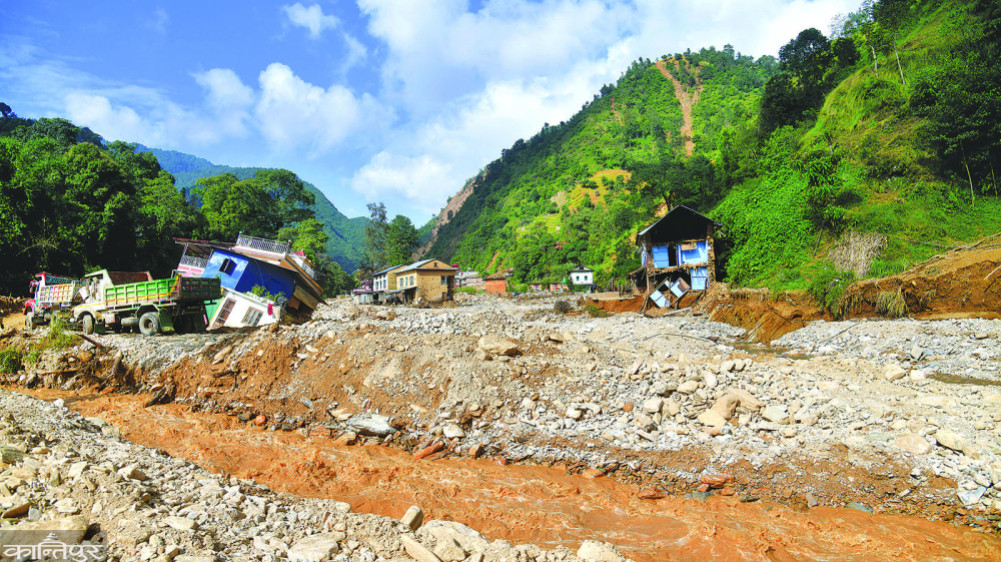
If unauthorized exploitation of nature is controlled and regulated along with the strategy of building sustainable and reliable development, there would be scope to reduce the damage.
We use Google Cloud Translation Services. Google requires we provide the following disclaimer relating to use of this service:
This service may contain translations powered by Google. Google disclaims all warranties related to the translations, expressed or implied, including any warranties of accuracy, reliability, and any implied warranties of merchantability, fitness for a particular purpose, and noninfringement.
In the first week of last May, Nepal's own weather forecasting department predicted that the monsoon will last longer in Nepal this year, and it may rain more than the average rainfall of the last decade. Needless to say, with the onset of monsoon, some areas experienced maximum rainfall, some areas experienced partial rainfall and others experienced dry spells.
Until about two decades ago, the monsoon in Nepal used to start from the middle of May on average and leave by the 15th of August. This time, meteorologists are saying that it will last until the end of October. According to the calculations of October 10-12, the rainfall was several times higher than the average. The rain which caused tragedy in the Nepalese people has created a huge disaster. The earthquake of 2072 destroyed houses and displaced water sources, but after this year's rains, even though the same level of loss of life was not suffered, public national highways, subsidiary roads, agricultural roads, riverside markets, houses and terraces, farmers' crops and drains, public irrigation, drinking water, Sewers, bridges and culverts have suffered more damage than in the past.
The source of current natural environmental disasters is not purely natural. Environmentalists are saying that by destroying unnatural and unusual nature, humans themselves have become the bearers of disaster. Even in Nepal, some scholars are alerting us by writing such things with factual evidence. Environmental destruction is spreading all over the world and it is posing a threat to human civilization itself. The extraordinary growth in production, consumption and technology over the past five decades seems more risky than sustainable and reliable. Scientists have predicted that if the carbon emitted globally cannot be reduced to zero by the middle of this century, the human civilization itself may be apocalyptic. (Editorial, Monthly Review, Vol. 76, No. 5 (October 2024) This means that extreme and uncontrollable changes in the climate will lead to the highest increase in temperature. As mentioned above, if carbon emissions are not reduced, a global temperature increase of 4 degrees Celsius has been announced by the end of this century. A large population Especially the young generation has to bear the most risk.
A devastating flood occurred in Kathmandu Valley this time. Beyond that, Kathmandu Valley has suffered a lot of loss of people and wealth this time. Anyone can say that the cause of the destruction suffered by the valley is uncontrolled and unplanned urban development and excessive exploitation of resources (rivers and water sources).
Various highways and road sections connecting the Kathmandu Valley have been injured because they could not withstand three days of water. Five of the concrete bridges, which were hastily built within half a decade after contractors spent a long time, fell prey to this year's rains. The trend of changing the plan without evaluating the level of physical structure even after the project design, construction and construction has been completed with the collusion of politicians, administration and contractors without conducting sufficient 'hydrological' survey about the effects of over-exploitation of nature, global and regional changes in climate, has become fatal. For example, the Phoksingtar bridge connecting Khotang and Udaipur was completely destroyed less than two years after the traffic started. It is not difficult to understand that the failure of a bridge built after 12 years to withstand two days of incessant rain means that errors in the selection of the construction site, detailed survey design, poor construction materials or the use of technology were the main reasons. However, the political leaders, contractors and officials working in the state administration try to blame the nature and are eager to repeat the mistakes to increase profits and commissions.
When building infrastructure such as main roads and bridges, at least the competition is pretended, DPR gossip is added, IEA (Integrated Environmental Assessment and Reporting) is done in the name of environmental accounting. Accurate, cost accounting is done for minimum bids. But for almost a decade and a half, rural roads, agricultural roads, culverts, drains, canals for irrigation and whatever other infrastructure was built in the name of local development, they were built with the involvement of local leaders and activists in the name of consumer committees. There is no obligation to go through the legal process mentioned above. Since it was done for the benefit of collusion and cronies, there was no supervision, warning or regulation. After not being accountable to anyone, the rural roads built under any name became a constant source of floods, landslides and erosion. After the last rain, not only are there no rural roads in the village, but because of the landslides, the crops of the houses and farms under the road have been destroyed. Similarly, some people have become a living situation. The three levels of government do not seem to be responsible for such damages.
environmental education
Geographically, the Himalayan mountain range is sensitive because it is a new mountain, say geographers. They have been saying for a long time that if biological and environmental balance between mountains, hills, Chure-Bhavar and Terai-Madhesh could not be achieved and one of the 'climatic zones' is overexploited, then it can cause irreparable damage. But the geographic sensitivity of the country at the general level (mass-scale) environmental science, especially global discussion, debate and environmental balance about the damage caused to the ozone layer due to excessive carbon emissions due to deforestation and burning, use of coal and petroleum materials (fossil fuels) And in order to create and distribute institutional management and knowledge, such a sensitivity is not seen in practice as the debate should have been started as a campaign from school to university level.
Sir David King, chairman of the Advisory Group on 'Global Climate Crisis', writes, 'Petroleum, gas and coal have helped to make life easier for ordinary people and have made producing nations prosperous, but they also emit carbon that increases global temperatures. . And, it is playing the role of destroying the world itself. To raise voice to protect sustainable and reliable development and human civilization, reduce pollution, expand tree planting and greenery for environmental balance and stop local and global mining, demolition and nuclear explosion or practice and reduce 10 to 20 billion carbon dioxide production per year or There is a need to protest collectively. The first thing to do for that is to reduce the use of fossil fuels.' (David Seierman (June 12, 2024) 'World War Third and Our Failure Against Climate', Monthly Review). But the awareness about the environment is very low in the Nepali public as called for globally.
Nepal has been experiencing torrential rains for the past few years. This means, there is an increase in drought due to lack of rain and in some places due to excessive rain, there is a terrible loss of wealth. In the last few years, forest fires have increased and the eyes have to suffer due to cold spreading for months. The same dust, ash and coal are washed away by the rain water and mixed with the river and the river in the form of mud.
Due to increasing urbanization, large-scale power plants and random mining of gravel, sand and stone needed for road construction, the river channel is polluted even during non-rainy seasons. Local residents are saying that the record-breaking heat has increased in the mountain ridges, interior Madhesh and Terai for the past few years. The Sherpa climbers who have been climbing the mountains for decades are saying that the snow has stopped falling in the mountains and the snowfall has decreased even in the high snow ranges. Earlier, drinking water was extracted from a depth of 5/6 feet, but nowadays it is said that the underground water surface has been flooded or the water level has decreased, so that it has to be reached much deeper. But systematically, there is a lack of serious debate and discussion on these issues in society, schools and university classrooms. 90% of people may think that Kathmandu valley was covered with thick fog in the morning from October to January-February. In Nepal, it used to rain from May to August, like the last rain, it rained continuously for seven to nine days, the water sources in the villages were extended, but it may not be known that the flood disaster was not so severe. Climate, weather and monsoon trends have changed tremendously within three decades. Which the government and policy makers do not seem to have taken seriously. For the sake of
, the governments hold a cabinet meeting at Kalapatthar (near Mt. Basecamp) and create a drama to attract the attention of donors, but the direct impact of the environment on the ground, the impact of snowfall, the impact of rainfall and non-rainfall, and its impact on economic and social life patterns should be deeply studied and common. They do not seem to realize that the public should be made aware. The common people who travel through that area have realized how much the dozens of crusher industries established for stone, gravel and sand mining of Roshi river on the BP highway connecting Sindhuli-Dhulikhel have contributed to the erosion, inundation and loss of life. Not only Roshi, it has been providing licenses for crusher industry in the vicinity of big and small rivers for river channel exploitation. Local to federal governments receive royalties for mining. No account is taken of the fact that the royalties received by the government and the profits earned by the private businessmen themselves are many times more than the amount to be spent on opening blocked roads, providing relief, rescuing and in the long term rebuilding roads and bridges. Moreover, no one seems to take responsibility for the adverse effects of fine dust particles on human health.
Shared Integrated Development Concept
People who want to debate environmental sensitivity are often labeled as anti-development. Infrastructure like energy, communication, irrigation, drinking water are essential to make life easy and worthwhile for everyone. Public transport is important not only for easy and convenient travel, but also for the rapid development of the above-mentioned infrastructures. But the question that all levels of government, political parties, society and community should play a role in making the development of all these infrastructures environment-friendly is related to our civilization, our integrated concept of development, development strategy and our institutional mobilization method and process.
In 2072, a lot of property was lost in the earthquake. After 2076, there was a lot of loss of wealth in the corona epidemic. Now, the country is again in the grip of floods, landslides and erosion. Although the disaster after the earthquake and covid-19 and the current disaster are beyond the control of the state, if the state had taken the initiative to manage it properly, it would have suffered less loss of human resources. Especially if unauthorized exploitation of nature is controlled and regulated with a strategy of building sustainable and reliable development, there would be scope to reduce the damage.
The state has to find the minimum common point when adopting the overall development strategy of the country. It is almost certain that the market economy that is being adopted not only in Nepal but also in most of the countries of the world will no longer hold. The future hope lies in state capitalism. That is a mixed economy where the aim is to promote employment-oriented and socially just economic development through mutual support, harmony and cooperation between the public, private and cooperative sectors. In this matter, agreement is required for minimum cooperation between the major political parties of the country. After the minimum agreement, it is necessary to build reliable data and institutional structure for integrated development, especially for short-term, medium-term and long-term planning. Public participation campaigns have to be conducted to get out of some emergency situations. But even when the state calls for such campaign work, the parties have to get a minimum agreement. The first condition is that the state needs to be serious about disaster risk reduction methods and procedures (Disaster Risk Reduction (DRR)) while giving authorization (license) to individuals or private or public organizations to prevent natural exploitation. Unnecessary irritation and solid decisions, unintended decision-making-solid decisions, not only individuals or rulings, but by the ruling-defeat.