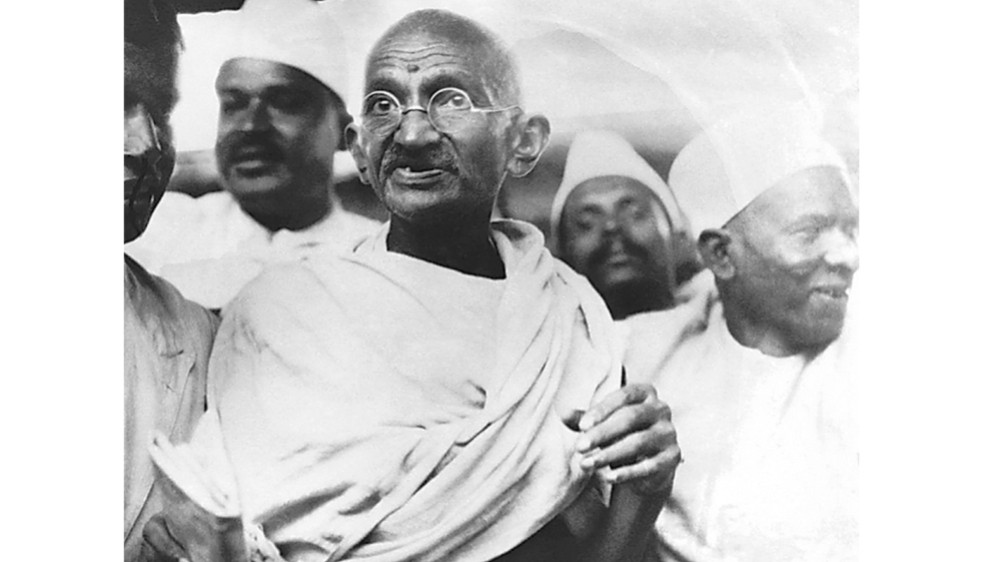
Gandhi warned - there will come a time when people who are determined to multiply their needs will look at their own actions and say - what have we done?
We use Google Cloud Translation Services. Google requires we provide the following disclaimer relating to use of this service:
This service may contain translations powered by Google. Google disclaims all warranties related to the translations, expressed or implied, including any warranties of accuracy, reliability, and any implied warranties of merchantability, fitness for a particular purpose, and noninfringement.
Mahatma Gandhi's birth anniversary week is being celebrated all over the world. In India, the country of Gandhi, the year after Narendra Modi became the Prime Minister, Gandhi Jayanti took the form of cleanliness campaign. Even in Nepal, there are rituals to remember Gandhi.
In Gandhi there is that element which makes a man extraordinary, who tries hard to change his weaknesses, is always ready to correct his mistakes and admits them openly. Gandhi is the name of moving forward by modifying oneself.
I am remembering a scene from the beginning of Richard Attenborough's film 'Gandhi'. It is the last evening of Gandhi's life. The roaring crowd looks curious—where is Gandhi to be found? A voice calls out — go to the prayer meeting, he will be found there. Whom to ask today - Where does Gandhi meet? When Gandhi was killed in Delhi, there was mourning from there to the countryside of Nepal. But we have not done so in our own lifetime to grapple with the question in the way that Gandhi should be remembered. Gandhian thought was made irrelevant, unscientific and unnational from various angles. However, no matter how much we try to stay away from Gandhi, his relevance is increasing. Where will Nepal look for Gandhi today? Searching for the Gandhian element within the struggling environment can save us from the impending doom.
'Maiya tora nahi maya Dareg, log sab kare unghol.' This folk song line means - River mother you have no compassion, no mercy, people are crying out. At present, similar sentiments are being heard in different parts of Nepal. Madhesh was known for 'soil and water'. There was scarcity of food, easy availability of water. Currently, this 'lifeline' is slowly becoming a 'poison pill'. The story of this transformation is the tragedy of this plot. However, this disaster story is not limited to Madhesh. Even in the mountains and hills, people's lives and livelihoods are in turmoil.
Let's remember Gandhiji's belief - earth, air, water are not property inherited from ancestors. It is the heritage of our children. It must be handed down to future generations as we have received it. Gandhi said many times - There are enough resources on this earth to fulfill our needs but not for our greed. It is considered a useful slogan for environmental movements around the world. Gandhi's concerns about the environment, urbanization and mechanization are echoed through his speeches, writings and practice. Yes, Nepal should show the wisdom to see this in the canvas of its crisis.
In fact, false notions about Gandhi were spread in Nepal. As if he is against technology. He used a spinning wheel, which is also a device. Gandhi was in favor of such technology, which would not cause unemployment on a large scale. Do not cause intensive impact on the environment. When choosing a technology, be aware of who has control over it? What is the goal of those who have taken ownership? Because the technology should be in accordance with the real needs of the society. Let it not push us towards such an unwanted outcome that we become more helpless in the clutches of it.
Gandhi did not use the now popular term environment. Right now, environmental movements are going on all over the world in their own way. Now it is starting to be felt that the effects of climate change will fall more on the lower-middle income groups. The environmental movement is not directly related to Gandhianism. However, the method of movement adopted there often includes Gandhian elements. Most of the environmental movements in India have originated in response to the paradigms of development that post-independence India adopted. These movements focus on issues related to livelihood, land, water and ecological security. What is remarkable about these movements is that some of them have adopted a Gandhian approach. Such as civil disobedience, throwing oneself on the beach sand, water satyagraha, long walk, hunger strike, seed-satyagraha, giving memorandum to responsible officials, group letter writing, tree hugging, water conservation, rainwater harvesting, local tree plantation, all-party dialogue. incentives etc.
Gandhi had predicted all those environmental problems, which the present world has become a victim of. At the same time, Gandhi accepted that while some amount of violence should be done to nature, it should be minimized as far as possible. Gandhi warned - there will come a time when a person who is determined to multiply his needs will look at his own actions and say - what have we done? According to Gandhi, let's ask nature for what is necessary for man to survive. We don't have the ability to compensate for the loss of water, forests and land. Its economic value can be understood even without a detailed knowledge of economics. This is the dominant postmodern aspect of Gandhian thought.
Gandhi compared the current development model to a kite and said - when this kite is close to its destruction, it gets dizzy the most and finally falls down. Indeed, it is increasingly difficult to see the alternative dream of development in the periphery of modern science and capital. Organized exploitation of natural resources, extreme use of pesticides in agriculture, embankment-based river control, encroachment of river flow areas, pollution in the mountains, deforestation in the plains, crisis of existence of traditional wells and ponds, rural villages, increasing water scarcity, construction of dozer-based infrastructure, etc. Powers and limits have been questioned. Gandhi did not account for the limits of Western modernity and the idea of reducing the material needs of man to a minimum.
is an open book on the natural disasters we are currently experiencing. Are we reading it thoroughly? Are we honest to understand and hand it over to the next generation in a safe and protected manner? Are we going to implement new thinking, new programs and new practices? Knowledge gained from disaster can be useful forever. Let us not repeat the trials of history. However, it is necessary to avoid the ugliness of history, we can identify the real problem. The happy and prosperous Nepal we envision today exists in Gandhi-Goretto.
Gandhi was way ahead to show the way to the society of his time. Instead of accepting the path he showed as a fixed one, he encouraged his followers to use it as a dynamic alternative, to move forward with self-examination. If we ignore our own nature and culture and adopt other options, it is certain that disasters will come to us more quickly in one form or another.