In a scenario where Europe, the Middle East, and the Asian Peninsula have become a complex issue for the future American president to deal with simultaneously, the possibility that small countries like Nepal can rely on big power nations in the field of economic development is gradually weakening.
We use Google Cloud Translation Services. Google requires we provide the following disclaimer relating to use of this service:
This service may contain translations powered by Google. Google disclaims all warranties related to the translations, expressed or implied, including any warranties of accuracy, reliability, and any implied warranties of merchantability, fitness for a particular purpose, and noninfringement.
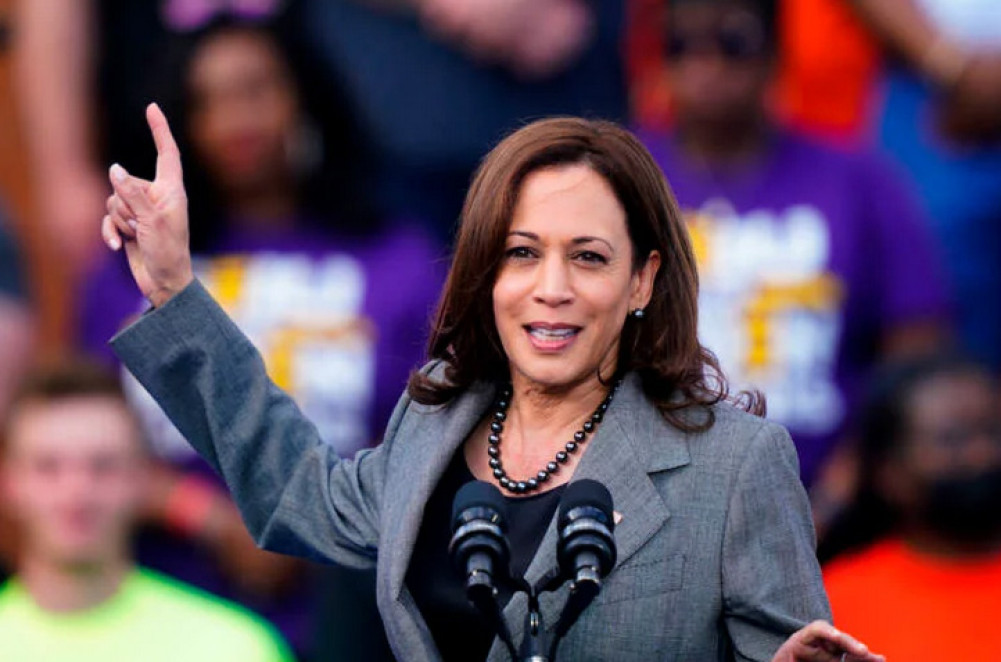
The record candidate in American history is Kamala Harris. At a time when the American world system of white supremacy is crumbling and white supremacy is declining demographically, Harris is seen as a beacon of hope for liberal democracy.
A black, especially a woman, and a representative of a community that has to advocate for women's rights even after the second decade of the twenty-first century, Harris may be the last option to save the American world-system. The American media is writing comments about him from many dimensions to reveal that the political philosophy of Democratic candidate Harris is as fundamental as the inherent dignity of every human being and the importance of freedom for all. The word Harris often says is 'Freedom'.
It's meant to focus on restoring the natural right to abortion rather than commemorating the heroic civil movements of blacks in America. The much-anticipated Harris-Trump televised debate featured this hilariously. But how will she possibly resolve the US-led carnage of freedom-loving people around the world, especially the Palestinians, once she assumes the presidency?
Will Gaza stop the slaughter or turn the Middle East into a war zone by further provoking Iran? (The question is made even more dire by Israel's worst attack on Lebanon, along with Gaza, since 2006.) How many years will the Russia-Ukraine war be prolonged or will some peaceful solution be found? Will the trade-war with China be lifted or will the Taiwan explosion be sponsored to destroy the Asian axis? The world is watching Harris around these questions.
It is clear that American foreign policy is currently focused on how to destroy Russia's military power and bring its economic rival, China, to its knees. Trump is known to the world as a fierce and irresponsible representative of tried-and-true populism. But can Harris, the Democratic candidate standing on the stage as Biden's successor, really represent the diverse world? It is natural for us to be interested in how Harris, who has ancestral ties with India, will deal with Asia and South Asia.
Democratic-internationalist claimants were given a huge boost by then-President Harry Truman when he declared that America's policy was to help free and independent nations maintain their independence. Building alliances with like-minded allies to advance shared values and a rules-based democratic system, essential to maintaining American and global security to protect democracy, has become a key policy-duty of presidents-elect of both political parties.
According to various reports investigating Harris, Kamala is the most informed leader among contemporary politicians about the Russian cyber threat and conspiracy to divide America internally through the use of high technology since 2015. Kamala has also announced in her party's convention to indicate this. Comments have been showing up lately that Kamala has gotten used to a lot of things as President Biden's vice president. Biden is the most experienced foreign policy leader in American politics after former President George W. Bush.
Naturally, Kamala will have to represent the 'Gen-G' generation, obsessed with new, high-tech threats. Today's challengers and strategists are less familiar with the Cold War generation represented by Biden. A series of cyber threats, including election hacking and surveillance from abroad, alleged threats from space via state-run companies such as China's Huawei, Russian or Chinese plots to disrupt GPS systems, and risks posed by artificial intelligence and quantum computing have all come to the fore of U.S. foreign policy. .
Kamala has claimed that she will prove to be a tough commander in chief and will 'ensure that America always has the strongest and deadliest fighting force in the world'. It is the lifeblood of the American system that threatens the anti-war and peace-loving communities around the world. She has been repeating over and over again 'We will lead the world in space and artificial intelligence, not China for the 21st century, America will win the competition and we will strengthen our global leadership without giving up.' To say that the common policy that the US President is embracing is to continue the US hegemony in the world. Among the topics that Kamala outlined as her policy are AI and technology, China, defense and NATO, Israel-Gaza and the Middle East, Russia-Ukraine and trade affairs. In the future, AI, cyber security and China will definitely be the main foreign policy of the US administration.
On top of that, the Biden-Kamala administration has been advancing the accusation that 'China has stolen American intellectual property and flooded the American market with cheap exports' in order to point out the major national security threat to China. (Washington Post, 11 September 2024) In the debate on September 10, Kamala accused Trump of "selling American chips to China and helping modernize the Chinese military." Democrats are busy debating whether to put the US-China rivalry at the center of foreign policy or pursue a global strategy that includes China.
But Trump's approach will be business-like and free from the constraints of multilateralism or alliances, Chatham House director Leslie Vinjamuri has questioned. If Trump becomes president again, it is sure to expand populism by further spreading the identity of power brokers. Therefore, only the memory of Trump's previous term is enough for his future policy. But since Kamala is a new character, there has been a slight increase in interest across the world. Inside the US, when Kamala is president, she will be an easier hand for the security agencies and arms dealers than Trump.
On the other hand, it is estimated that the strategy of the Kamala-Tim administration will be to delay the military encounter with China for a while in order to deal with Moscow, which first arrived in front of NATO through Ukraine, and disrupt the plan to make Israel a US base camp in the Middle East forever by evacuating the Palestinian territory itself. This is what western strategists and idealistic advocates of liberal democracy call 'rules-based democratic world'.
Asia or China?
is a diplomatic phrase that all the officials of the US administration during the Obama era say, ``Understanding Asia correctly is the most important issue for US foreign policy.'' Agree or disagree, it's a point of view that needs to be heeded.' That's the roadmap for Kamala. In 2011, the Obama administration announced a shift in U.S. strategic direction after more than two centuries of U.S. prioritization of Europe. Obama said, "Now with Asia as a major region, the United States will refocus its military, diplomatic and economic efforts on the Indo-Pacific region."
This strategy was called the "Pivot to Asia". The strategy aimed to harness Asia's dynamism, respond to China's rapid rise, end wars in the Middle East, and limit defense spending in Europe. This policy was a journey towards the edge of world change. However, not everything could go according to plan. The Russia-Ukraine war and the Gaza massacre have pushed Washington's strategists into yet another strategic tension. But Kamala Harris interestingly There is no doubt that the
will follow. In October 2011, the then Secretary of State Hillary Clinton wrote in a long article in Foreign Policy magazine that the US is at a turning point and called on Americans to "resist the seduction of isolationism and focus on foreign priorities rather than domestic priorities". There is no doubt that this directive will be implemented if Kamala becomes the President.
Beijing's latest strategy is forcing the Washington administration to focus more on this. Xi Jinping Thought on Diplomacy advances reforming and transcending traditional international relations principles. In recent years, traditional theories have become unable to clearly explain the contemporary world and notions such as 'might is truth' and 'zero-sum game' are no longer in keeping with the trend of the times. (Wang Yi : October, 2022) Just as Biden is regarded as a seasoned politician in Washington, Wang Yi is the most experienced and foreign policy strategist of President Xi in Beijing. When Wang Yi said this, he indicated more.
China has greatly advanced its technological capabilities, expanded its arsenal of weapons, and successfully landed spacecraft on the Moon and Mars. As Xi approaches the end of his second five-year term in 2022, three major trends have been observed. 'Among these three tendencies, strengthening the consultative Leninist system of the ruling party, adopting a more balanced approach to deepening reforms, and adopting a more aggressive policy in the international community, are taken as numerous risk-taking efforts to play a more active role in world affairs. (Steve Chang and Olivia Cheng, The Political Ideology of Xi Jinping, Osford Press: 2024) It can be understood that the Chinese state media's aggressive commentary on the Quad Summit in Delaware, USA, in the context of UNGA-79, has given Wang Yi's signal a practical form.
China's remarkable economic growth has led to Beijing's more assertive policies to achieve its strategic interests in Asia through military modernization, while many countries faced severe economic crisis in the Great Depression of 2007-2009, and despite Beijing's increased economic growth and accusations about the origin of the Covid-19 virus, China is better than the US in controlling the infection. The US perception that it is trying to gain geopolitical advantage from the epidemic by performing well has angered Beijing.
On top of that, Chinese authorities are starting to claim that their one-party system of government is superior to the western democratic system, and a direct confrontation is taking place. (Cory Roberts and Saira Banu S., The Ascendence of Regional Powers in Contemporary US–China Relations: 2023) This position has always had bipartisan support in the US Congress. According to a recent Pew Research Center survey, 9 in 10 Americans see China as a major competitor. That is, 90 percent of Americans are ready for a confrontation with China, which may intensify the US-China rivalry in the near future. Due to different political identities, weak economic and low public relations and geostrategic incompatibility, it seems that India and Russia will separate and the emerging powers between America and China will move towards the anti-Cold War camp.
In the American understanding, China thinks that it has adopted a strategy of encirclement to stop India's regional dominance. China's CPEC network in Pakistan, pressure of investment in infrastructure development under the BRI project in Nepal, construction of huge ports in Sri Lanka, Bangladesh and Myanmar, China is trying to create an uninterrupted energy supply network to further strengthen its growing economic power. New Delhi believes that if Beijing builds military bases in many ports in the South Sea through such a Chinese campaign, it will lead to a strategic siege against it.
Not long ago, when a Chinese spy ship reached the port of Sri Lanka, there was a stir in New Delhi. India described it as a 'dual-use spy ship'. Last time, the 9th China-Africa Cooperation Summit was held in Beijing with the participation of the governments and heads of state of 53 countries out of 54 of the African continent. The US, once a world colony, has been completely dependent on China since the 1990s. (Alzarjira 4 September 2024) Starbage-Break, the parliament, the establishment of the regional capacity, establishing the area of the new partner, and the expression of the strategic households is increasing in the Pacific, the Sheikh Hasina's expression of Bangladesh also increased Indicated.
Kamala Harris has not found a foreign policy of the military, the formulated Harris Administration, as soon as Based, Defense Center Penota Director and Defense Secondi Director and Defense Secondi Director of Penota. The event of the Nancy Peelisa, who made the government after the fragment of Taiwan, can be considered a significant background to remote agenda and to move the heads to the Haris. What is the story-braak Europe? & nbsp;
Outstanding US Striologists are saying that if they lose their associates in Asia and keep Europe in their behalf, he will maintain the ability to compete with China. But the opposite is not true seemingly like realistic. If the United States has lost Europe, and China forced it to make a coach, or the Asian companies in Russian companies cannot replace the role of Europe. & Nbsp;
Pre-Break-Branch National Safety Bahbinu Bhogger's Bahbiginu Bhogger's Bowards, Europe is' going to be 'as the main gender of the United States' in the Uurasian continent. The geography in the center has created a central area to solve global problems. For all practical purposes is the sub-theater in the Middle East in the context of American interests. In Europe, the United States has projected a power against Russian towards Ukraine. Through Israel, Power of Levanon and east is expanding the power of the Ocean of Levan.
Eastern Asia has a good effect on the Whitewhs of those who do not give up for these benefits. Healthy commercially is a Uranian power in partnership with Europe, but without Europe, it can only seem to be like a continental powers in the edge of the world. As soon as the New US President feels the new US president, Asia's stress will be reduced. Scenario, but Nepal, small countries like Europe, the Middle East and the Asian Presian President has been gradually weakening in the field of economic development by the nations to address the future American President. Only by sending these events only by using these events alone, our Singha Durbar will have to adopt proper and restless policy. & Nbsp;