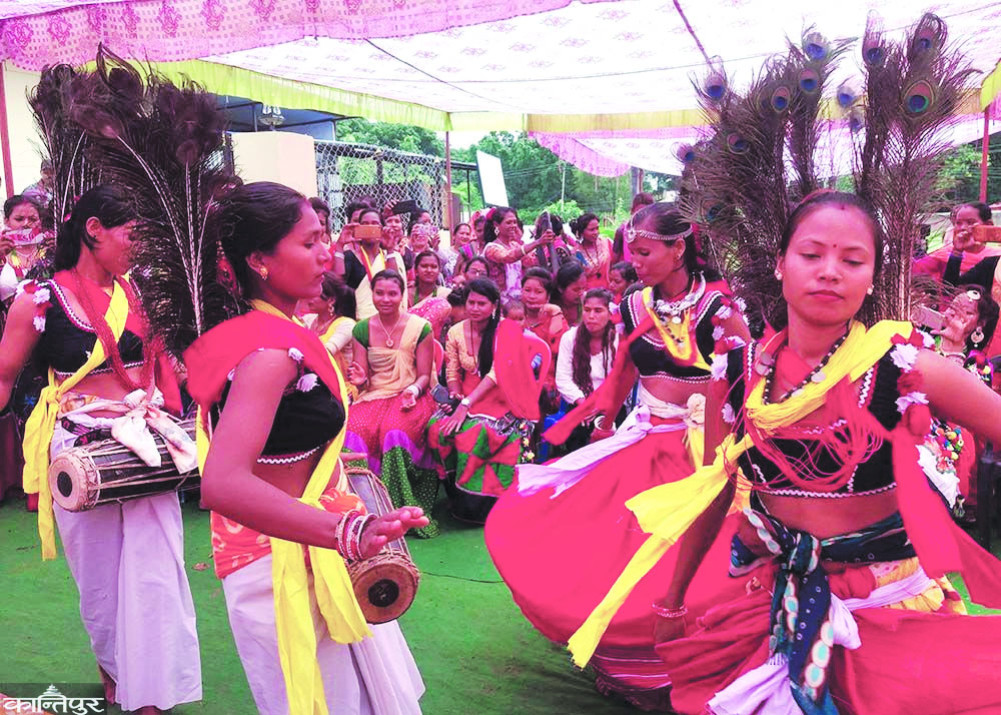
In recent times, the voice of tribals saying 'no' against every policy, plan and program against the tribals of the state is getting louder. Tribals defend their existence and identity depending on land, territory and resources and fight against the merciless state behavior that takes away the basis of people's livelihood - 'No' is a symbolic word.
We use Google Cloud Translation Services. Google requires we provide the following disclaimer relating to use of this service:
This service may contain translations powered by Google. Google disclaims all warranties related to the translations, expressed or implied, including any warranties of accuracy, reliability, and any implied warranties of merchantability, fitness for a particular purpose, and noninfringement.
August 9 is the day established by the struggle of more than 476 million tribals in more than 90 countries around the world. This year, the 30th edition of the World Indigenous Peoples Day is being celebrated with the slogan 'Protection of the Rights of Indigenous Peoples Voluntarily Separated from the State, in Initial Contact'.
Adivasis, numbering about 5,000 groups, speak more than 7,000 languages. Out of 124 languages in Nepal, tribals speak 93 languages. The indigenous tribes of Nepal have also been raising various tribal issues since 1993 on the occasion of this day.
The tribal movement, which is considered to be one of the strongest social movements in Nepal, is becoming multifaceted. The initiative, activism and leadership of the new generation in the movement and their 'agency' building is commendable. Both the practice and commentary that the movement should be carried out only under the leadership of the Federation of Nepal Tribal Tribes and the legal mechanisms of the Federation are changing. In recent times, the voice of tribals saying 'no' against every policy, plan and program against the tribals of the state is getting louder. Tribals defend their existence and identity depending on land, territory and resources and fight against the ruthless state's behavior which takes away the basis of people's livelihood - 'No' is a symbolic word.
Voices manifesting as 'No Koshi/Cablecar', 'No Hydropower/Substation Line', 'No Intermediate/Park Conservation Area' are not 'anti-development voices'. It is a common struggle to be free from state-created-fostered injustice and suffering. It is an effort to maintain the balance of nature, culture and animal world. Although question-centered tribal movements are fighting alone with exceptions, they have not been able to create a 'space' that holds the essence of commonality. Common mechanisms have become ghosts. He is losing hope and faith. However, due to the strength of the community, movements are rising from the ground level.
The Newar tribals of the valley staged a strong protest in Baisakh 2076 against the bill made by the government by breaking the Guthi system which operates in the rhythm and practice of the community. He forced the then two-thirds government to return the 'Guthi Bill 2076'. The Guthi movement is a vivid example of successful tribal movement to stop the arbitrary attitude of the government. The historical cultural Khona (Khokna) of the tribal Newas have been militarized in development in the name of national pride schemes - fast track and zero kilometer of fast track, Wagmati Corridor, railway line, high tension line, smart city favored by liberal capitalism.
The Newas are constantly challenging private companies, governments and security agencies to protect their historic land. The tribal Tamang of Shankharapur Bhoda (Bozheni), which is 25 km away from Singha Durbar of Yambu (Kathmandu), has also been struggling since 2076 to protect their ancestral land. Around 350 households are being displaced due to the construction of the main substation of the hydroelectric project. The struggle, which heavily involved women, has been going on with resistance demonstrations every day since January 1, 2023.
The life of the tribal fisher is rooted in the river/river and the power boat. The Ladi (river) is enough to cure the fisher. During the rapid development of physical infrastructure, ferries were replaced by suspension bridges, suspension bridges by motor roads. The Majhis became powerless when the communication between the powerful and the Majhis from the common people to the high ranks of the ruler was displaced. The development of hydropower such as Sunkoshi, Tamakoshi, Kaligandaki is making them rise and fall. Democracy, established to ensure the rights of every citizen, is taking everything away from Majhi. Against it they are fighting alone like a rock in the ascent of Sakinas.
The indigenous Tharu challenged the state power through the Tharuhat movement around the constitution of Nepal. The Tikapur incident of August 7, 2072 made the movement which had started surprisingly on behalf of the Tharuhat Autonomous Province, damaged. The strength of the fragmented Tharu community reappeared in the form of the Dhakiya election slogan that emerged with the second election of 2079. Achieving a kind of political power in a parliamentary democracy, hope has also been sown. Unfortunately, the Dhakia, Tharu and tribal movements could not turn that political power into a strategic-political weapon. Tharu's case is still there. Even though it conveys disappointment in the identity movement, the activists of the Tharuhat movement are persisting for the sake of addressing their issues.
The tribal Tharu are the gendered forms of bonded laborers created by the modern state system—kamaiyas and kamalaris. The struggle of Kamaiya and Kamalari, who were declared free in 2057 and 2070 respectively, is still ongoing. With the strength of Kamaiya and Kamalari movement, the process of implementing the agreement made with the then government has not stopped. Kamalari Movement, which is connected with Kamaiya, Tharuhat, tribal women and tribal women's movement, has been putting pressure on the union, state and local government for the implementation of the 10-point agreement made with the then government in July 2070. The Kamalari movement, which is directly linked to the 5 social movements, has neither the support nor the comrades-in-arms of the other movement groups that share their journey.
The strong side, the Kamalari movement itself is becoming independent and financially strong. Out of the 42 cooperatives registered in the name of the co-operatives, 32 are functioning regularly. They have a capital of around 19 crores. After making economic empowerment the main issue of the movement, free workers have made such a return, which practice is exemplary for any civil movement.
is another state-made and colonial conceptual mechanism that is becoming a source of murder, rape, violence, injustice, torture of tribals - parks and protected areas. The park is being used to encroach on tribal land and protect the entertainment and sports grounds of the rulers. Protected areas that destroy the livelihood of the community, such as Chitwan National Park, Bardia National Park, Dhorpatan Hunting Reserve, Shuklaphanta National Park, Bara National Park, etc.
For the sake of the nearby residents, the conservation area is not only a source of human rights violations but also a 'risky killing area'. Even the mothers of small children are kept locked up all night when they go to pick roots, tubers, fruits, dried firewood, grass, and leaves. For the purpose of cultural, social rites and religious rituals, restrictions have also been imposed to get the leaves of essential plants. The role of the donor agency working in the protection sector is also to help the government and security agencies in their suppression work rather than the community.
In recent times, many campaigns have been launched to restore the historicity and practice of tribal Raithane place names. They are trying to destroy the internal colonial practice by re-asserting that Maitighar's Raithane name in the corner of the Singha Darbar is Timbung Pokhari and not Vishnu Pokhari on the border of Taplejung and Panther, Tansing not Tansen, Machhapuchhre not Khatasun. The local municipalities are increasingly protesting against the local historical name Raithane being replaced by the fictitious name Hindukrit. The difference in naming such as Adivasi Rangshala or Madan Bhandari Rangshala in Prime Minister Oli's home district Jhapa, Suketar Airport or Rabindra Adhikari Airport in Taplejung is a friction between the colonial mindset of the state and the government and the community's history-culture entwined pride.
Ground-level movements are breaking down centralized thinking, thinking and behavior. The nature of the movement, the issues, the leadership and the mechanisms are embodying the abstract that the situation must be transformed. They are looking for comprehensive partnerships and complementary collaborations between the movements and the struggling communities.