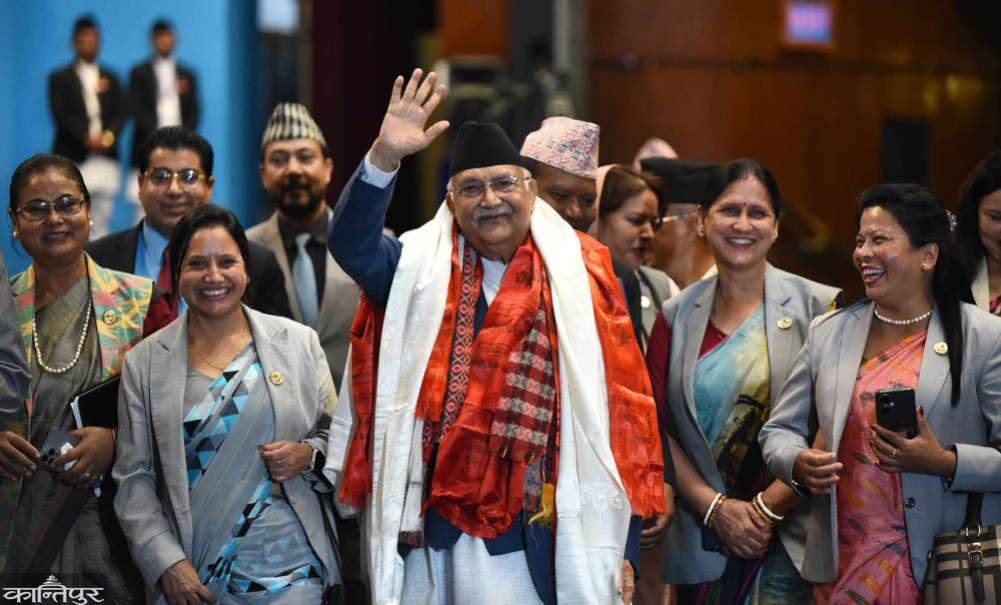
For Oli, the period from April 2077 to June 28, 2078 is a greater educational experience than any other university he has attended and no one else has attended.
We use Google Cloud Translation Services. Google requires we provide the following disclaimer relating to use of this service:
This service may contain translations powered by Google. Google disclaims all warranties related to the translations, expressed or implied, including any warranties of accuracy, reliability, and any implied warranties of merchantability, fitness for a particular purpose, and noninfringement.
UML president KP Sharma Oli has returned to power after three years by overthrowing the guerrilla leader in guerrilla style. Oli, who was deposed by the decision of the Supreme Court on June 28, 2078, returned to power on June 30. In this process, he killed the Prime Minister he made himself. This is Oli's fourth innings.
The difference is that Oli has come to power on the strength of the innately anti-Congress by agreeing to adopt a two-party competitive system without saying anything about doing this or that. While his predecessor, Oli, like in the second innings, gave the gossip that he would take the country to the peak of prosperity.
But he has returned to Khumaltar after living in Baluwatar for one and a half years as an average tenure. Prachanda had been declaring that he was emotional and would not hesitate to be harsher than harsher if necessary. But both of these were completely lacking in government practice. Oli not only tried his best to establish himself as a strong leader in the second term, but also did his best for that. At that time, his desire for strictness in governance could not be fulfilled. Among the leaders in Nepal, Oli has been presenting himself as a strong leader. For this, he faced the Indian blockade when he was the first prime minister, and agreed to go to the Chinese port for the second time.
The most discussed events are those passed by the parliament. Also, Prachanda says that he is an emotional and strong leader and gives examples from armed war to peace agreement. This time, from the rostrum of the Parliament, he easily explained that he was stupid and emotional. But studies have shown that emotions and strong leaders have their limits.
'How to lead from a strong mind and kind heart by putting yourself in the driving seat of your emotions Using clear, simple and tested skills and strategies, you should be able to coordinate and communicate more authentically with your colleagues and partners, this is with emotional intelligence. It is a sign of leadership. ...by embracing emotional self-awareness and empathy, acknowledging your feelings and the feelings of your colleagues, you can produce extraordinary results. But unfortunately, most leaders choose a different path, one that ignores their feelings and the feelings of their partners and begins to see them as difficult and irrelevant. Unpleasant history that happens in such a mood is a witness.
Last February, Oli, who took Prachanda from the clutches of the Congress and brought him to his shoulders with the "historic concern" of not letting the left movement of Nepal collapse, remains to be revealed. Regardless of the truth and facts, it is commonly said that 'Congress and UML have colluded to close the files of fake Bhutanese refugees, land acquisition of Giribandhu, Bal Mandir, Lalita Niwas, and other files that are about to be opened'. From his predecessors to the streets, this charge will not be answered by the public in any way, not by affidavits, but by harshly judging such injustices. This is the first and main challenge of this innings.
At least this columnist does not think that constitutional amendment has opened the 'Pandora's box' of Girija Prasad Koirala's words. On top of that, the issue of geopolitical sensitivity is sure to bother Prime Minister Oli the most. Oli is at a point where he cannot do some things even if he wants to. Oli lacks the facilities of geopolitical pretense that his predecessors in Nepal and any future prime minister had and will have. There is a situation like 'do or die', especially Oli's relations and problems with India and China. It remains to be seen to what extent the western powerhouse will take the field. Oli is relatively comfortable in this sector. If we can capitalize on it, it is also an opportunity to do something for the country itself.
There is no single point where the interests of UML and Congress do not clash, except when all the interests and conflicts are buried under the red carpet and standing on the wall. Moreover, the resentment towards politics, the system and the rulers shows no signs of abating any time soon. It will continue to grow louder. Even the co-producers of 'anti-social networks', who have been somewhat maligned due to the government formed by Oli, will leave no stone unturned in stoking more fires. It is not possible to tell how much Aringal touches him. The roadmap that Prime Minister Oli has put forward while seeking a vote of confidence is not new. The only hope is the honest treatment of those things.
The way Oli got confused while answering the questions raised by the leaders of various parties, did it not do more than confirm the accusations made by Prachanda when he was being deposed? Oli's statement may have pleased the business community that is gaining access to the power of the Singha Durbar, but did it make the people and UML workers uncomfortable all over the country? In the first question-and-answer session as Prime Minister, the speaker had to step forward to handle Oli again. Is it a little too much? For this, it would be appropriate if the Prime Minister's advisers could observe the debates and accusations being made in the Parliament of India and Britain, which have just started, and make the Prime Minister restrained accordingly? Taking into account the needs, constraints and possibilities of the alliance, Oli has not only given a possible deep message to everyone, but has also tried to keep more space by not making any comments about the party and its leader who was recently pushed to the opposition bench. This must have put a chill in the hearts of Shekhar-Gagan and Vishwaprakash.
'For too long, emotional intelligence has either been limited to private individuals or has not been given importance', the suggestion of political scientist Caroline, who considers it one of the essential keys to successful leadership in the twenty-first century, seems to have been written for Oli and Deuba at the moment. This is the second time that UML has led the government with the support of Congress. For the first time, Girijababu made Madhav Nepal the Prime Minister to teach Prachanda a lesson. His charioteer from within the party was the current Prime Minister Oli. But Deuba and the couple, who did not want to listen to Oli's repeated offer to Deuba as the prime minister, suddenly reached Balkot on the day of June 15 and offered Oli the prime ministership, is mysterious in itself, certainly not unchallenged.
The environment in which Oli has become the prime minister has once fulfilled his dream of becoming the prime minister with the support of the Congress, but even if the problems that have been raised everywhere can be addressed, the objective situation is not at all. Oli's well-known nature and style do not seem to help to reconcile such an objective situation. As expected in Carolyn Stern's book 'The Emotionally Strong Leader', our brain integrates everything in our mind into one rhythm and empowers us to better understand our emotional biases. As a result, it will help create better, more empathetic leadership. All over the world and especially in Nepal, leaders do not realize the reality that mind and brain should be balanced. Perhaps this is also an unsolved problem of the current liberal democratic system.
According to a 2023 study on leadership ability, sometimes the environment makes leaders fail. For example, organizations competing in the market and facing new competitors, whose prices fail to compete, are under more pressure to compete. The recognition of failures is also a process of social construction, meaning that society suffers the consequences of such failures. Its defects are not clearly visible in the cultural process, but it must be considered as a social construction at various levels.
Leaders use power to make decisions and need to balance aspects that can affect and harm others. Organizations or governments have three main sources of power: objective status quo, relational, and personal power. (Harvard Business School Press, 2006) A leader needs to understand the types of power his government needs and how and when to apply these to achieve its goals. In addition, formal and informal power structures within coalitions and in parliaments must always be taken into account. There is a recent example of a surprisingly large exodus due to a failure to observe this very thing.
For Oli, the period from May 2077 to June 28, 2078 is a greater educational experience than any university he has studied so far and no one else has studied. It may be dear to a handful of people that the alliance was formed with the consent of the amendment of the constitution, but what had addressed the terrible situation from the mid-term of 2051 to the blockade of 2072 and what had raised a challenge to the existence of the country, there is a risk of playing on the constitutional system of inclusive and proportional representation. pick up How can we ignore the fact that the mere display of a momentary whim is enough to destroy anything in the physical and human world, compared to the invention, power and means required to build it? The choice to return to 'Real Politico' or to succumb to the fire of agitation is again the choice of the leaders.
Leaders must legitimize their power to make decisions effective. Effective strategies for this may include mechanisms such as information, networks, and technical rights. British Columbia professor Claudia Krebs says that power is needed to make decisions, "Leaders need to avoid abuse and unethical behavior or attitudes. The beginning of Oli's predecessor was like a constraint, midday seemed like his natural path, in the second half he did the most because of Oli-Mohani." Blunder' was.
But Oli's beginning has started with a historical 'blunder' that will be discussed from the left-wing angle for a long time in history. After boarding such a damaged boat, there is no other option but how to get back safely. This is not the natural path of a liberal parliamentary democracy. Unnatural is the correct, revolutionary path is not even more. The plight of Pakistan and South Africa in recent times is only being repeated in Nepal in a different way, which is by no means natural. Now the coalition of Bhutto and Sharif Gharani has emerged as a new power in Pakistan and has reached the Supreme Court with an appeal to ban the party of former Prime Minister Imran Khan and all his supporters, who have played handballs with all kinds of vested interests. At least such an event cannot be imagined in Nepal.
What a coalition government is and will be depends on the nature of the coalition. The executive head is most powerful only when the coalition government acts as a trusted agent among natural allies. Among the living ex-prime ministers, Oli wants to present himself as a strong leader. But Bob Hahn's study, published in the journal Chicago Medicine, says that an emotionally strong leader is a warning bell for all leaders who ignore emotions in the workplace. Especially in challenging times like these, we need to embrace our emotions and the emotions of others.
The biggest challenge is the moment when Oli personally came to power standing on the shoulders of the Congress. While commenting on the new alliance, former Indian ambassador Ranjit Ray clearly said, "India is carefully monitoring how the new government addresses the growing American-Chinese rivalry in Nepal." This is also a sign that our geopolitics has touched everywhere.
At the moment, while wishing success to the Oli-Deuba coalition government, the leaders and workers of both parties have definitely not forgotten the inevitable opportunity to run to Singha Darbar and Baluwatar with another bunch of wishes in a year. The analysis of the French daily "Le Monde" that made Nepal a champion of political instability would be done for the last time. Once again, I wish Prime Minister Oli a successful fourth term.