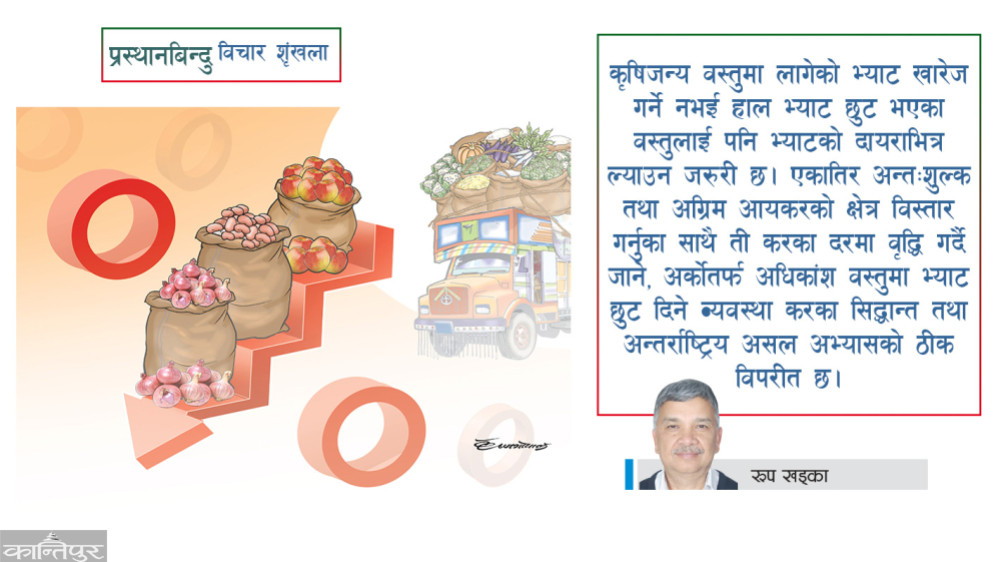
The Ministry of Finance should make a detailed schedule on which goods and services to remove VAT exemptions and on which goods to abolish excise duty and advance income tax within the next three/four years. A national consensus should be established politically as well as widely discussed with the stakeholders.
We use Google Cloud Translation Services. Google requires we provide the following disclaimer relating to use of this service:
This service may contain translations powered by Google. Google disclaims all warranties related to the translations, expressed or implied, including any warranties of accuracy, reliability, and any implied warranties of merchantability, fitness for a particular purpose, and noninfringement.
In the context that revenue mobilization in the country is becoming challenging, it has become inevitable to find a way to collect more revenue at a lower cost. Among the existing taxes, the most flexible and economically efficient tax with a broad base is 'Value Added Tax (VAT)' and it is also the tax that has the greatest potential to meet the growing revenue needs.
Due to this, in the financial year 2080/81, the VAT exemption given to more than 200 goods and services was removed in order to increase the revenue mobilization by expanding the VAT base. In 2081/82, VAT exemptions on over two dozen goods and services have been abolished. By continuing this campaign in the next year as well, within three to four years, the number of goods and services exempted from VAT should be greatly reduced and the tax base should be expanded and revenue mobilization should be increased.
VAT on agricultural products
In fiscal year 2080/81, VAT was imposed on several agricultural products including potatoes and onions to increase revenue mobilization and develop agriculture. On the contrary, the VAT on potatoes, onions, apples and other vegetables and fruits was abolished by the budget of 2081/82 with the aim of protecting domestic production. Remember, abolishing VAT on agricultural products such as potatoes and onions means not imposing VAT on both domestically produced and imported products. This means that there is no protection of domestic production by abolishing VAT on these goods.
But, indirectly, indigenous agricultural produce gets some protection. If VAT is applied to agricultural products, theoretically, agricultural products produced and imported in Nepal will be taxed, but in practice, all imported goods will be taxed. Due to the registration limit (threshold) of VAT, VAT is not charged on a large part of the agricultural products produced in the country. The current VAT registration limit is Rs 50 lakh.
This means that farmers who produce agricultural products up to 50 lakhs annually do not have to register for VAT purposes and collect tax. Similarly, small retailers who sell agricultural products worth up to 50 lakhs annually do not have to register for VAT and collect tax. As a result, most low-income consumers who purchase agricultural products from small sellers who are not registered for VAT do not have to pay VAT. This means that if VAT is imposed on agricultural products, Nepali agricultural produce will be cheaper by 13 percent compared to imported agricultural produce.
Agricultural goods produced in Nepal are subject to VAT if they are sold through a VAT-registered seller. On the other hand, large farmers can deduct the tax paid on the purchase and import of all goods and services including vehicles, fuel, communication services, computers, furniture, stationery, equipment, etc. used in the production of agricultural products, so their investment is freed from the tax burden. If agricultural products are brought under the ambit of tax, their export will be encouraged. The reason is that when agricultural products are exempted from VAT, VAT is not charged on the export of agricultural products, but the tax on the inputs of the exported agricultural products cannot be deducted or refunded. This results in a portion of the VAT remaining on the export price.
On the other hand, if there is no tax on the export of agricultural goods within the scope of VAT, the tax paid on the purchase and importation of all the goods and services used in the exported goods will be recovered from the Internal Revenue Administration. This will completely free the export from the burden of VAT and in that case our agricultural produce will be more competitive in the international market and export will be promoted. In a country like ours that imports a large amount of agricultural products, it is better to apply VAT instead of giving VAT exemption to agricultural products for agricultural development.
When I proposed VAT on agricultural produce in the context of creating a VAT law for the West African country of Liberia, the counterparts insisted on exempting VAT on agricultural products there. In that context, I asked them, 'What percentage of your total agricultural produce is produced within the country and what percentage is imported? What level are the businessmen who produce agricultural produce in the country? They said that more than 80 percent of agricultural produce is imported and most of the agricultural produce producers in the country are small farmers.
In that case, I suggested that it would be better for agricultural development in Liberia to impose VAT on agricultural produce rather than exempting it from VAT. The reason is that if VAT is imposed on agricultural products, VAT will be charged on all imported agricultural produce at the customs point, while the production of agricultural products produced by small farmers within the country remains outside the scope of VAT due to the registration limit of VAT. As a result of this, compared to imported agricultural products, domestically produced agricultural products will be cheaper and agriculture will develop, so there was a consensus to impose VAT on agricultural products.
International treaty-agreement
If VAT exemption is given to agricultural products, VAT will not be charged on the importation of those products. There is also less possibility of imposing other taxes on the importation of agricultural produce. For example, due to trade agreements with India, customs duties cannot be levied on imports of basic agricultural products. Imposing other taxes on imported agricultural produce does not conform to the principles of the World Trade Organization.
Agrarian reform duty is currently imposed on some agricultural commodities. As this is not in accordance with the principles of the World Trade Organization and the treaty with India, various questions are raised about it from time to time. This issue will become more complicated when Nepal will be upgraded to a developing country after two years. In that context, if the agricultural reform fee is also abolished, there is a great possibility that agricultural products produced abroad will be imported into Nepal in large quantities without any tax on the import of agricultural products, which will adversely affect the agricultural development here.
VAT is levied on both domestically produced and imported goods, so this tax is in line with the principles of the World Trade Organization. This arrangement is not inconsistent with the treaty with India and the facility under SAFTA does not affect it. Therefore, we should not cancel the VAT on agricultural products, but we should also bring agricultural products that are currently exempted from VAT within the scope of VAT.
Expansion of tax area
At present, agricultural products are subject to VAT as well as customs duty, excise duty and advance income tax. Although it is natural to impose customs duties to protect the vegetables and fruits produced in Nepal, excise duty and advance income tax have been widely imposed on vegetables and fruits like customs duties for some years. These tax rates also increase every year. For example, various vegetables and fruits under parts 7 and 8 of the Harmonized Code are subject to excise duty of 15 percent and advance income tax of 10 percent, while most vegetables and fruits are exempted from VAT.
In this way, on the one hand, expanding the area of excise duty and advance income tax as well as increasing the rate of those taxes, on the other hand, the system of giving VAT exemption to most items is completely contrary to the principles of taxation and international good practice. This kind of system is also contrary to the tax system developed as a model in South Asia as a result of the first generation tax reform implemented in our country in the 1990s.
Excise duty is a tax levied on limited goods such as tobacco products, alcohol, petrol, diesel, vehicles and soft drinks that are harmful to health, damage the environment, have negative external effects on other than consumers and increase social costs. This is also international good practice. According to that, during the first phase of tax reform in Nepal, the number of items subject to excise duty was reduced from more than four dozen to less than a dozen.
However, over the past few years, the number of items subject to excise duty has increased significantly, making it like a 'mini customs'. According to the meaning of excise duty and international good practice, excise duty should be levied on petrol and diesel, instead, road maintenance and improvement duty, infrastructure development tax and green tax and pollution control duty on petrol and diesel sold and distributed within Nepal have been imposed on the import of these goods. This has made our tax system unnecessarily complicated administratively and financially distorted/inefficient. This has unnecessarily increased the tax compliance, administrative and financial costs.
The provision of advance income tax on the import of many goods, including agricultural products, is not a feature of the modern tax system. It is also not in line with international good practice. Such a tax is used in war-torn countries where normal income tax and other good tax arrangements cannot be implemented and an attempt is made to collect some revenue from immigrants in the name of advance income tax. For example, currently in war-torn Yemen, advance income tax is charged on immigrants, while this type of tax was used in war-torn Iraq about two decades ago.
In Nepal, in the past, advance income tax was imposed as an exception for small-scale immigrants from Tibet, etc., but this kind of bad practice was stopped after the implementation of the Modern Income Tax Act 2058. But Advance Income Tax has been revived in recent years. When VAT was introduced, the list of tax exemptions was small and the policy was to reduce them. But a few years after the implementation of VAT, due to the pressure and temptation of influential people and middlemen, the number of VAT exemptions was increased significantly, contrary to the principle of VAT and international good practice.
Goods are subject to all three taxes, including VAT, customs duty and excise duty, but their impact on the economy and consumer prices is different. For example, importers have to pay excise duty and customs duties when importing agricultural products, which they collect from the customer by adding a profit percentage to the price including tax as an investment. Although the trader can deduct the advance income tax from their annual income tax, in practice they add this tax to the price of the goods and charge a profit percentage on it from the customer. As a result, the increase in consumer prices is much higher than the tax collected by the government from customs duties, excise duties and advance income tax.
On the other hand, under VAT, the tax payer can deduct or claim back the tax paid on purchase and import from the tax collected on sale, so there is no need to charge profit percentage on VAT. As a result, as much as the government collects revenue in the form of VAT at various levels, consumer prices also increase by that amount and consumers do not have to pay unnecessarily high prices. On the other hand, since VAT can be collected more efficiently on a comprehensive basis, it is possible to collect more revenue at a lower cost.
VAT is an economically neutral and growth oriented tax. Under this, there is a possibility of tax evasion at the first level being recovered at the last level (catch up effect). Similarly, in the VAT system, over-invoicing goods and services is against the interests of the seller and under-invoicing is against the interests of the buyer, so there is less possibility of revenue leakage by over- or under-invoicing, which is called self-control of VAT.
Similarly, it is easy to audit because invoices are issued at different levels under VAT. Due to these various reasons, this tax has been established as the most important and effective mechanism of revenue mobilization in different countries. We should also expand the scope of this tax by canceling the VAT exemption and make our tax system administratively simple and financially capable by canceling the excise duty and advance income tax on various goods including agricultural products. In this way, a policy should be adopted to increase revenue mobilization by making it flexible/productive in terms of revenue.
at the end of
After giving VAT exemption to potatoes, onions, etc., domestic production is not protected by VAT exemption, as VAT is not charged on both types of potatoes and onions produced in the country and imported. Rather, to increase the production of such agricultural products, VAT should be imposed, not VAT exemption. Potatoes and onions are daily items used in the kitchen of every Nepalese. Strategically, if the VAT exemptions on most of the items were canceled and the VAT exemptions on these items were removed after two/three years, there would have been no opposition in the parliament and on the streets. However, during the expansion of the VAT base and the development of the agricultural sector, after removing the VAT exemption given to such agricultural products in 2080/81, the system of giving VAT exemption to potatoes, onions and other items in 2081/82 should not have been implemented without homework. According to
tax principles and international best practices, the number of VAT exemptions should be reduced in the future in order to mobilize more revenue at a lower cost. Excise duty and advance income tax imposed on agricultural products such as fruits and vegetables as well as other items should be removed. If such a policy is possible to mobilize more revenue in low cost, while consumers will not be unnecessarily, unnecessarily taxes.
that should schedule a detailed schedule to remove the vacation exemption on Kacob discharge in Kacobu exemption and four years in the next three years. In that contctaries, consensus should be maintained by further discussions with widely, and political consensus. In such cases, the tendency will end or remove taxation on the basis of exacer of the tax system and the stakeholder's faith will increase. & Nbsp in the country. & Nbsp;