He even tried to form a Samajwadi Front together with the Maoists or to reunify the party. Prachanda was given the constituency of Gorkha where he was fighting. How do these practices and efforts promote new alternative politics?
We use Google Cloud Translation Services. Google requires we provide the following disclaimer relating to use of this service:
This service may contain translations powered by Google. Google disclaims all warranties related to the translations, expressed or implied, including any warranties of accuracy, reliability, and any implied warranties of merchantability, fitness for a particular purpose, and noninfringement.
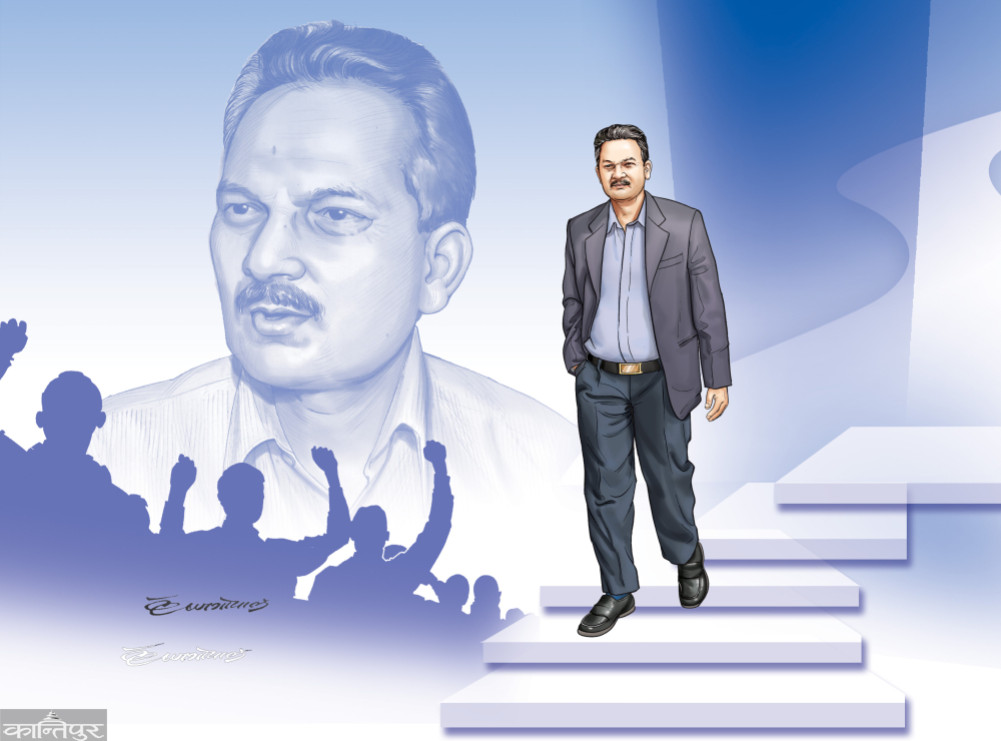
Former Prime Minister Baburam Bhattarai is a leader with deep political understanding. He can destroy politics/society. Political economy can be interpreted in a way that common people can understand. Among the contemporary leaders, even though he can hold a firm grip on political philosophy, the reins of politics are not in his hands.
His politics is getting weaker day by day. Bhattarai, who is struggling for political survival, is probably searching for his relevance at this time. He may assess that Sanjeevani booty in losing credibility and relevance if he gathers new alternative forces and takes its leadership. His views expressed in the program organized on the occasion of the establishment of 'New Power' on May 30th were aimed at that.
After leaving Maoist and forming a new power, Bhattarai, who joined the Janata Samajwadi Party through the Federal Socialist Party, many commented that his political career was over. In this background, Bhattarai, the coordinator of the Congress Ad Hoc Committee of Nepal Samajwadi Party, organized the program with the aim of making his presence felt in the political scene. He has tried to convey three messages through the program.
First, he gave the message that he advocated the necessity and justification of alternative political trend in Nepal. Although now different people or parties are seen as alternative forces and leaders, he tried to take the credit of laying the foundation for it. 11 years ago, he wrote, 'Nepali society has entered a new phase. Now, in order to lead it, the parties should be able to change their organization, leadership, and working style. If that cannot be done, a new power will emerge. (February 25, 2070, Nepal Weekly) Two years after writing the article, he left the Maoist party on October 9, 2072 and announced a party named New Power under his leadership on May 30, 2073.
Second, the Nepal Samajwadi Party tried to convey another message that it leads from an alternative political direction. That was the meaning of advocating alternative politics by organizing a program on the date of the announcement of New Power Party.
Thirdly, Bhattarai believes that the new political mainstream will not be the old parties, but new alternative forces. For that, he proposed that the alternative political forces that have emerged after the last general election, Rashtriya Swatantra Party (RASWPA), Janmaat Party and Civil Liberties Party, etc., can be united or form a front. The essence of this proposal is to gather the parties and leaders that emerged on the basis of frustration and dissatisfaction with the old parties and leaders and give a political/ideological shape to the alternative power.
After Bhattarai, who is on the sidelines of the national political scene, shows his enthusiasm for reawakening new power with these messages, some questions naturally arise. Is it possible that he will become the political guide of alternative forces as he aspires to be? Where did he go when he formed a new power almost eight years ago? Is the alternative political power seen now is the product of the seeds sown by Bhattarai? What are the limits and options of his politics? This analysis is done around these and similar questions related to Bhattarai's political ups and downs.
Political heyday
Bhattarai's "high time" in his four-and-a-half-decade-long political career began after passing the political line of the Democratic Republic at the famous Chunbang meeting of the Maoists. The meeting decided to put an end to the violent rebellion and put the Maoists in favor of the Interim Government, the Round Match Conference, and the Constituent Assembly. After taking the same political path, Maoists became the largest political party in the first Constituent Assembly elections.
In the political scenario of Tintaka, Girija Prasad Koirala, the then president of Nepali Congress, was at the center of discussion and influence for bringing Maoists into the mainstream politics. Pushpa Kamal Dahal (Prachanda), who became a 'myth' from an underground political background, was another attractive character. Bhattarai, who was being accepted by the Nepali society as a popular political leader, was also among those losers. The Maoist leader, who came from a background of violent politics, was highly criticized and hated by one Tapka. However, another section of the society had special affection and expectations for Bhattarai's 'scholar' personality.
When he became the finance minister in the Prachanda-led government in 2065, the society began to expect more from him. During his tenure as Finance Minister, he showed some divisive attitude. After the increase in revenue collection, the announcement of not taking allowances for foreign visits, projects of national pride, etc., his popularity graph went up. After he became the Prime Minister in 2068, the public's expectations for him increased. Some of the works were also criticized as 'stunt and propaganda'. However, he was also praised for his public-oriented work to widen the roads of Kathmandu, starting from riding the locally produced vehicle 'Mustang Max'.
image
The 'downfall' in the popularity of Bhattarai, who played the role of building the constitution through the Constituent Assembly to establish the twelve-point agreement as the basis of the second people's movement, bring down the Maoist rebellion peacefully and build the constitution through the Constituent Assembly, started in the latter days during his prime ministership. When some of his expressions were disputed. Like, in a press conference held in Baluwatar, he commented on the geopolitical complexities and made very controversial statements. He said, "The key to the country is the end, the country can be merged or sub-merged." This statement made the accusation of being a "pro-Indian" leader even louder. To break the story, because of the political deviations and divisions in the Maoists, the criticism towards the leadership of this party was increasing. The credibility of this party, which became the largest party from the first Constituent Assembly, was losing its credibility after the party line started to be crossed in the cases of financial irregularities and corruption. Bhattarai, who was observing all these developments, saw the need for a new political power in this background. The old parliamentary political parties were also criticized. Society had already lost faith in them.
Bhattarai, who came to the conclusion that Maoist politics is also rusty, embarked on a campaign to form a new power. Prachanda's disdain for and limitation to the party's constant second-tier leadership further motivated him to form a new power. Encouraged by the rise of the Aam Aadmi Party in India, he finally abandoned three and a half decades of communist politics and formed a new Shakti Party with great fanfare. Among contemporary leaders, Bhattarai is certainly a leader who is thoughtful and can see beyond the times. However, the people did not accept this move of his, and rejected it. This is where his politics killed him. Both the local and federal elections gave a clear message that the people are not attracted to the new power.
A rapper with no political background, who is known in a limited community, has become a symbol of hope and trust in Nepali politics overnight. The party, which was launched two years ago on the initiative of a journalist who did not have the basic knowledge of journalism, has become the fourth political force in the country. However, why could not the people be confident about the new power of Bhattarai, a lecturer of political philosophy, who has a history of political struggles?
There were some reasons behind this. The first and foremost reason is the commentary made along with the announcement of the New Shakti Party. Bhattarai made a comment that political parties coming from the background of struggle cannot lead to prosperity, for that a new power with new thinking and machinery is needed. However, his talent was born from the Maoist circle and his steps were viewed with suspicion. Bhattarai was also criticized as a pro-Indian leader within the Maoists, and after leaving the party and forming a new power without informing his close colleagues, suspicions about him increased. Because of this suspicion, those who were with him when he was in Maoist politics did not stay. Those who had also left in the middle and started to protect their political future. Prachanda accused Bhattarai of inciting India to form a new power.
If the image of a pro-Indian leader has been imposed on him, even now he has to refute it. He was expressing his anger at the program of June 30, "Indian brokers who think that unequal treaty agreements with India should be reviewed by forming a nationalist and enlightened group who would go to Delhi and be lazy? And this country will improve?' In essence, this is the main reason for Bhattarai's decline in popularity in the Nepalese society, where anti-India psychology is high, and for the new power not to be 'picked up' by him.
Second, Bhattarai's move to form a new power was perceived by the society as a political deviation. Criticism started from Maoist circles, accusing them of deviation. When he said that he was not even an ordinary member of the Communist Party and that he was a non-Marxist, the Mohan Vaidya group must have seen him disturbed, Mani Thapa who was with him also saw the same. The society believed that and did not accept the new power. The election results of 2074 are proof of this.
Thirdly, while setting the political base, he could not expand organizationally according to the pompous 'branding' of the new power. He was a leader of a weak group, especially within the Maoists. Leaders who are close to him say that he is self-centered and tries to impose his ideas, so he cannot be cooperated for long. Therefore, most of those who are said to be close to him did not come to the new power. Even those who came returned, became inactive. He tried to connect professional people connected with different professions but he also did not find the collaboration with him easy and left. To some extent, even those who earn their livelihood by managing his politics have left and are leaving in search of opportunities. Now his organizational politics has been limited to a few leaders and family circles.
As Bhattarai's politics weakens, another question also arises, how much of his decision to form a new power was due to his personal ego and prestige battle with Prachanda and how much was 'conviction'? Why this question arises, despite claiming to be an alternative force, he tried to harmonize and unite with the old. Sometimes he was ready to join the electoral front of the Left Alliance and sometimes with the Madhesi party.
Lately, he tried to form a Samajwadi Front together with the Maoists or to reunify the party itself. Prachanda was given the constituency of Gorkha where he was fighting. How do these practices and efforts promote new alternative politics? These efforts were more driven by power and opportunistic character. Becoming a political and theoretical commentator is one thing and being able to take leadership by implementing it is another. Leadership skills are hidden in strategy and managerial ability. Bhattarai lacks this qualification. Therefore, many people suggest him to teach politics in the latter part of the political life, as Ravi Lamichhane, President of RSVP and Minister of Home Affairs, indicated that he would not cooperate.
The top level of Nepali politics is in the midst of controversy and questions. Bhattarai is not immune to it. However, he is comparatively the character expected and expected by the society. Bhattarai, once a commentator on Maoist politics, is now trying to position himself as a pioneer of alternative political power. Now let's see, will the emerging power accept his claim that he is qualified for alternative politics as a 'new soul in an old body'? Or, like in the past, will they use 'old wine as new wine'?